

Government Guidelines
Government Guidelines
Government Guidelines on the Use of GFRP
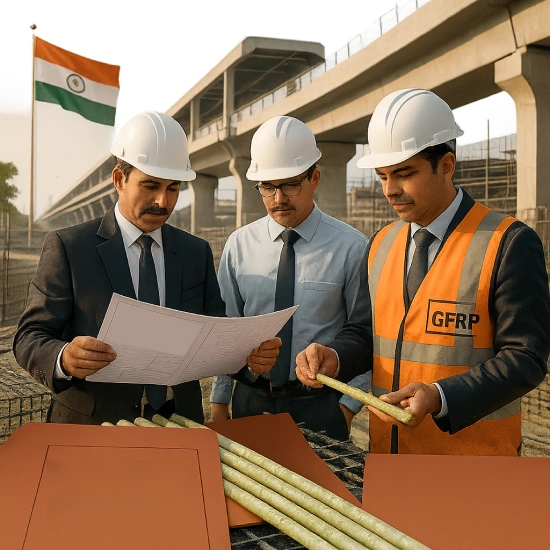
Government bodies and industry experts in India have started recognizing the importance of Glass Fiber Reinforced Polymer (GFRP) reinforcement as a durable and sustainable alternative to steel.
FRP bars are now being encouraged and standardized for use in key national infrastructure projects.
National Guidelines and Endorsements
Ministry of Road Transport and Highways (MoRTH)
The Ministry has officially promoted the use of composite rebars for national highways and bridge construction.
- Hon. Shri Nitin Gadkari, Cabinet Minister (MoRTH), emphasized the use of FRP bars in new road and building projects, describing them as an innovative and long-lasting technology.
- Ref: “India Will Get Innovative ‘Glass Fiber Steel’ Technology” Watch on YouTube
IRC:137-2022
The Indian Roads Congress (IRC) issued guidelines for the use of Fiber Reinforced Polymer Bars in Road Projects:
IRC:137-2022 – Part 1: Glass Fiber Reinforced Polymer (GFRP) Bars
These guidelines outline design principles, applications, and durability parameters for FRP reinforcement in road and bridge projects.
BIS – IS 18256:2023
India has officially standardized the use of GFRP bars through the Bureau of Indian Standards (BIS):
IS 18256:2023 – Solid Round Glass Fibre Reinforced Polymer (GFRP) Bars for Concrete Reinforcement
This standard specifies material properties, testing methods, and quality parameters to ensure consistent performance in concrete structures.
International Standards Reference
India's adoption of FRP aligns with leading global standards such as:
- ACI 440.1R-15 - U.S. Guide for Structural Concrete Reinforced with FRP Bars
- CSA-S6-14 (Section 16) - Canadian Highway Bridge Design Code
- FIB Bulletin 40 - FRP Reinforcement in RC Structures (Europe)
- AASHTO LFRD-01 - Bridge Design Guide for GFRP Reinforced Decks
- CNR-DT 203/2007 - Italy's FRP Design Guidelines
What This Means for India
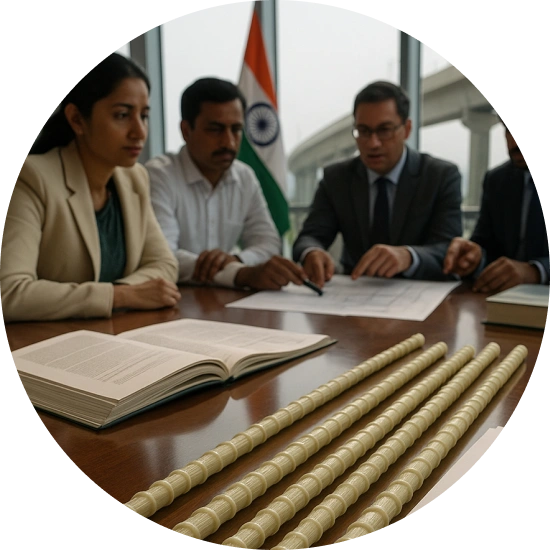
With formal recognition by MoRTH, IRC, and BIS, the use of GFRP reinforcement in India is now backed by policy, research, and proven field applications.
These guidelines pave the way for more durable, maintenance-free, and corrosion-resistant infrastructure.