
No. FRP has different mechanical behavior and must be designed using FRP-specific codes and serviceability criteria.

Resources
3
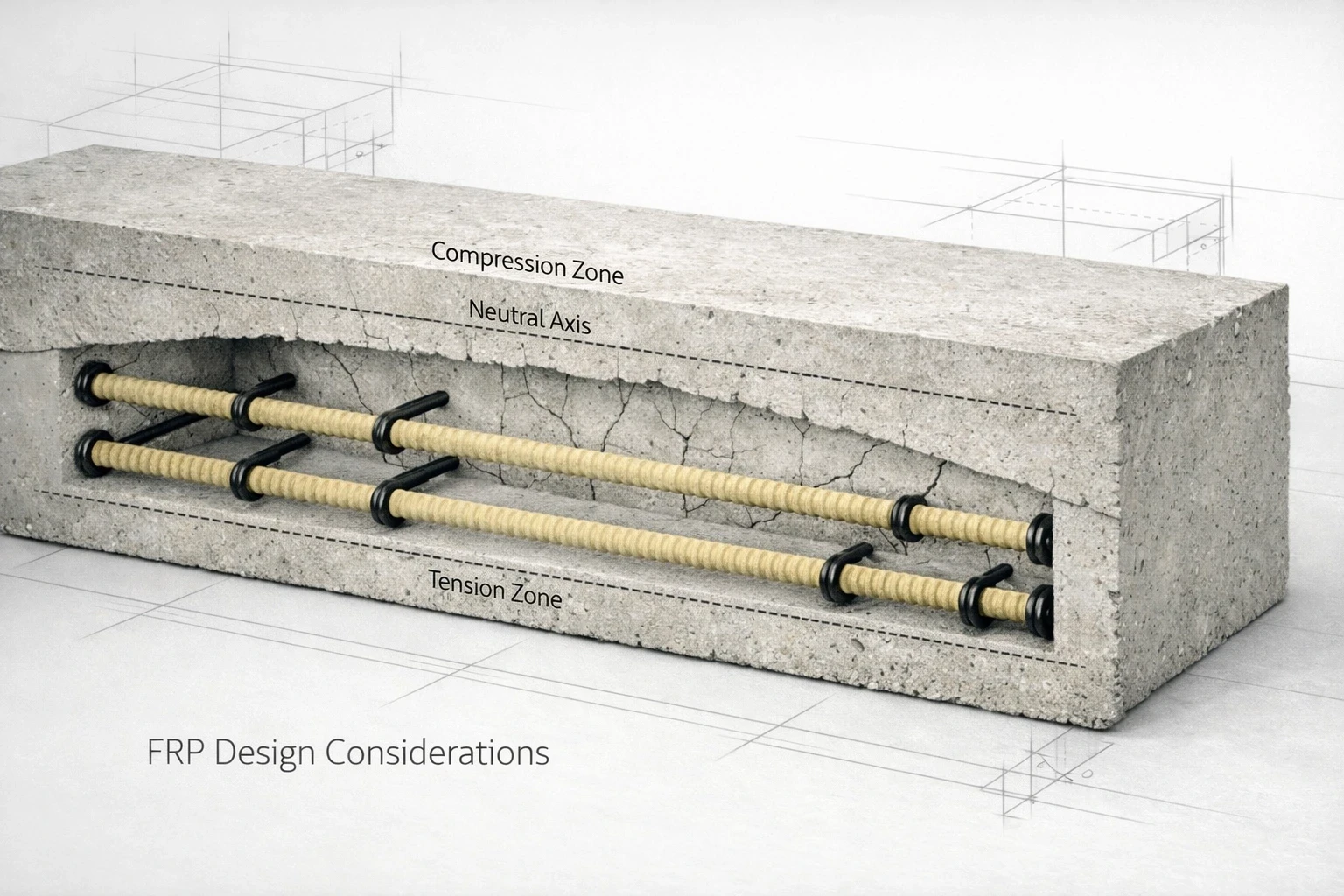
Feb'26Design Considerations for Reinforced Concrete Structures Using FRP
The selection of reinforcement material plays a critical role in the performance and service life of reinforced concrete structures. While steel reinforcement has been used for decades, its vulnerability to corrosion has led engineers to consider alternatives for aggressive and demanding environments.
FRP reinforcement (Fiber Reinforced Polymer) offers corrosion resistance and long-term durability, but it behaves differently from steel. As a result, it requires a distinct design approach. This article outlines the key design considerations when using FRP systems and highlights the factors engineers must evaluate to ensure safe and effective structural performance.
Key Structural Design Differences Between FRP and Steel Reinforcement
FRP differs from steel in both mechanical behavior and material characteristics. Understanding these differences is essential before incorporating FRP into structural design.
Key differences include:
- FRP exhibits linear elastic behavior until failure and does not yield like steel.
- FRP generally has higher tensile strength but lower modulus of elasticity.
- FRP does not corrode, while steel is susceptible to rust in aggressive environments.
Because FRP does not yield, structures reinforced with FRP must be designed to control serviceability and ensure predictable failure modes.
The following table summarizes the key design-related differences between steel and FRP reinforcement
Parameter |
Steel Reinforcement |
FRP Reinforcement |
| Stress–Strain Behavior |
Ductile; yields before failure |
Linear elastic until sudden rupture |
| Failure Mode |
Gradual, with warning due to yielding |
Brittle; no yielding prior to failure |
| Tensile Strength |
Moderate to high |
High (often higher than steel) |
| Modulus of Elasticity |
High (~200 GPa) |
Lower than steel (varies by FRP type) |
| Serviceability Control |
Usually strength-governed |
Often serviceability-governed (deflection, cracking) |
| Corrosion Resistance |
Susceptible to corrosion |
Non-corrosive |
| Creep / Sustained Load Sensitivity |
Low | High; sustained stress limits required |
| Fire & Temperature Performance |
Good performance at elevated temperatures |
Strength degrades at high temperatures |
| Constructability |
Can be bent on-site |
Cannot be bent; prefabrication required |
| Design Approach |
Yield-based design assumptions |
Strain- and serviceability-based design |
| Typical Applications |
General-purpose structures |
Corrosive, marine, industrial, or durability-critical structures |
Material Properties Influencing FRP Reinforcement Design
1. Tensile Strength and Modulus of Elasticity
FRP reinforcement has high tensile strength, but its modulus of elasticity is typically lower than that of steel. This affects:
- Deflection behavior
- Crack width control
- Overall stiffness of reinforced concrete members
Designs using FRP reinforcement must carefully address serviceability limits to maintain acceptable structural performance.
2. Bond Behavior with Concrete
Bond between FRP reinforcement and concrete depends on surface treatments such as sand coating or surface deformation. Proper bond performance is essential for load transfer.
Design considerations include:
- Development length requirements
- Anchorage and lap splice detailing
- Surface condition of FRP reinforcement
Bond behavior must be evaluated according to applicable design guidelines rather than steel-based assumptions.
3. Sustained Loads and Creep Rupture
FRP materials are sensitive to sustained tensile stresses over long periods. Prolonged loading can lead to creep rupture if stress limits are exceeded.
Key considerations:
- Limit sustained stress levels as prescribed in design codes
- Consider long-term loading conditions in structural analysis
Ignoring sustained load limits can compromise long-term structural safety.
Structural Design Behavior of FRP-Reinforced Concrete Members
1. Flexural Design Behavior
FRP-reinforced concrete members behave differently in flexure compared to steel-reinforced members.
Important aspects include:
- FRP-reinforced sections are typically designed to be over-reinforced
- Failure is governed by concrete crushing rather than reinforcement yielding
- Adequate safety factors must be applied to ensure controlled behavior
Design must ensure that failure modes are predictable and safe.
2. Serviceability Requirements
Serviceability often governs the design of FRP-reinforced members.
Design checks should include:
- Deflection limits under service loads
- Crack width control to maintain durability and aesthetics
Because FRP does not yield, serviceability checks are often more critical than strength checks.
3. Shear and Compression Zones
FRP reinforcement can be used in shear reinforcement, but its behavior differs from steel stirrups.
Design considerations:
- Lower modulus affects shear crack control
- Hybrid reinforcement (steel and FRP) may be considered in some cases
- Compression zones are typically reinforced with conventional concrete behavior assumptions
Engineering judgment is essential when detailing shear reinforcement with FRP.
Durability and Environmental Performance of FRP
One of the primary reasons for using FRP reinforcement is its durability in aggressive environments.
FRP performs well in:
- Marine and coastal environments
- Water and wastewater structures
- Industrial and chemical exposure zones
However, environmental exposure conditions should still be evaluated during design to ensure long-term performance.
Fire Resistance and Temperature Effects on FRP Reinforcement
FRP reinforcement is sensitive to elevated temperatures and fire exposure.
Design considerations include:
- Reduction in strength at high temperatures
- Need for adequate concrete cover
- Additional fire protection measures in fire-critical structures
FRP reinforcement should be used cautiously in structures with stringent fire-resistance requirements unless appropriate protection is provided.
Installation, Detailing, and Constructability Considerations for FRP
Design decisions directly affect on-site execution.
Important points include:
- FRP reinforcement cannot be bent like steel and must be prefabricated
- Cutting and placement should follow manufacturer guidelines
- Lightweight nature reduces handling effort but requires proper support during placement
Design detailing should account for these constructability constraints.
Applicable Design Codes and Standards for FRP Reinforcement
FRP reinforcement design must follow recognized standards and guidelines.
Commonly referenced documents include:
- ACI 440 (Guide for the Design and Construction of Structural Concrete Reinforced with FRP Bars)
- CSA S806
- Relevant ISO and international standards
Using approved standards ensures safety, consistency, and regulatory acceptance.
Applications Where FRP Offers the Greatest Advantage
FRP reinforcement is particularly suitable for:
- Structures exposed to corrosion and moisture
- Infrastructure requiring long service life with minimal maintenance
- Projects requiring non-conductive or non-magnetic reinforcement
In such cases, FRP reinforcement can provide significant long-term benefits.
Applications Requiring Special Design Caution
When Using FRP FRP reinforcement may require additional evaluation in:
- Fire-critical structures
- Applications requiring high ductility
- Structures subjected to high sustained loads or temperatures
In these situations, careful design review and engineering judgment are essential.
Common Design Mistakes in FRP-Reinforced Concrete Structures
Avoiding these mistakes is key to achieving reliable performance.
1. Treating FRP as a Direct Replacement for Steel
- FRP and steel have fundamentally different mechanical behavior. Applying steel-based assumptions to FRP design can result in unsafe or overly flexible structures.
- Consequence: Excessive deflection, wide cracking, and non-conservative design outcomes.
2. Neglecting Serviceability Limit States
- Due to its lower modulus of elasticity and lack of yielding, FRP-reinforced members are often governed by deflection and crack width rather than strength.
- Consequence: Serviceability failures such as unacceptable sagging, cracking, and reduced user comfort even when strength requirements are met.
3. Exceeding Sustained Stress Limits
- FRP materials are susceptible to creep rupture under long-term tensile loading. Ignoring sustained load limits prescribed in design codes can severely compromise durability.
- Consequence: Gradual loss of capacity and potential long-term failure under sustained service loads.
4. Applying Steel-Based Detailing Rules
- Development length, lap splices, anchorage, and bend detailing for FRP differ significantly from steel and must follow FRP-specific guidelines.
- Consequence: Inadequate load transfer, bond failure, and premature cracking.
5. Underestimating Fire and Temperature Effects
- FRP reinforcement loses strength rapidly at elevated temperatures, unlike steel. Failing to account for fire exposure can lead to unsafe designs.
- Consequence: Reduced load-carrying capacity during fire events and non-compliance with fire-resistance requirements.
6. Ignoring Constructability Constraints
- FRP reinforcement cannot be bent on-site and requires precise prefabrication and handling. Designs that overlook this can be difficult to execute correctly.
- Consequence: Site modifications, installation errors, delays, or compromised reinforcement placement.
Conclusion: Applying FRP Reinforcement Safely and Effectively
The use of FRP reinforcement in reinforced concrete design offers clear advantages in durability and corrosion resistance. However, its successful application depends on understanding its material behavior and applying appropriate design principles.
When designed according to recognized standards and used in suitable environments, FRP reinforcement can significantly improve structural service life and reduce long-term maintenance requirements.
FRP reinforcement is not a universal replacement for steel, but when durability governs design, it offers a fundamentally different and often superior engineering solution.
Frequently Asked Questions (FAQs)
Find clear answers to the most common queries.
-
Can FRP reinforcement directly replace steel reinforcement in concrete?
-
Why do serviceability checks govern FRP-reinforced concrete design?
Because FRP does not yield and has a lower modulus of elasticity, deflection and crack width often control design.
-
Is FRP reinforcement suitable for fire-exposed structures?
FRP is sensitive to high temperatures and requires adequate cover or additional fire protection in fire-critical applications.
-
How does sustained loading affect FRP reinforcement?
Long-term tensile stresses can lead to creep rupture, so sustained stress limits defined in design codes must be respected.
-
Which standards should be followed for FRP reinforcement design?
Commonly used standards include ACI 440, CSA S806, and relevant ISO or international guidelines.
Subscribe to Our Newsletter
Get updates on products, research collaborations, and new developments in FRP technology.

Subscribe to Our Newsletter
Subscribe our newsletter and get notifications to stay update