
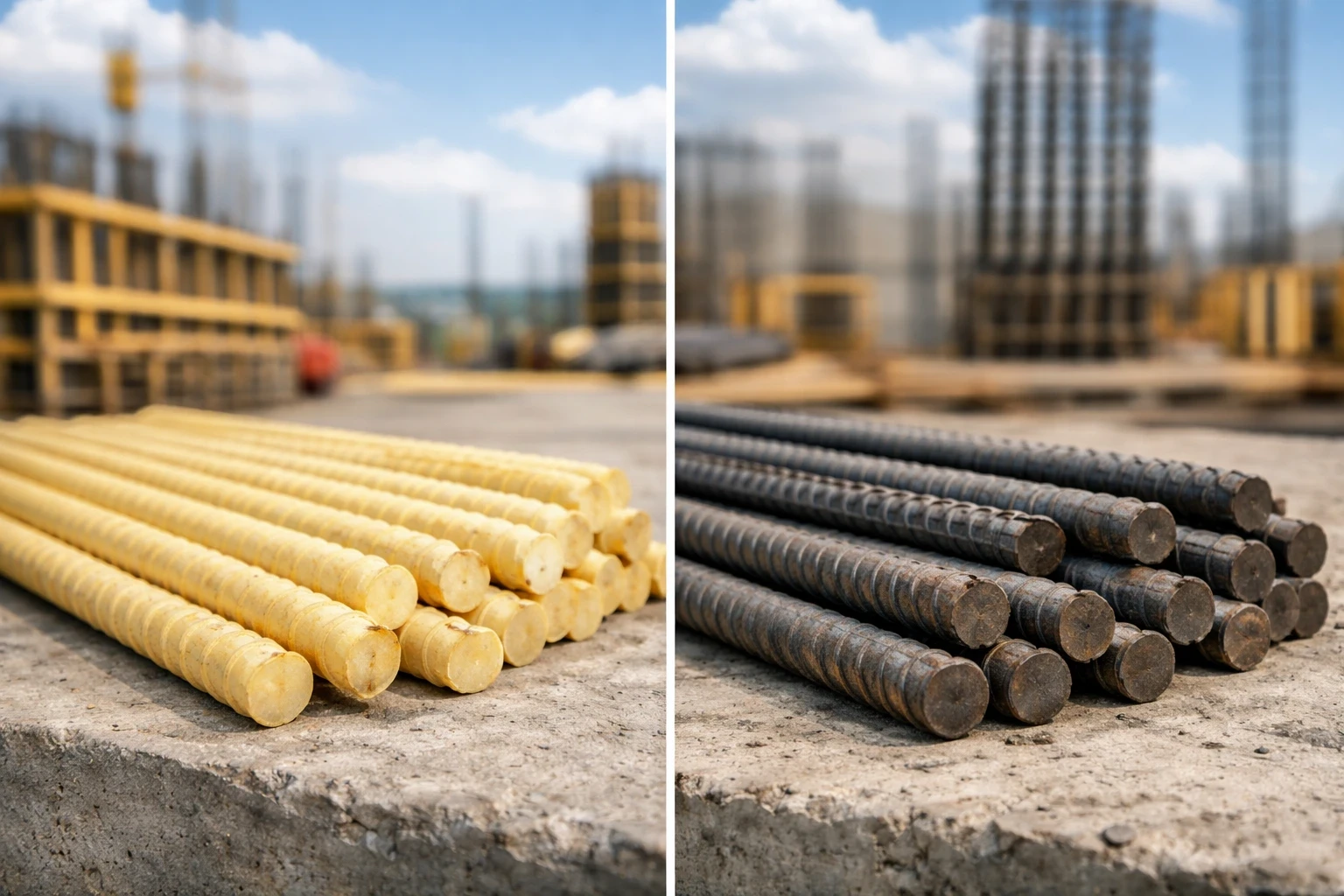
FRP reinforcement has high tensile strength, comparable to steel, but it behaves differently under load. The choice depends on design requirements and application conditions.

Resources
9
Jan'26FRP vs Steel Reinforcement: Which One is Right for Your Project?
Steel reinforcement has been the backbone of concrete construction for decades. From residential buildings to highways and bridges, it has been the default choice for strength and reliability. However, changing project requirements, aggressive environments, and long-term durability concerns have led engineers to consider alternatives.
One such alternative is FRP (Fiber Reinforced Polymer) reinforcement. While FRP is not new, its use in infrastructure and industrial construction has increased significantly in recent years. This blog explains the practical differences between FRP and steel reinforcement, where each material performs well, and how to decide which reinforcement solution suits your project.
Understanding Steel Reinforcement
Steel reinforcement bars are widely used because they are:
- Strong in tension
- Easily available
- Familiar to engineers and contractors
- Supported by long-established design practices
Steel works well in many standard construction environments. However, its biggest limitation is corrosion. When exposed to moisture, chlorides, or chemicals, steel begins to rust. Over time, this corrosion leads to:
- Expansion inside concrete
- Cracking and spalling
- Reduced structural life
- Increased maintenance costs
To manage this, protective coatings, higher concrete cover, or regular repairs are often required.
Understanding FRP Reinforcement
FRP reinforcement is made from fibers (such as glass or basalt) combined with a polymer resin. Unlike steel, FRP does not corrode, even in aggressive environments.
If you’d like a deeper explanation of the material itself, you can refer to our earlier blog on what FRP material is and how it works.
FRP reinforcement is increasingly used in:
- Coastal and marine structures
- Chemical and industrial facilities
- Water treatment plants
- Pavements and precast elements
Key Differences Between FRP and Steel Reinforcement
While both materials are used to strengthen concrete, their performance differs significantly when it comes to durability, handling, and long-term behavior. The comparison below highlights these differences from a practical project perspective.
1. Strength and Weight
- Steel is heavy and strong, with well-known mechanical properties.
- FRP reinforcement offers high tensile strength while being significantly lighter than steel, which makes transportation and handling easier on site.
2. Corrosion Resistance
This is the most critical difference.
- Steel corrodes when exposed to moisture, salts, or chemicals.
- FRP is naturally resistant to corrosion and does not rust.
For structures exposed to harsh environments, this single factor can greatly affect service life.
3. Durability and Service Life
- Steel-reinforced structures often require maintenance over time to address corrosion-related damage.
- FRP reinforcement maintains its performance without rust-related degradation, making it suitable for projects designed for long-term durability.
4. Installation and Handling
Steel bars are heavy and require more effort to transport and place.
FRP reinforcement is lightweight, which:
- Reduces manual handling effort
- Speeds up installation
- Improves site safety
No special equipment is usually required to cut or place FRP bars.
5. Maintenance Requirements
Steel structures in aggressive environments often need:
- Protective coatings
- Periodic inspection
- Repair work over their lifespan
FRP-reinforced structures typically require minimal maintenance, especially where corrosion is the primary concern.
Parameter |
FRP Reinforcement |
Steel Reinforcement |
| Material Type |
Fiber Reinforced Polymer composite |
Carbon steel |
| Weight |
✓ Very lightweight, easy to transport and handle |
✕ Heavy, requires more effort on site |
| Tensile Strength |
✓ High tensile strength |
✓ High tensile strength |
| Corrosion Resistance |
✓ Does not corrode |
✕ Prone to rust in aggressive environments |
| Performance in Moisture & Saline Conditions |
✓ Excellent, no protection required |
✕ Requires coatings or increased concrete cover |
| Chemical Resistance |
✓ Resistant to many chemicals |
✕ Can degrade in chemical exposure |
| Durability |
✓ Long service life |
✕ Service life affected by corrosion |
| Maintenance Requirement |
✓ Minimal maintenance |
✕ Periodic inspection and repair required |
| Installation Effort |
✓ Faster due to low weight |
✕ Slower due to handling weight |
| Electrical Conductivity |
✓ Non-conductive |
✕ Conductive |
| Magnetic Properties |
✓ Non-magnetic |
✕ Magnetic |
| Initial Material Cost |
✕ Higher than steel |
✓ Lower upfront cost |
| Lifecycle Cost |
✓ Lower in corrosive environments |
✕ Higher due to repairs and maintenance |
| Typical Applications |
Marine structures, pavements, industrial facilities, water projects |
Residential, commercial, general construction |
Steel vs FRP: Performance in Real-World Conditions
Beyond laboratory tests, factors like moisture, salts, chemicals, and traffic loads determine the actual performance of reinforcement. Here’s how FRP and steel compare in such real-world scenarios.
1. Coastal and Marine Structures
Salt exposure accelerates steel corrosion. FRP reinforcement performs well in such conditions without additional protective measures.
2. Industrial and Chemical Facilities
Chemical exposure can reduce the life of steel-reinforced concrete. FRP remains stable in many chemical environments.
3. Pavements and Infrastructure
FRP dowels and bars are commonly used in pavements to avoid joint corrosion and reduce long-term maintenance.
When Steel Reinforcement Makes Sense for Modern Construction
Steel is still a practical choice when:
- The environment is non-corrosive
- The project has a shorter design life
- Budget constraints are a priority
- Traditional design methods are preferred
In such cases, steel continues to be a reliable and cost-effective solution.
When FRP Reinforcement is a Better Fit
FRP reinforcement is often preferred when:
- The structure is exposed to moisture, salts, or chemicals
- Long service life is a key requirement
- Maintenance access will be limited
Lifecycle cost matters more than initial material costIn these situations, FRP can help reduce repair and replacement expenses over time.
Steel vs FRP Cost Comparison
Material cost is often the first point of comparison when selecting reinforcement. On a per-kilogram basis, steel reinforcement appears less expensive than FRP. However, upfront price alone does not reflect the true cost of reinforcement over a structure’s lifespan.
Initial Material Cost (Indicative)
Material |
Typical Product Type | Approximate Cost (INR per kg) |
| Steel Rebar |
Fe500 / Fe500D (TMT bars) |
₹50 – ₹90 |
| FRP Rebar | GFRP / BFRP (standard construction grades) |
₹180 – ₹280 |
Note: Prices vary based on bar diameter, resin system, fiber type, order volume, region, and supplier. Steel prices are also subject to frequent market fluctuations.
Why Initial Cost Does Not Tell the Full Story
While FRP reinforcement may cost 2-3 times more upfront, reinforcement selection should consider lifecycle cost, especially for structures exposed to corrosion.
1. Corrosion-Related Repairs
Steel reinforcement in coastal, marine, industrial, or water-retaining structures is vulnerable to corrosion. Over time, this can lead to:
- Concrete cracking and spalling
- Structural repairs
- Reduced service life
FRP reinforcement does not corrode, eliminating corrosion-related repair costs.
2. Maintenance and Downtime
Steel-reinforced structures often require:
- Protective coatings
- Periodic inspections
- Repair work that may disrupt operations or traffic
FRP-reinforced structures generally require minimal maintenance, reducing both direct repair expenses and indirect downtime costs.
3. Lifecycle Cost Comparison
When accounting for:
- Initial material cost
- Corrosion prevention measures
- Repairs and maintenance
- Extended service life
FRP reinforcement often provides better value over the structure’s lifespan, particularly in demanding or corrosive environments.
Practical Example of Steel vs FRP Costs
For a coastal infrastructure project with a 25-30 year design life:
Steel reinforcement
- Initial cost: ~₹75–₹85 per kg
- Maintenance and repair costs over time may double or triple the initial reinforcement cost.
FRP reinforcement
- Initial cost: ~₹220–₹260 per kg
- Maintenance savings can reduce total reinforcement-related expenses by 30–50% over the structure’s lifespan.
Choosing reinforcement should not be based on upfront price alone. For projects exposed to moisture, salts, or chemicals where corrosion control drives long-term costs, FRP reinforcement often delivers a lower total cost of ownership, despite its higher initial material cost.
FRP vs Steel: Which Reinforcement Solution is the Best?
There is no universal answer to the question of FRP vs steel reinforcement. The right choice depends on:
- Environmental exposure
- Expected lifespan
- Maintenance strategy
- Project priorities
Steel remains a proven material for many applications. FRP reinforcement provides a strong alternative where corrosion resistance and durability are critical. Understanding these differences allows engineers and project planners to select reinforcement that aligns with both technical requirements and long-term performance goals. For projects exposed to corrosive environments, FRP offers long-term savings and durability, while steel remains a reliable choice in standard conditions
Frequently Asked Questions (FAQs)
Find clear answers to the most common queries.
-
Is FRP reinforcement stronger than steel?
-
Why does FRP reinforcement cost more than steel?
FRP has a higher upfront cost due to composite materials, but it can reduce maintenance and repair expenses over the structure’s lifespan.
-
Can FRP replace steel in all construction projects?
No. FRP is best for corrosive environments, while steel remains suitable for standard, non-corrosive conditions.
-
Where is FRP reinforcement commonly used?
FRP is commonly used in marine, coastal, industrial, pavement, and water-related structures.
-
How do engineers choose between FRP and steel reinforcement?
Engineers consider environment, design life, maintenance needs, and lifecycle cost before selecting reinforcement.
Subscribe to Our Newsletter
Get updates on products, research collaborations, and new developments in FRP technology.

Subscribe to Our Newsletter
Subscribe our newsletter and get notifications to stay update