
FRP (Fiber Reinforced Polymer) is a composite material made of reinforcing fibers embedded in a polymer resin, offering high strength, corrosion resistance, and low weight.

Resources
23
Dec'25What is FRP Material? Components & Construction Uses
If you work in construction, water treatment, or chemical processing, you’ve likely encountered persistent challenges. Corrosion eating away at metal structures. Constant maintenance and repainting of steel. The heavy weight of traditional materials can make installation difficult and expensive.
For decades, the search for a material that could withstand these harsh conditions while being practical to use has been ongoing. The solution that has steadily transformed these industries is FRP.
At Tapashri Engineering, we work with FRP, specifically GFRP, every day. This guide is written for engineers, contractors, and project managers evaluating materials for long-term performance. We’ll explain what FRP is, why it works, and where it makes the most sense to use.
What Does FRP Stand For?
FRP stands for Fiber Reinforced Polymer. Sometimes you might hear it called Fiber Reinforced Plastic. Both terms refer to the same type of material.
Why FRP is Classified as a Composite Material
FRP is a composite material, meaning it’s created by combining two distinct components to get the best properties of each.
- Fibers: Carry the load, providing strength and stiffness.
- Polymer Resin: Binds the fibers together, gives the product its shape, and protects them from the environment.
When these two components work together, the result is a material that is strong, durable, and much lighter than traditional construction materials like steel.
While FRP is the general category, our focus at Tapashri is on one of the most common and versatile types: Glass Fiber Reinforced Polymer (GFRP).
What is FRP Material Made Of?
FRP material is a composite, meaning it is not a single substance but a combination designed to perform better together than it would alone. To understand FRP, it helps to look at its two main parts:
1. Fibers (The Reinforcement Component)
These are the load-bearing component. The most common types are:
- Glass fibers: Used in GFRP for a balance of strength and cost.
- Carbon or Aramid fibers: Used for specialized, high-performance applications.
These fibers carry the load and provide tensile strength.
2. Polymer Matrix (The Resin System)
This is the liquid resin that hardens into a solid plastic around the fibers. Common types include:
- Polyester
- Vinyl ester
- Epoxy
The resin holds the fibers in place, transfers stress between them, and protects them from moisture and chemicals. The choice \ depends on the required resistance to chemicals, heat, or impact.
How is FRP Material Made?
Sheets or loose fibers are saturated with liquid resin. This combination is then shaped and hardened or cured using methods like pultrusion (for long, consistent profiles), hand lay-up, or molding. This process allows for significant design flexibility.
Key FRP Material Properties
FRP is chosen because it offers a distinct set of advantages over metals, wood, or concrete:
- Strength with Light Weight: FRP products are often as strong as steel in specific applications but weigh about a quarter as much, simplifying transport and installation.
- Corrosion & Chemical Resistance: This is frequently the primary reason for choosing FRP. It does not rust or rot, making it ideal for wet, salty, or chemically aggressive environments, common in factories, coastal areas, and water treatment plants.
- Low Maintenance: Because it doesn’t corrode, it requires no protective painting or coatings. Routine cleaning is often sufficient for decades of service.
- Non-Conductive & Non-Magnetic: FRP is an electrical insulator. This makes it a safe choice for platforms, ladders, and cable trays near electrical components.
- Design Flexibility: It can be molded into complex shapes, integrated colors, and varying thicknesses during the manufacturing process to meet exact project specifications.
What is FRP in Construction Industry Used For
FRP is a practical choice for upgrading traditional methods and solving specific durability problems. It is often selected not just as an alternative, but as a strategic improvement.
Common Applications Include:
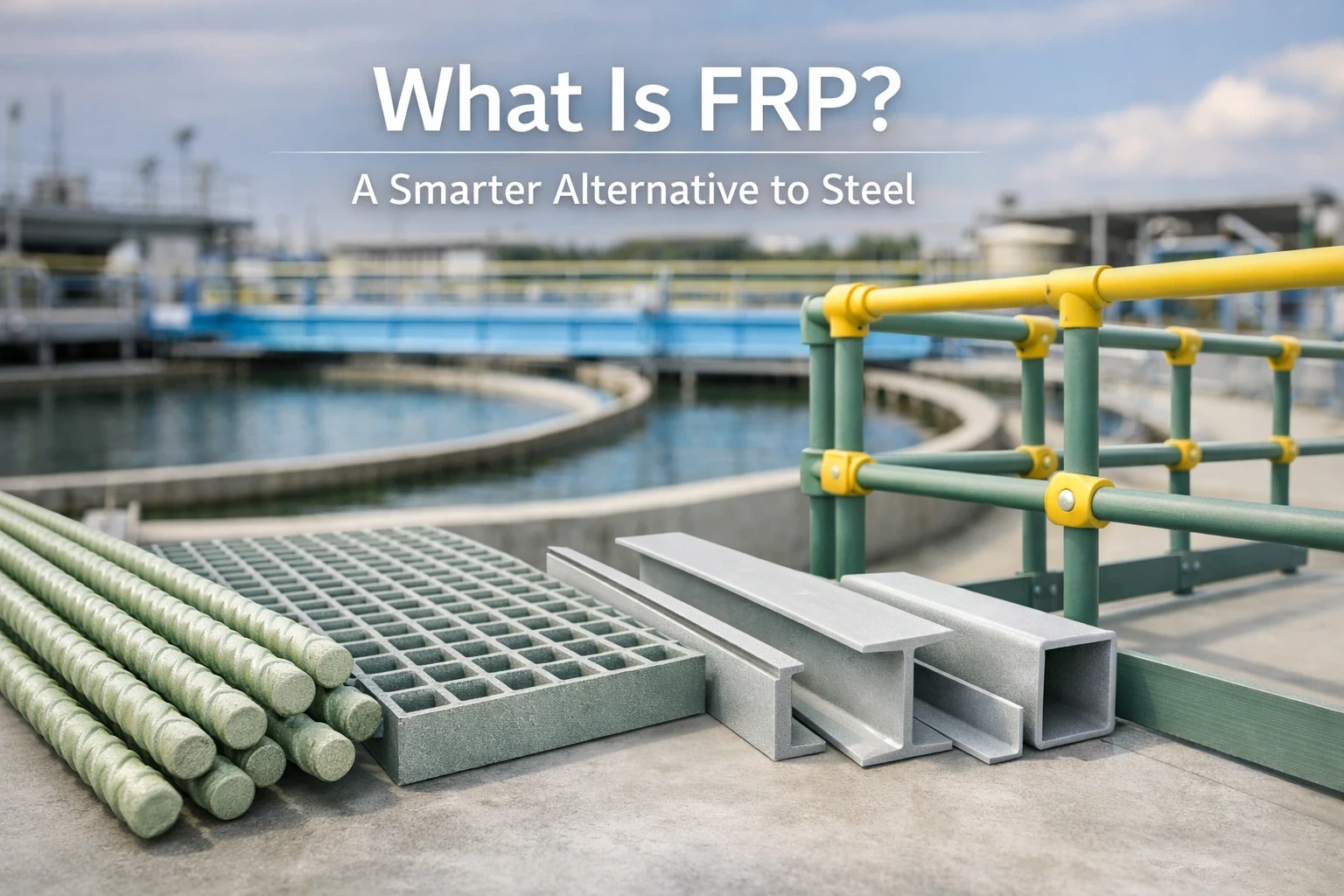
- Reinforcing Bars (Rebar): GFRP rebar is used in concrete exposed to de-icing salts or seawater (bridge decks, parking garages) where steel rebar would rust and crack the concrete.
- Walking Surfaces: FRP grating and floor panels provide a strong, slip-resistant surface in industrial plants and water treatment facilities that won’t corrode from spills or moisture.
- Structural Shapes: Beams, channels, and angles are used to build supports, shelters, and platforms where long service life with minimal upkeep is critical.
- Equipment and Components: This includes ladders, handrail systems, cable trays, and covers for trenches or pits, leveraging FRP's strength, durability, and light weight.
Benefits of FRP for Your Construction Project
- Long-Term Durability: Structures last longer because the material itself does not degrade from environmental exposure.
- Reduced Lifetime Cost: While the initial cost may be higher, savings from eliminated maintenance and replacement make it cost-effective over a project's full lifespan.
- Easier Installation: Lightweight components allow for faster installation with smaller crews and equipment.
- Inherent Safety: Its non-conductive nature and availability with fire-retardant resins add built-in safety layers to a design.
For these reasons, FRP is often selected for projects where durability is more important than short-term material cost.
Why FRP is Chosen Over Steel in Corrosive Environments
Steel’s major limitation is corrosion. When it rusts, it expands and cracks the concrete around it, compromising the structure. FRP directly addresses this issue.
Consideration | Steel |
FRP |
| Corrosion Resistance |
Prone to rust, requires coatings |
Inherently resistant, even in harsh environments |
| Weight | Heavy, requiring more support and labor |
Lightweight (≈1/4 the weight of steel) |
| Long-Term Maintenance |
Requires ongoing painting and repair |
Very low; primarily cleaning |
| Electrical Conductivity |
Conductive, a safety hazard in some settings |
Non-conductive and non-magnetic |
FRP is selected for projects where long-term durability and lower lifetime cost outweigh the initial material price.
Understand the FRP vs Steel difference in depth.
What is GFRP and Why is It the Most Practical FRP Type?
When we talk about FRP in construction and industrial settings, the type that delivers the best balance of performance and cost is Glass Fiber Reinforced Polymer (GFRP).
While carbon or aramid fibers are for specialized, high-performance niches, GFRP is the versatile workhorse, providing the strength, corrosion resistance, and durability needed for most real-world applications.
How Tapashri Engineering Delivers Reliable GFRP Solutions
We focus on GFRP to provide practical solutions. Our role is to translate these material advantages into reliable products that perform as specified on your site. We understand that choosing a new material is about solving a problem. That’s why our approach goes beyond supplying standard products.
- Problem-Solving from the Start: We collaborate from the design phase, whether you need a custom bracket, a specific resin formulation, or guidance on the right profile for your load requirements.
- Manufacturing for Reliability: Our controlled processes ensure every beam, panel, or piece of rebar delivers consistent strength and durability.
- Focus on Long-Term Performance: We provide components for the lifespan of your structure, which guides our material selection and quality assurance.
Building Long-Lasting Structures with FRP Material
FRP, particularly GFRP, is a material chosen for modern engineering challenges where long-term durability, safety, and total cost of ownership are paramount. It is a direct answer to the limitations of traditional materials in corrosive and demanding environments.
Understanding where FRP fits is the first step toward designing longer-lasting structures. The next step is choosing a partner who understands both the material science and the practical demands of your project.
Want to explore if GFRP is the right solution for your current or upcoming project?
Contact Tapashri Engineering today to discuss your specific requirements.
Frequently Asked Questions (FAQs)
Find clear answers to the most common queries.
-
What is FRP material?
-
What is the difference between FRP and GFRP?
FRP is the general category, while GFRP (Glass Fiber Reinforced Polymer) uses glass fibers and is the most commonly used type due to its balance of performance and cost.
-
Does FRP material corrode or rust?
No. FRP does not rust or corrode, even in wet, saline, or chemically aggressive environments.
-
Is FRP stronger than steel?
FRP can match or exceed steel in tensile strength, but it has a lower stiffness (modulus), which is considered during structural design.
-
Where is FRP commonly used in construction?
FRP is widely used for GFRP rebar, gratings, walkways, structural profiles, ladders, and handrail systems in corrosive environments.
Subscribe to Our Newsletter
Get updates on products, research collaborations, and new developments in FRP technology.

Subscribe to Our Newsletter
Subscribe our newsletter and get notifications to stay update