
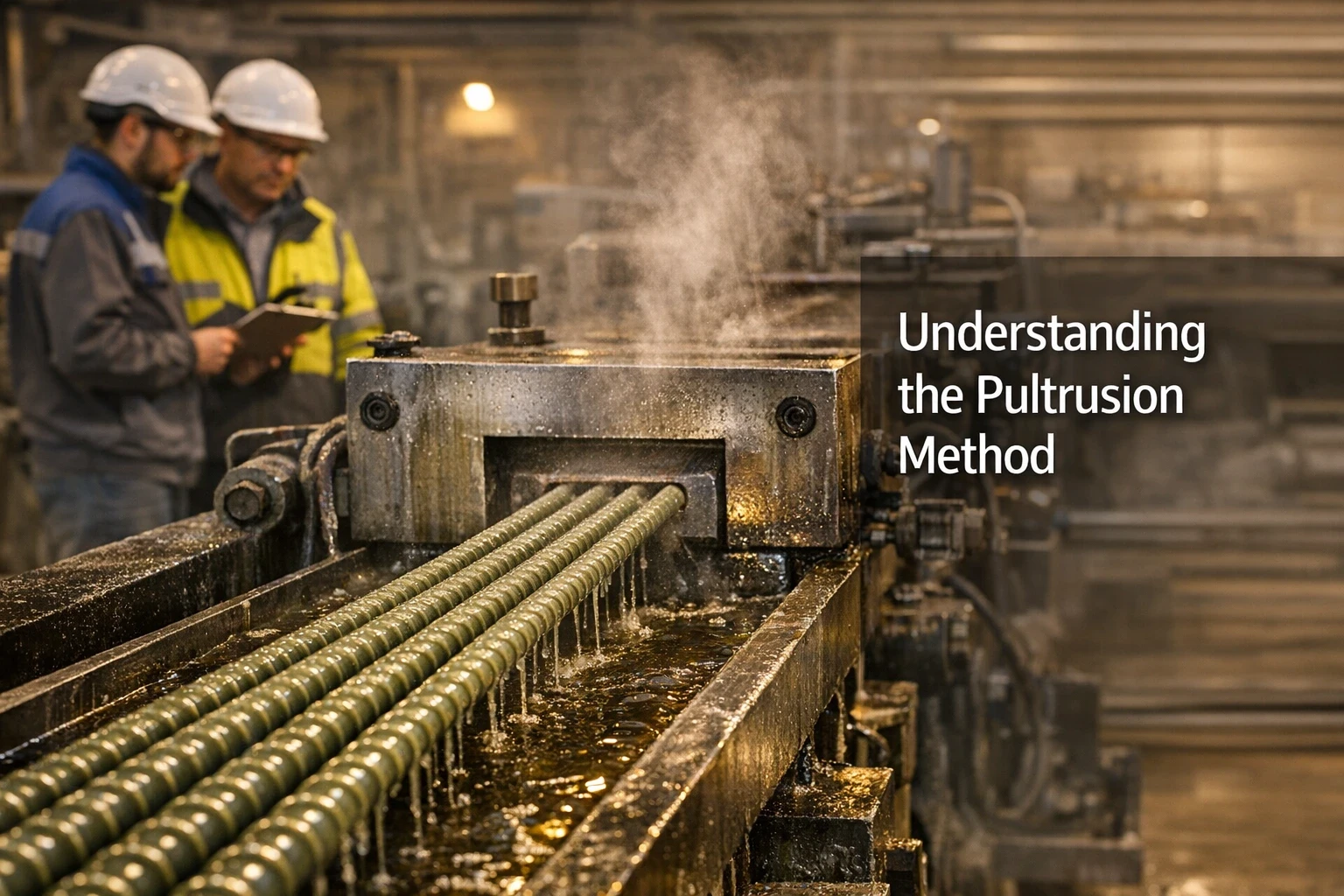
Pultrusion is a continuous manufacturing method where fibers are pulled through resin and a heated die to form solid FRP rebars or profiles. It ensures fibers remain aligned along the bar’s length, giving consistent strength and durability.

Resources
10
Mar'26What is Pultrusion Method in FRP Manufacturing Process
For decades, engineers facing corrosion problems in concrete had one reliable option: steel. But steel rusts. Over time, corrosion weakens structures and leads to costly repairs around the world.
FRP was developed to address this issue. Unlike steel, it does not corrode. But its performance depends heavily on how the material is manufactured.
Steel is melted, cast, and rolled into bars. FRP, on the other hand, is made by combining fibers and resin to form a composite material. The most widely used method for producing FRP reinforcement is called pultrusion.
Understanding this process helps explain why FRP behaves differently from steel and why it performs well in environments where traditional reinforcement struggles.
What is the Pultrusion Process?
Pultrusion is a manufacturing method used to create fiber-reinforced polymer profiles such as rebars, rods, and structural shapes.
The word itself comes from two terms: “pull” and “extrusion.” In this process, fibers are pulled through resin and a heated mold to form a solid composite shape.
Unlike extrusion, where materials are pushed through a die, pultrusion relies on continuous pulling. This keeps the fibers straight and aligned along the length of the bar, which is important for strength.
Because the process runs continuously, manufacturers can produce FRP rebars with uniform dimensions and predictable material properties.
Raw Materials Used in FRP Manufacturing
FRP is made by combining high-strength fibers with a polymer resin. Each component contributes to the final mechanical and durability properties of the composite.
Fibers
Fibers provide most of the strength in FRP.
Common types include:
- Glass fibers (GFRP): These are the most widely used fibers for construction reinforcement. They provide good strength while keeping costs manageable.
- Carbon fibers (CFRP): Carbon fibers offer higher stiffness and strength but are usually used in specialized applications due to their cost.
- Aramid fibers (AFRP): Aramid fibers are known for their toughness and resistance to impact.
Resin Systems
Resins bind the fibers together and protect them from environmental damage.
Common resin types include:
- Polyester resin: Widely used for general composite products.
- Vinyl ester resin: Offers improved resistance to chemicals and moisture.
- Epoxy resin: Provides high mechanical strength and strong bonding.
Additives
Small amounts of additives are sometimes used to improve performance. These may include:
- UV stabilizers
- fire retardants
- fillers that improve processing or durability
With the fibers and resin ready, we can now follow their journey through the pultrusion machine.
Step-by-Step FRP Pultrusion Process
The pultrusion process involves several stages that gradually transform raw materials into finished reinforcement bars.
Step 1: Fiber Preparation
The process begins with continuous fiber rovings, which are large bundles of thin filaments wound onto spools.
These fibers are arranged and guided through alignment plates so that they run parallel to each other. Maintaining this alignment is important because it allows the final product to carry loads effectively along its length.
Step 2: Resin Impregnation
The fibers are then pulled through a resin bath.
During this stage, the resin fully saturates the fibers, filling the spaces between them. Proper impregnation ensures that the fibers bond well with the resin once curing begins.
If the fibers are not evenly coated, weak spots can develop in the finished bar.
Step 3: Preforming
After leaving the resin bath, the saturated fibers pass through preforming guides.
These guides shape the fibers into the general form required for the final product. At this point, excess resin may also be removed to maintain the correct fiber-to-resin ratio.
Step 4: Heated Die Forming
Next, the material enters a heated steel die.
The die determines the final shape and diameter of the FRP bar. As the fibers and resin pass through this heated mold, heat triggers a chemical reaction within the resin. This process, called polymerization, transforms the liquid resin into a solid material.
Because the fibers are continuously pulled through the die, the material takes on a uniform shape.
Step 5: Curing and Hardening
Inside the heated die, polymerization locks the fibers into place and creates the rigid composite structure that gives FRP its strength.
By the time the material exits the die, the reinforcement bar has already formed its final structure.
Step 6: Surface Treatment
FRP rebars require a surface texture that allows them to bond properly with concrete. This surface roughness creates a mechanical interlock between the bar and the surrounding concrete, allowing loads to transfer effectively.
To achieve this, manufacturers may apply sand coating or create surface patterns while the resin is still slightly reactive.
Step 7: Cutting and Finishing
The finished profile continues moving along the production line until it reaches a cutting system.
Here, the continuous FRP bar is cut into required lengths. The bars are then inspected and prepared for packaging and transport.
Advantages of the Pultrusion Method
Pultrusion is widely used for FRP manufacturing because it offers several practical advantages:
- Continuous fiber alignment: Because the fibers run along the entire length of the bar, the material can handle high tensile loads without adding unnecessary weight.
- Consistent product quality: The controlled manufacturing environment makes it easier to maintain uniform dimensions and material properties.
- Efficient production: Pultrusion is well-suited for creating long profiles such as rebars, rods, and structural sections at scale.
These advantages make pultrusion a reliable method for producing reinforcement materials used in modern infrastructure.
Quality Control in FRP Manufacturing
To ensure reliable performance, manufacturers carry out quality checks during and after production. Tapashri Engineering implements strict quality control measures at every stage of the pultrusion process to deliver FRP rebars with consistent strength and durability.
Some common checks include:
- Monitoring fiber alignment
- Verifying proper resin curing
- Measuring dimensions and surface finish
- Conducting mechanical strength tests
These inspections help confirm that the finished product meets FRP design requirements and industry standards.
Applications of Pultruded FRP Products
Pultruded FRP materials are used in environments where corrosion resistance and durability are important.
Common FRP applications include:
- Reinforcement in concrete structures
- Bridges and highway infrastructure
- Marine and coastal construction
- Water treatment plants
- Industrial and chemical facilities
In these settings, FRP can help reduce maintenance issues related to corrosion.
Why Pultrusion Works Well for FRP Rebars
The pultrusion process allows manufacturers to control how fibers are arranged inside the bar. This is a key difference between FRP and traditional steel rebar. Steel gains its strength from its metallurgical composition after rolling, while FRP gains its strength from the continuous alignment of its internal fibers.
At the same time, the resin matrix protects the fibers from moisture, chemicals, and environmental exposure.
This combination of aligned fibers and protective resin is what gives FRP its distinct performance characteristics.
The Role of Pultrusion in FRP Performance
The properties of FRP are closely tied to the way it is manufactured. The pultrusion process brings together fibers, resin, and controlled curing to produce reinforcement bars with consistent structure and strength.
For engineers and builders, understanding this process provides insight into why FRP performs differently from steel in reinforced concrete.
As infrastructure projects increasingly demand longer service life and reduced maintenance, materials that resist corrosion are becoming more important. Pultrusion makes it possible to manufacture FRP reinforcement reliably at scale, helping support structures designed to last for decades.
Frequently Asked Questions (FAQs)
Find clear answers to the most common queries.
-
What is the pultrusion process in FRP manufacturing?
-
How are FRP rebars made?
FRP rebars are made by combining high-strength fibers like glass, carbon, or aramid with polymer resin. The fibers are saturated with resin, shaped, cured in a heated die, treated for surface texture, and then cut to length.
-
Why is pultrusion important for FRP reinforcement?
Pultrusion keeps fibers aligned continuously along the bar, maximizing tensile strength while maintaining a lightweight structure. It also allows manufacturers to produce uniform, corrosion-resistant FRP rebars at scale.
-
What are the advantages of FRP rebars made by pultrusion?
FRP rebars produced via pultrusion offer consistent quality, high strength-to-weight ratio, corrosion resistance, and long service life. They are ideal for bridges, marine structures, chemical plants, and other environments where steel may corrode.
Subscribe to Our Newsletter
Get updates on products, research collaborations, and new developments in FRP technology.

Subscribe to Our Newsletter
Subscribe our newsletter and get notifications to stay update