
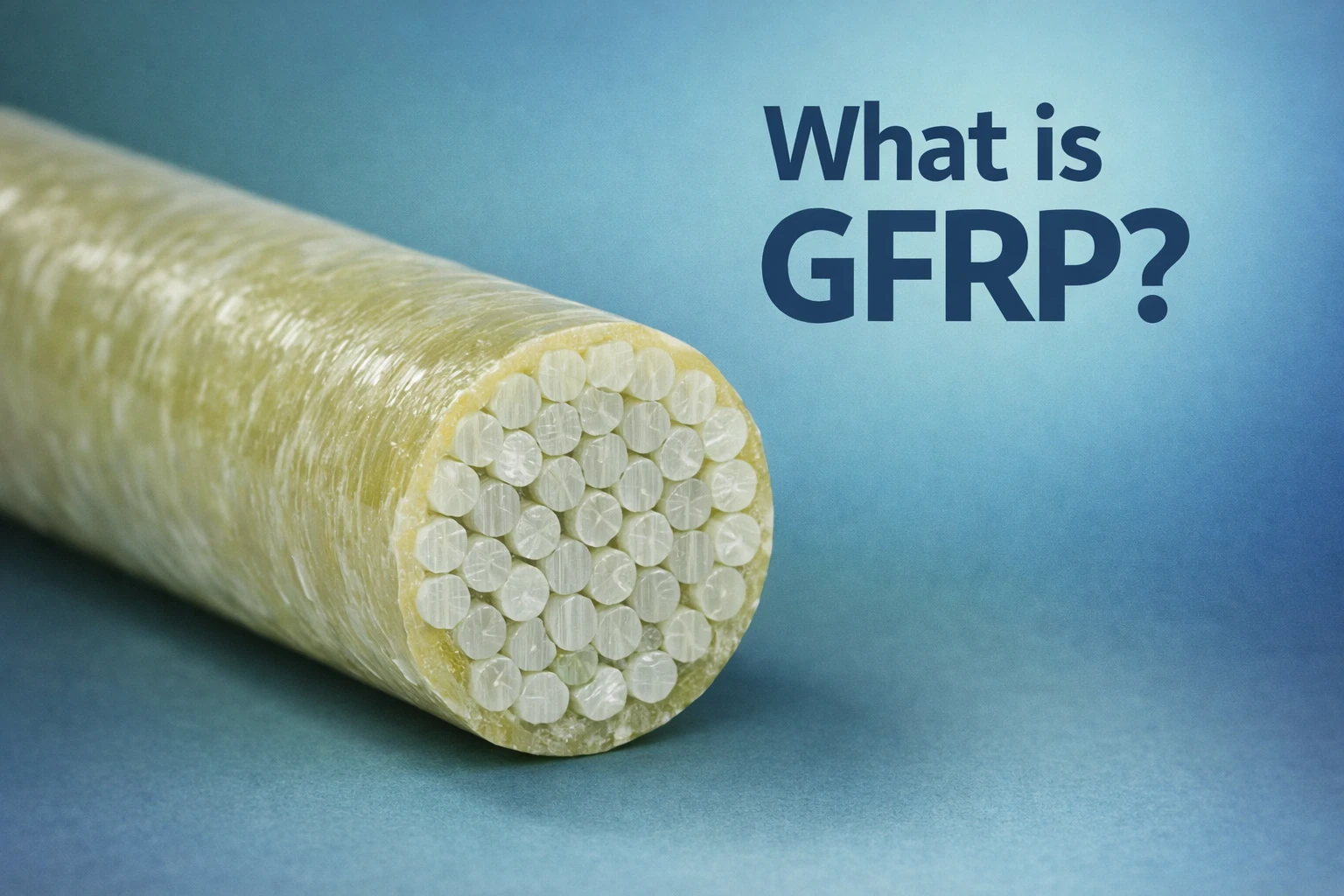
GFRP stands for Glass Fiber Reinforced Polymer.

Resources
19
Feb'26What is GFRP? Glass Fiber Reinforced Polymer Properties & Uses
If you work in construction, infrastructure, or manufacturing, you may have heard the term GFRP.
It is becoming more common in projects where strength, durability, and corrosion resistance are important. But what exactly is GFRP? How is it different from steel or concrete? And why are more engineers and builders choosing it?
Let’s break it down in simple terms. Imagine a material that is as strong as steel, as light as plastic, and resistant to rust. That is the basic idea behind GFRP.
What is the full form of GFRP?
GFRP stands for Glass Fiber Reinforced Polymer.
It is made of two main materials:
- Glass fibers – thin strands of glass that provide strength
- Polymer resin – a type of plastic that binds the fibers together
When combined, these materials create a strong, lightweight composite.
The glass fibers handle the load, while the polymer protects and holds everything in place.
The polymer resin not only holds the glass fibers together but also protects them from damage and gives the material its shape and corrosion-resistant properties.
How is GFRP Made?
GFRP is manufactured by embedding glass fibers into a polymer resin. The mixture is then shaped using different processes such as pultrusion or molding. In simple terms:
- Glass fibers are aligned or woven.
- They are soaked in resin.
- The material is shaped and cured (hardened).
In the pultrusion process, continuous glass fibers are pulled through a resin bath and then through a heated die. The die shapes the material and cures the resin into its final form, such as a solid rod or structural profile, which is then cut to length.
The result is a solid product that is strong, lightweight, and resistant to corrosion.
Key Properties and Advantages of GFRP
Here are the main characteristics that make GFRP useful, along with the practical benefits they offer:
- Lightweight (approximately 70–75% lighter than steel): Easier to transport, handle, and install, reducing labor and equipment costs.
- High Tensile Strength: Often stronger than steel, allowing it to carry heavy loads despite its low weight.
- Corrosion Resistance: Does not rust in marine, chemical, or moist environments, leading to a longer service life.
- Low Maintenance: No need for regular painting or inspections, saving significant costs over time.
- Electrical Insulation: Non-conductive and non-magnetic, making it suitable for use in electrical railways, substations, and MRI facilities.
- Durability in Harsh Conditions: Performs reliably for decades in environments where traditional materials like steel would deteriorate quickly.
Types of GFRP Products
GFRP can be manufactured in different forms depending on the application. Each type is designed to meet specific structural or industrial needs:
- GFRP rebars: Used to reinforce concrete in place of steel, especially in bridge decks, sea walls, and foundation slabs where corrosion is a concern.
- GFRP rods: Often used as dowels for load transfer in concrete pavement joints or as tensile elements in anchoring systems.
- GFRP sheets and panels: Commonly applied as protective cladding, flooring, or wall panels in chemical plants and food processing facilities.
- GFRP structural profiles: Shapes like beams, channels, and angles used to build lightweight, corrosion-resistant frameworks for walkways, platform structures, and ladder systems.
- GFRP pipes and tubes: Used for fluid handling in corrosive environments, such as in water treatment plants or chemical processing industries.
Uses of GFRP - Glass Fiber Reinforced Polymer
GFRP is used in many industries. Some common applications include:
Construction and Infrastructure
- Reinforcement in concrete structures
- Bridges
- Parking structures
- Coastal buildings
Because GFRP rebars have a different surface than steel, they are often manufactured with a surface treatment, such as a helical wrap or a sand-coated layer. This ensures a strong mechanical bond between the GFRP bar and the concrete, allowing them to work together effectively without slipping.
Marine and Coastal Projects
- Docks and ports
- Sea walls
- Water treatment plants
Industrial Applications
- Chemical plants
- Factories exposed to moisture or corrosive materials
Electrical Applications
- Cable trays
- Utility structures
GFRP vs Steel: What’s the Difference?
Here is a simple comparison to show why GFRP is often the better choice in specific environments:
Property | GFRP |
Steel |
| Weight |
Light |
Heavy |
| Corrosion |
Does not rust |
Rusts over time |
| Electrical Conductivity |
Non-conductive |
Conductive |
| Tensile Strength |
Very high (often higher than steel) |
High |
| Maintenance |
Lower | Higher in harsh environments |
Steel is still widely used, but in environments where corrosion is a concern, GFRP can be a superior option.
Are There Any Limitations to GFRP? (And How to Address Them)
Like any material, GFRP also has some limitations:
- It can be more expensive in terms of upfront material cost compared to steel. However, when factoring in lower transportation costs, easier installation, and reduced maintenance over its service life, the total project cost can often be lower than traditional materials.
- It requires proper design understanding because it has a lower modulus of elasticity than steel. This means GFRP will bend or stretch more under the same load, so structures must be designed to accommodate this different behavior.
- It behaves differently under high temperatures. While GFRP does not burn easily and is self-extinguishing, its mechanical properties, such as strength and stiffness, can begin to reduce as temperatures approach the glass transition temperature of the resin (typically between 150°C and 300°C, depending on the resin type). In applications with high fire risk or continuous exposure to elevated temperatures, additional fire protection measures may be necessary, or steel might be preferred for primary load-bearing elements.
Because of this, GFRP should be selected based on project requirements, considering the long-term savings in maintenance and replacement alongside its performance in specific environmental conditions.
The Future of GFRP
As construction projects demand longer-lasting and corrosion-resistant materials, GFRP is gaining more attention. With better manufacturing methods and growing awareness, its use is likely to increase in infrastructure and industrial projects.
Making the Right Choice with GFRP
GFRP, or Glass Fiber Reinforced Polymer, is a strong, lightweight, and corrosion-resistant material made from glass fibers and polymer resin. It offers practical advantages in environments where steel may not perform well over time.
Understanding how GFRP works helps engineers, builders, and project owners choose the right material for their needs.
If you are exploring GFRP solutions for your project and need to know which product, whether rebar, rods, or structural profiles, is right for your specific application, contact our team at Tapashri Engineering for a consultation. We can help you understand the options available and select what suits your application best.
Frequently Asked Questions (FAQs)
Find clear answers to the most common queries.
-
What is the full form of GFRP?
-
What are the main properties of GFRP?
GFRP is lightweight, has high tensile strength, resists corrosion, does not conduct electricity, and requires low maintenance.
-
Is GFRP electrically conductive?
No. GFRP is non-conductive and non-magnetic, making it suitable for electrical and railway applications.
-
Where is GFRP commonly used?
GFRP is used in bridges, sea walls, parking structures, water treatment plants, and industrial facilities exposed to moisture or corrosion.
-
Is GFRP more expensive than steel?
GFRP may have a higher initial cost, but lower maintenance and longer service life can reduce overall project costs.
Subscribe to Our Newsletter
Get updates on products, research collaborations, and new developments in FRP technology.

Subscribe to Our Newsletter
Subscribe our newsletter and get notifications to stay update