
The key FRP material advantages include corrosion resistance, high strength-to-weight ratio, and low maintenance needs. The disadvantages include linear elastic behavior, lower stiffness than steel, fire sensitivity, and higher initial cost.

Resources
10
Feb'26Benefits and Limitations of FRP (Fiber Reinforced Polymer)
Fiber Reinforced Polymer (FRP) reinforcement is used in concrete structures primarily to overcome durability limitations associated with steel reinforcement. In exposure conditions where corrosion governs structural performance and service life, material selection becomes as important as structural capacity.
FRP eliminates corrosion-related deterioration but introduces different material behavior and performance considerations. A clear understanding of what FRP material is, along with its advantages and disadvantages, is therefore necessary to determine where FRP can be used effectively and where its constraints must be accounted for.
At Tapashri, FRP is evaluated and applied with a focus on durability performance, exposure conditions, and long-term structural reliability.
Benefits of FRP Reinforcement
Look at the key advantages that make FRP reinforcement suitable for specific exposure and durability requirements.
1. Corrosion Resistance
One of the primary advantages of FRP is its resistance to corrosion. Unlike steel, FRP does not rust when exposed to moisture, chlorides, or chemicals.
- This makes FRP reinforcement suitable for structures in aggressive environments such as coastal regions, marine structures, chemical plants, water treatment facilities, and bridges exposed to de-icing salts.
- In comparison to conventional steel reinforcement, as explained in FRP vs steel reinforcement, eliminating corrosion-related deterioration significantly improves durability and service life.
2. High Tensile Strength and Strength-to-Weight Ratio
FRP reinforcement offers a very high ultimate tensile strength, often significantly greater than that of conventional steel reinforcement, while being much lighter. It is critical to note that while its ultimate strength is high, FRP exhibits linear elastic behavior and does not have a distinct yield strength or yield plateau like steel.
- This combination of strength and low density results in an exceptional strength-to-weight ratio.
- The reduced weight lowers transportation and handling costs, simplifies on-site logistics, and can help reduce the overall dead load of a structure, which can be beneficial in certain structural situations.
Detailed mechanical properties and material characteristics are covered in FRP specifications, which help explain how these properties influence structural performance.
3. Lightweight and Ease of Handling
Due to its low density, FRP is easier to handle on site compared to steel bars. Manual lifting is simpler, and less heavy equipment may be required for placement.
- This can improve work efficiency, especially in projects with limited access, tight working spaces, or remote locations where handling heavy steel reinforcement is challenging.
4. Non-Conductive and Non-Magnetic Properties
FRP reinforcement is electrically non-conductive and non-magnetic.
- These properties make it suitable for structures where electromagnetic interference or electrical conductivity must be avoided.
- Common applications include power substations, MRI facilities, railway signaling zones, and research laboratories. Steel may interfere with sensitive equipment in such environments, whereas FRP does not.
5. Chemical and Environmental Resistance
FRP shows good resistance to a wide range of chemicals, including acids and salts commonly found in industrial and wastewater environments.
- It also performs well in humid conditions and does not suffer from electrochemical degradation.
- This makes FRP a reliable choice for structures exposed to harsh environmental conditions over long periods.
6. Reduced Maintenance Requirements
Because FRP does not corrode, structures reinforced with FRP generally require less maintenance related to reinforcement deterioration.
- This reduction in repair and rehabilitation needs can lower long-term maintenance costs and minimize service disruptions, particularly for infrastructure projects where access for repairs is difficult or expensive.
Limitations of FRP Reinforcement
Key disadvantages that must be addressed when selecting and applying FRP reinforcement.
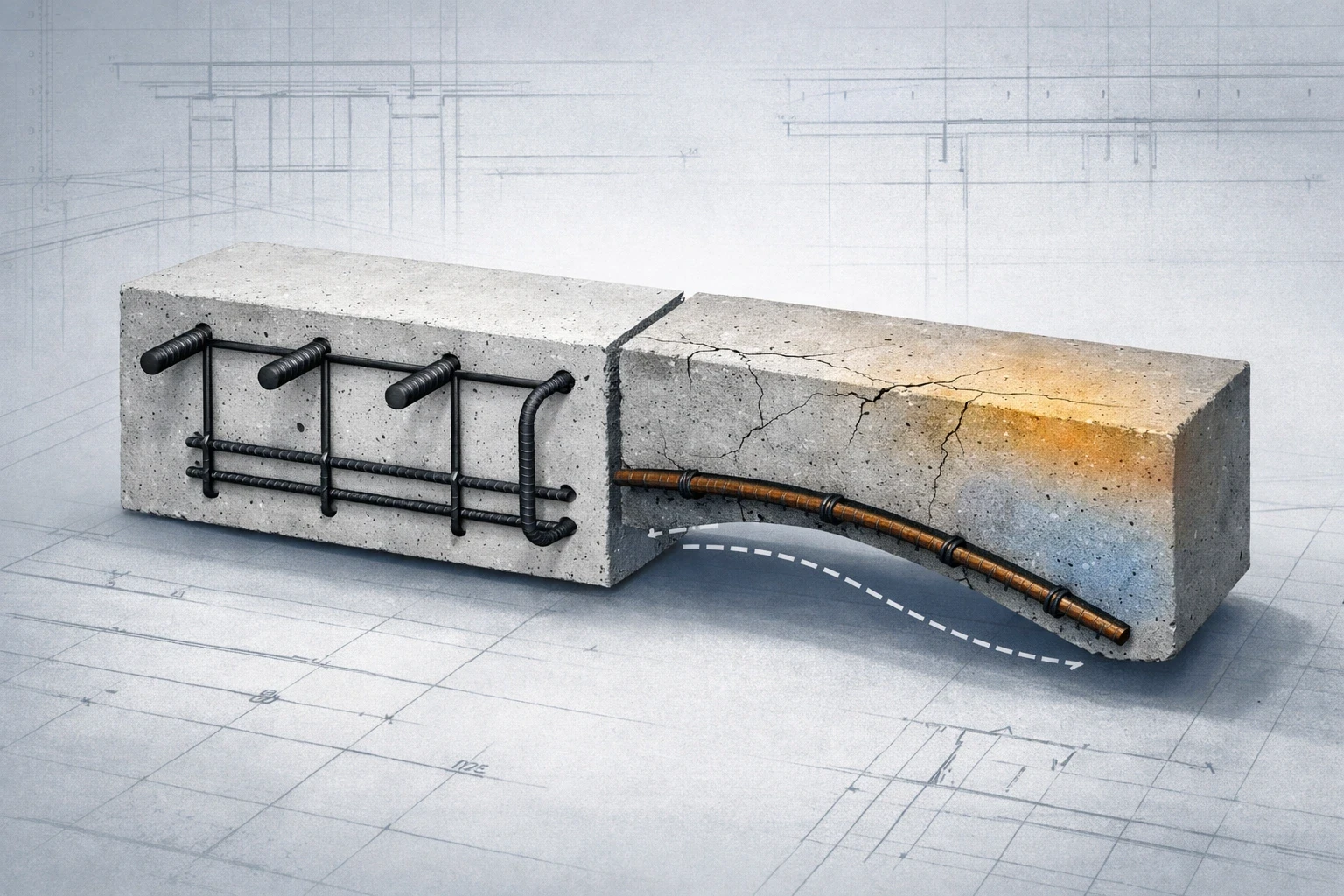
1. Linear Elastic Behavior and Lack of Yielding
Unlike steel, FRP does not yield before failure. It behaves in a linear elastic manner until rupture.
- This means there is no visible warning or plastic deformation prior to failure, which affects how structural behavior must be accounted for.
- Adequate safety margins and serviceability controls are therefore required when using FRP.
2. Lower Modulus of Elasticity
FRP typically has a lower modulus of elasticity compared to steel.
- As a result, FRP-reinforced concrete members may experience higher deflections and wider crack widths under service loads.
- To control these effects, adjustments such as increased reinforcement ratios or modified section dimensions may be required.
3. Fire and High-Temperature Performance
FRP contains polymer resins that can degrade at elevated temperatures. While the fibers themselves may retain strength, the resin matrix can lose stiffness and bond strength when exposed to fire or high heat.
- For structures with fire resistance requirements, additional protective measures such as increased concrete cover or fire-resistant coatings may be necessary.
- Fire performance and protective requirements should be carefully evaluated, particularly for structures with fire resistance obligations, as discussed in FRP design considerations.
4. Bending and Shaping Limitations
FRP cannot be bent on site like steel bars. Any bends or hooks must be manufactured at the factory.
- This requires careful planning during detailing and coordination between project teams and suppliers.
- Late design changes on site can be more difficult to accommodate compared to steel reinforcement.
5. Initial Material Cost
The initial cost of FRP reinforcement is generally higher than that of conventional steel reinforcement. This can influence material selection, especially in cost-sensitive projects.
- However, initial material cost alone does not reflect overall project economics.
- In many cases, reduced maintenance and longer service life can offset the higher upfront cost over the structure’s lifespan.
6. Design Code Availability and Familiarity
Comprehensive design codes for FRP, while established, are not yet as universally adopted or ingrained in practice as those for steel.
- Designers often rely on specific guidelines and standards such as ACI 440.1R (Guide for the Design and Construction of Structural Concrete Reinforced with FRP Bars) in the US or CSA S806 (Design and construction of building structures with fibre-reinforced polymers) in Canada.
- Additionally, some designers and contractors may have limited experience working with FRP, which can create a potential learning curve during both the design and construction phases. This necessitates additional diligence in specification, detailing, and construction oversight.
When FRP is a Suitable Choice
- Structures exposed to moisture, chlorides, or chemically aggressive environments.
- Coastal, marine, industrial, and wastewater-related structures where corrosion governs service life.
- Projects requiring long design life with reduced maintenance and repair interventions.
- Structures where lightweight reinforcement improves handling or reduces construction effort.
- Applications requiring non-conductive or non-magnetic reinforcement due to operational constraints.
When FRP May Not Be Ideal
- Structures where ductile behavior and energy dissipation are critical to performance.
- Applications requiring significant plastic deformation before failure.
- Projects with strict fire resistance requirements without additional protection measures.
- Designs that depend on frequent on-site bending or late-stage detailing changes.
- Cost-sensitive projects where initial material cost is the primary selection criterion.
Leveraging the Advantages of FRP Reinforcement
FRP offers clear advantages in durability and corrosion resistance, particularly in environments where steel reinforcement is prone to deterioration. At the same time, its linear elastic behavior, stiffness characteristics, fire performance, and detailing constraints must be carefully addressed during engineering and execution.
The decision to use FRP should be guided by project conditions, exposure environment, performance requirements, and lifecycle considerations rather than material substitution alone. When selected and applied appropriately, FRP reinforcement provides a durable and reliable solution for concrete structures exposed to aggressive environmental conditions.
Frequently Asked Questions (FAQs)
Find clear answers to the most common queries.
-
What are the main FRP material advantages and disadvantages?
-
What are the advantages of using FRP material in concrete reinforcement?
FRP material offers advantages such as resistance to corrosion, chemical durability, lightweight handling, and suitability for aggressive exposure conditions where steel may deteriorate.
-
What are the disadvantages of FRP reinforcement compared to steel reinforcement?
Disadvantages of FRP reinforcement include lack of yielding before failure, bending limitations, lower modulus of elasticity, and additional considerations for fire performance.
-
Where do the advantages of FRP material outweigh its disadvantages?
The advantages of FRP material outweigh its disadvantages in structures exposed to moisture, chlorides, or chemicals, and in applications requiring long service life with reduced maintenance.
Subscribe to Our Newsletter
Get updates on products, research collaborations, and new developments in FRP technology.

Subscribe to Our Newsletter
Subscribe our newsletter and get notifications to stay update