
GFRP usually has a lower lifecycle cost than steel due to minimal maintenance and no corrosion-related repairs.

Resources
22
Apr'26GFRP Rebar vs Steel: Total Lifecycle Cost Analysis for Infrastructure Projects in India
Most contractors compare materials using ₹/kg pricing. At first glance, steel looks cheaper than GFRP rebar and that’s often where the analysis stops.
But that shortcut is exactly how projects end up costing significantly more over time.
The question here isn’t “What does it cost today?”
It’s “What will it cost over the life of the structure?”
When evaluated through Total Cost of Ownership (TCO), the comparison between GFRP and steel changes dramatically.
Why Price Per Kg is Misleading
The more complete way to evaluate this is:
- Total Cost of Ownership: every rupee spent on a material from procurement to the end of the structure's service life.
Steel rebar in India typically ranges between ₹40,000–60,000 per tonne, while GFRP is priced higher per kg (approx. ₹120,000 - ₹180,000), which is what most people notice first.
However:
- GFRP is ~75% lighter than steel
- Less material is required for equivalent structural performance
- Transportation and handling costs drop significantly
So even at the material stage, the gap in material cost is smaller than it appears.
What is Total Lifecycle Cost (TCO)?
Total lifecycle cost includes every rupee spent from:
- Procurement
- Transportation
- Installation
- Maintenance
- Repairs
- Rehabilitation
This is the only accurate way to compare GFRP vs steel.
5 Key Cost Factors That Decide the Winner
1. Material Cost
- Steel costs lower per kg, GFRP is more expensive.
- But because it's lighter, you need less of GFRP by weight to reinforce the same structure.
For a 1,000 sqm slab, the weight of GFRP required is a fraction of the equivalent steel quantity.
The initial cost difference is real, but smaller than the ₹/kg comparison suggests.
2. Transportation & Handling
This is where GFRP quietly saves money that most estimates ignore.
Lighter GFRP material means:
- fewer truck trips to site
- less crane time
- faster handling by workers
In India, where logistics costs on large infrastructure projects are substantial, this adds up.
For example, a project that would need 5 truckloads of steel may need only ~2 for GFRP.
3. Concrete Cover Savings
Steel requires 40–75 mm of concrete cover for corrosion protection.
GFRP requires only 20–25 mm because it doesn't corrode.
Benefits:
- Reduced concrete volume
- Lower structural weight
- Potential foundation cost savings
This cascading saving is almost never accounted for in simple material comparisons.
4. Maintenance & Repairs
This is where steel-reinforced structures in Indian conditions start to become expensive.
In Indian conditions:
- Steel corrodes due to moisture, chlorides, and chemicals
- Leads to cracking, spalling, and structural damage
The typical maintenance cycle for a steel-reinforced structure in an aggressive environment involves periodic inspections, crack sealing, epoxy injection, patching, and sometimes cathodic protection systems. Each of these has a cost.
Typical 30-year maintenance cost:
- ₹800–1,500 per sqm depending on exposure severity
Over a 5,000 sqm bridge deck, that's ₹40–75 lakh just in maintenance.
// GFRP's maintenance cost for corrosion-related issues over the same period: essentially zero.
5. Rehabilitation & Replacement
Steel structures in aggressive environments often require:
- Major rehabilitation at 20–30 years
- Costs 30–50% of initial construction
GFRP-reinforced structures:
- Designed lifespan: 75–100 years
- No corrosion-driven rehabilitation
For a project built today with a 50-year design life, avoiding one major rehabilitation cycle could save more than the entire additional material cost of choosing GFRP from the start.
Break-Even Point: When Does GFRP Become Cheaper?
In most corrosive environments:
- Break-even occurs in 5–8 years
After that:
- Every year = net savings
For a structure with a 50-year design life, that means 40+ years of operating at lower cost.
In highly corrosive environments like coastal Gujarat, Mumbai's waterfront, wastewater facilities, the break-even often comes sooner.
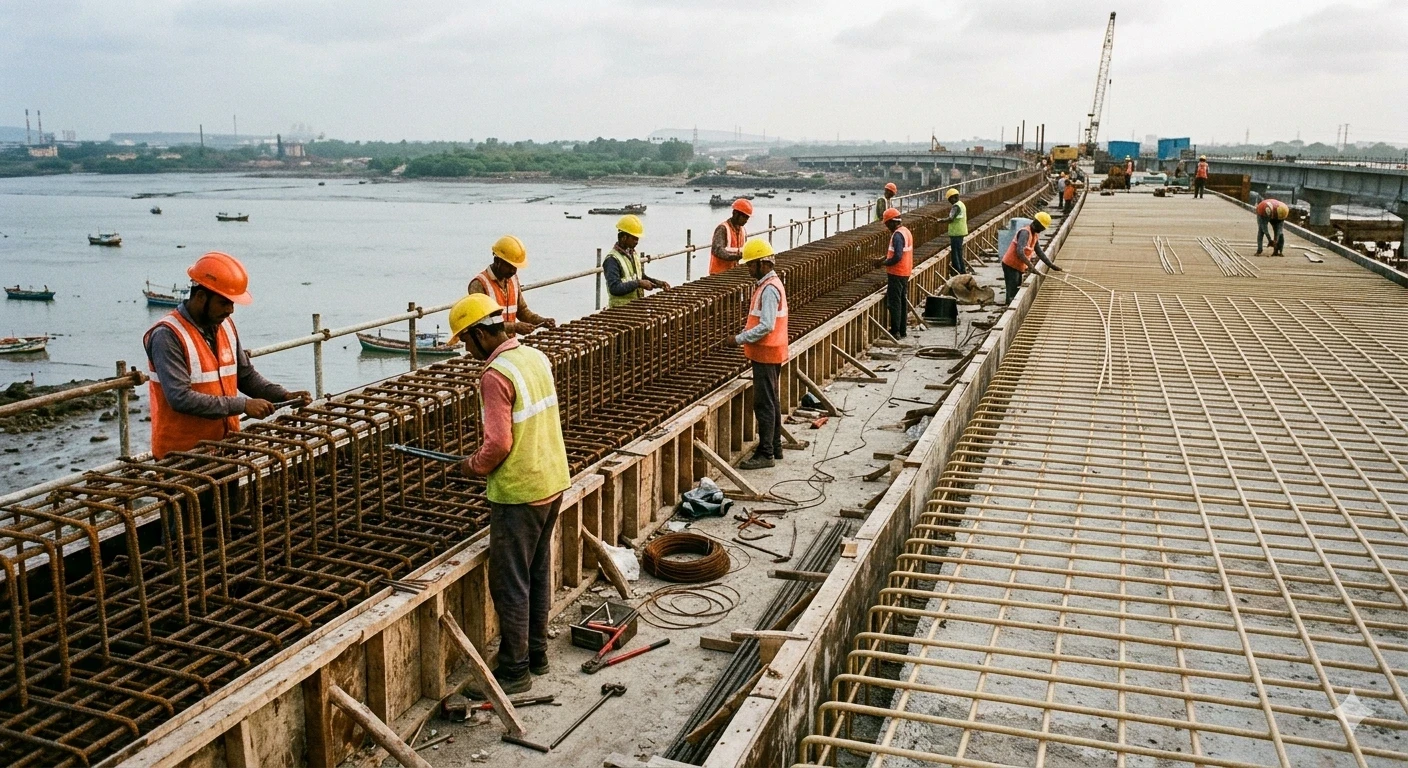
Worked Example: 500m Coastal Road in Gujarat
To make this concrete, here's a simplified comparison for a 500-metre coastal road project.
Steel Reinforcement Option:
- Material + installation: ₹35 lakh
- Maintenance (Year 10, 20, 30): ₹18 lakh cumulative
- Rehabilitation at Year 25: ₹22 lakh
- 30-year total: ~₹75 lakh
GFRP Reinforcement Option:
- Material + FRP installation: ₹46 lakh
- Maintenance over 30 years: ₹2 lakh (routine only)
- Rehabilitation: Not required
- 30-year total: ~₹48 lakh
Total Savings with GFRP
GFRP saves approximately ₹27 lakh over 30 years on this project alone. These are conservative estimates. In reality, the gap tends to be wider because steel deterioration in coastal conditions is often faster than standard models assume.
Where GFRP Makes Sense (and Where It Doesn’t)
A fair analysis has to acknowledge that GFRP is not the right answer for every project.
Project Type | Recommendation | Reason |
| Coastal roads & bridge deck | Strongly prefer GFRP |
Salt exposure accelerates corrosion and shortens steel's service life |
| Water treatment plants |
Strongly prefer GFRP |
Chemical environment, no tolerance for contamination from rust |
| Metro tunnels |
Prefer GFRP |
Chloride ingress, electromagnetic sensitivity requirements |
| Interior slabs |
Steel may be adequate |
Low corrosion risk, lifecycle savings are smaller |
| Seismic-critical structures |
Steel required | GFRP does not have the ductility needed for seismic energy dissipation |
The honest answer is that GFRP pays back most strongly where the environment is aggressive. In benign, dry, protected settings, the calculus is less clear.
Why GFRP Performs Better in Indian Conditions
Global lifecycle cost studies are usually based on European or North American climate data. Indian conditions are different in ways that matter.
1. Monsoon Exposure
- Six months of high humidity and intermittent flooding accelerates chloride ingress into concrete faster than temperate climate models predict.
- Steel corrodes sooner, maintenance cycles begin earlier, and rehabilitation costs arrive ahead of schedule.
2. Coastal Belt Development
- Gujarat, Maharashtra, Tamil Nadu, and Kerala have enormous amounts of infrastructure being built right now including ports, roads, bridges, water infrastructure.
- These are all within high chloride exposure and are exactly the environment where steel underperforms.
3. Labour Cost Reality
- Repair labour is cheaper in India. This reduces the maintenance cost advantage of GFRP somewhat.
- But frequency of repairs still increases lifecycle cost.
The numbers favour GFRP on projects with 20+ year design lives in corrosive conditions. On shorter-horizon projects in non-corrosive settings, steel may still win on cost.
4. Regulatory Support
FRP government guidelines in India:
- IRC 137:2022 (governs the use of FRP bars in Indian road projects)
- IS 18256:2023 (FRP material standard)
This means lifecycle cost models using GFRP can be formally included in Detailed Project Reports (DPRs) submitted to government clients, something that wasn't straightforward a few years ago.
How to Justify GFRP in Project Approvals
Many engineers are already convinced by the numbers but aren't sure how to present this to a project owner, approving authority, or government client who's focused on upfront BOQ cost.
A few things that help:
- Present Total Cost of Ownership (not material cost)
- Include lifecycle analysis in DPR
- Reference Indian standards (IRC & IS codes)
- Show break-even timeline clearly
Beyond Upfront Cost: The True Value of GFRP
Yes, GFRP costs more upfront.
But in corrosive environments, common across Indian infrastructure, it:
- Reduces maintenance costs
- Eliminates corrosion risk
- Avoids rehabilitation cycles
- Lowers total lifecycle cost
Together, they typically outweigh the higher initial material cost within the first decade.
// The comparison that matters isn't ₹/kg at the time of purchase. It's total spend over the life of the structure.
Evaluated on that basis, GFRP is often the more economical choice, not just the more durable one.
Planning a coastal, infrastructure, or industrial project? Get a project-specific lifecycle cost comparison from Tapashri Engineering tailored to your structure.
Contact our team today
Frequently Asked Questions (FAQs)
Find clear answers to the most common queries.
-
What is the GFRP vs steel lifecycle cost in India?
-
Is GFRP rebar more expensive than steel in India?
Per kg, yes. But GFRP is 75% lighter, so less quantity is needed. When transportation, maintenance, and rehabilitation costs are included, GFRP is typically cheaper over a 30–50 year project life.
-
What is the break-even point for GFRP vs steel?
GFRP typically breaks even within 5–8 years in corrosive environments like coastal and marine projects. After that, every year delivers net savings.
-
Where is GFRP better than steel in Indian construction?
GFRP is better for coastal roads, bridges, water treatment plants, and metro tunnels where corrosion is a major concern.
-
When should you not use GFRP instead of steel?
GFRP is not ideal for seismic or ductility-critical structures where steel performs better.
Subscribe to Our Newsletter
Get updates on products, research collaborations, and new developments in FRP technology.

Subscribe to Our Newsletter
Subscribe our newsletter and get notifications to stay update