
No. GFRP is a dielectric insulator and cannot carry current, which means it cannot serve as a grounding or bonding conductor. Any project switching from steel to GFRP still requires a fully independent, code-compliant electrical grounding/earthing system engineered separately from the reinforcement.

Resources
4
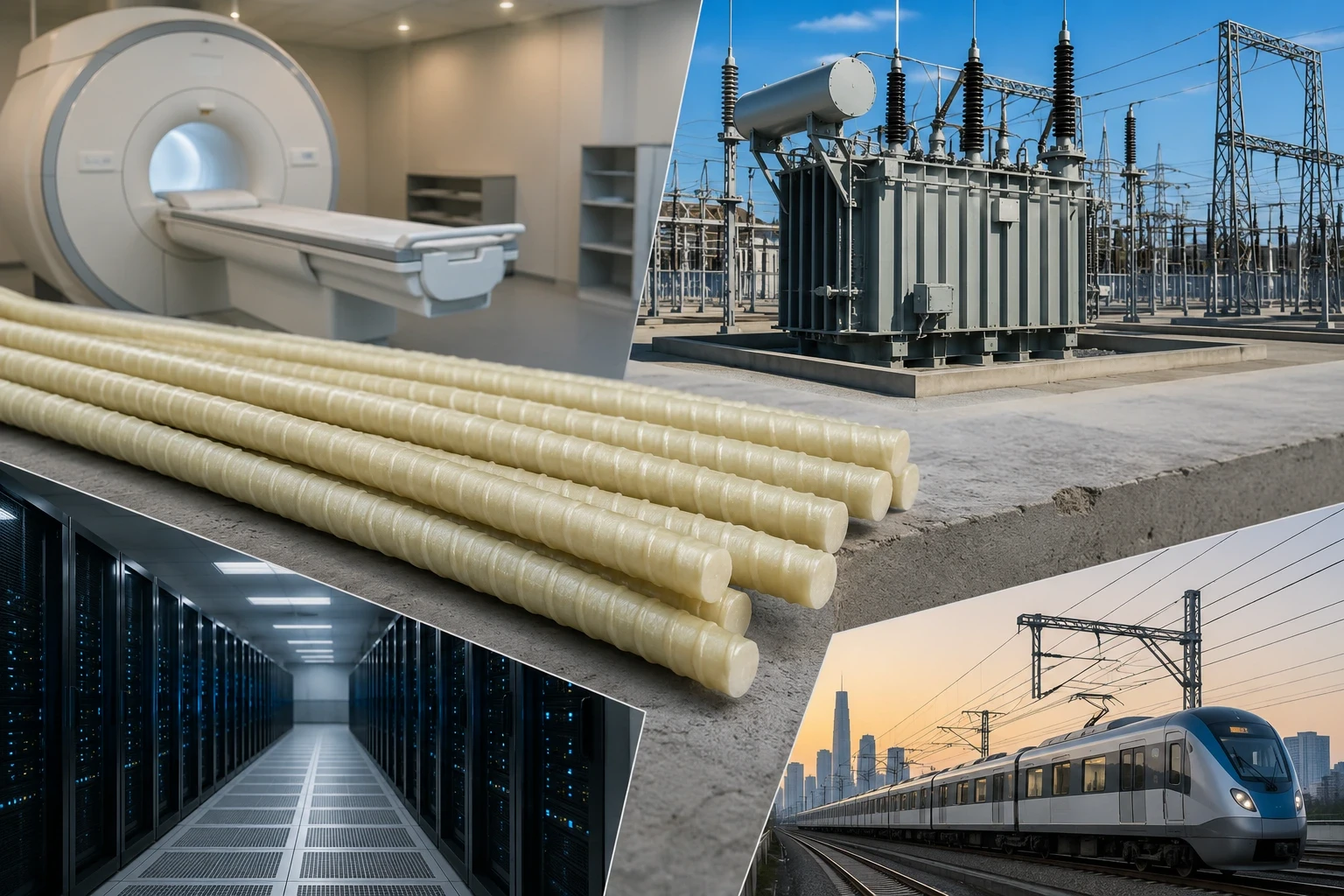
Aug'26Non-Magnetic GFRP Rebar for MRI, Substations & Data Centers
In most reinforced concrete (RCC) structures, conventional TMT steel reinforcement performs its job without issue. However, when a structure is built near powerful magnetic fields, high-voltage electrical systems, or precision electronic equipment, steel's inherent properties can create challenges that extend beyond structural performance.
Steel is both ferromagnetic and electrically conductive. While these characteristics are harmless in conventional buildings, they become problematic in environments such as MRI suites, electrical substations, data centers, railway infrastructure, and airports, where electromagnetic interference (EMI), stray currents, and signal integrity are critical design considerations.
Instead of simply reinforcing concrete, steel can unintentionally become part of the electromagnetic environment.
Eddy Currents
Alternating magnetic fields generated by transformers, induction equipment, or MRI magnets induce circulating currents known as eddy currents within closed steel reinforcement cages.
These currents can:
- Generate unwanted heat
- Increase energy losses
- Create localized thermal stresses within concrete
- Add unnecessary thermal load to transformer foundations and electrical infrastructure
Stray Electrical Currents
In substations, switchyards, electrified rail corridors, and traction systems, embedded steel reinforcement can unintentionally conduct stray electrical currents.
This may lead to:
- Unintended grounding paths
- Electrical arcing
- Increased touch and step potential risks
- Accelerated galvanic corrosion of nearby buried steel components
Traditionally, engineers have addressed these issues by adding insulation, isolation systems, or additional shielding. Glass Fiber Reinforced Polymer (GFRP) rebar offers a fundamentally different solution. It eliminates the problem by using a reinforcement material that is inherently non-conductive and non-magnetic.
Dielectric & Electromagnetic Properties of GFRP Rebar
GFRP rebar is manufactured from continuous glass fibers embedded in a polymer resin matrix. Unlike steel, it contains no ferrous metals and no electrically conductive material, making its electromagnetic properties inherent rather than engineered.
Property |
GFRP Rebar |
TMT Steel Rebar |
|---|---|---|
| Electrical conductivity | Non-conductive (dielectric insulator) | Conductive |
| Electrical resistivity | Typically >1012 Ω·m (manufacturer test data) | Low (conductor) |
| Magnetic permeability (μr) | ~1.0 (magnetically transparent) | High (ferromagnetic) |
| Thermal conductivity | ~0.35–0.5 W/m·K | ~45–50 W/m·K |
| Behavior in alternating magnetic fields | No induced eddy currents | Generates eddy currents and heating |
| RF/Radar transparency | Effectively transparent | Reflective and interference-prone |
Standards Note
It's important to distinguish between structural standards and electromagnetic performance. IS 18256:2023 and ASTM D7957 specify the dimensional, mechanical, and durability requirements for GFRP reinforcement. They do not specifically certify electromagnetic performance.
The dielectric and non-magnetic characteristics of GFRP arise naturally from its composition, glass fibers and resin contain neither free electrons nor ferromagnetic materials. Manufacturers typically verify these properties through electrical resistivity and material testing.
Where formal electromagnetic shielding performance must be validated, standards such as IEEE 299 may be referenced during facility design, particularly for highly specialized installations.
Applications of Non-Magnetic & Non-Conductive GFRP Rebar
1. MRI Rooms & Healthcare Facilities
Magnetic Resonance Imaging (MRI) systems operate using extremely powerful magnetic fields, typically between 1.5 Tesla and 3 Tesla, with research installations operating at even higher field strengths.
Steel reinforcement located near MRI scanners can:
- Distort magnetic field uniformity
- Produce imaging artifacts
- Cause localized heating through induced currents
- Increase vibration in structural elements close to the magnet
Benefits of GFRP Rebar
Because GFRP is magnetically transparent, it does not interact with the MRI field.
This provides several advantages:
- No magnetic distortion affecting image quality
- No reinforcement-induced heating
- No vibration caused by magnetic forces
- Simplified structural planning around MRI suites
- Reduced need for reinforcement-specific shielding strategies
For this reason, many modern MRI facilities specify non-metallic reinforcement in floors, walls, and ceiling slabs immediately surrounding imaging rooms, complementing the standard RF shielding already incorporated into MRI construction.
2. Power Transmission, Distribution & Electrical Substations
Transformer foundations, switchyard slabs, cable trenches, and reactor plinths operate continuously within strong electromagnetic fields.
Steel reinforcement in these environments can unintentionally interact with surrounding electrical equipment.
Advantages of GFRP
Using GFRP reinforcement helps:
- Eliminate induced eddy currents within foundation slabs
- Reduce unwanted heat generation around transformers
- Prevent reinforcement from acting as an unintended current path
- Lower risks associated with stray current during electrical faults
- Improve long-term durability by minimizing thermal stresses
Important Design Note
GFRP cannot replace a grounding system.
Because it is electrically non-conductive, GFRP reinforcement cannot perform bonding or earthing functions.
Every substation or power facility using GFRP reinforcement must still include a dedicated grounding system designed with:
- Copper conductors
- Ground rods
- Bonding grids
- Code-compliant earthing networks
3. Data Centers & Critical Technology Facilities
Modern data centers contain:
- High-density server racks
- UPS systems
- Battery backup rooms
- Power distribution equipment
- Extensive cable networks
Together, these systems generate complex electromagnetic environments.
Steel reinforcement can become an unintended source of electromagnetic interaction beneath sensitive equipment.
Why GFRP is Beneficial
GFRP-reinforced slabs are inherently electromagnetically neutral.
This helps designers:
- Minimize interference with sensitive electronics
- Support precision instrumentation
- Improve signal integrity
- Reduce dependence on additional EMI mitigation measures solely because of reinforcement
These benefits are particularly valuable in:
- Hyperscale data centers
- Semiconductor facilities
- Research laboratories
- Shielded server rooms
- Faraday cage environments
4. Transportation Infrastructure: Metro Rail, Airports & Toll Plazas
Transportation infrastructure often encounters challenges related to stray currents, radio-frequency signals, and electromagnetic compatibility.
Metro & Light Rail Systems
DC traction systems can leak stray current into surrounding structures.
Steel reinforcement near railway corridors may provide unintended conductive pathways, accelerating corrosion in nearby metallic infrastructure.
Using GFRP helps interrupt these current paths while maintaining structural performance, a factor increasingly relevant as GFRP adoption across Indian infrastructure expands into metro and rail projects.
Airport Infrastructure
Airport facilities contain numerous radio-frequency systems, including:
- Instrument Landing Systems (ILS)
- Ground radar
- Navigation equipment
- RFID-based tracking systems
Non-metallic reinforcement minimizes signal distortion and RF reflections that could affect sensitive equipment.
Toll Plazas
Electronic toll collection systems rely on:
- RFID communication
- Vehicle detection sensors
- Precision calibration
GFRP reinforcement avoids introducing conductive elements beneath pavement that could influence sensor accuracy.
Design & Specification Considerations
While GFRP offers unique electromagnetic advantages, engineers should consider several important design differences.
Independent Grounding Systems
Unlike steel reinforcement, GFRP cannot contribute to structural grounding.
Electrical consultants should always design a completely independent earthing system whenever GFRP reinforcement is specified.
This requirement should be clearly coordinated between structural and electrical design teams during the early stages of the project.
Stirrups & Tie Wire Selection
Even a small amount of steel tie wire can introduce conductive and magnetic material into an otherwise dielectric reinforcement cage.
For highly EMI-sensitive facilities, contractors should use:
- Nylon ties
- Plastic cable ties
- GFRP stirrups
- Other approved non-metallic fastening systems
This simple specification detail helps preserve the full electromagnetic benefits of GFRP.
Structural Design Considerations
Although GFRP provides superior corrosion resistance and electromagnetic neutrality, it behaves differently from steel.
Engineers must account for:
- Lower modulus of elasticity
- Deflection limits
- Development length
- Anchorage requirements
- Bar sizing
Structural design should follow applicable FRP design standards, including:
- IS 18256:2023
- IRC 137:2022
Proper design ensures both structural safety and long-term performance.
GFRP: More Than a Corrosion-Resistant Alternative
For many infrastructure projects, GFRP is selected because it eliminates corrosion and reduces lifecycle maintenance costs.
However, in MRI facilities, electrical substations, data centers, transportation infrastructure, and other electromagnetically sensitive environments, the value proposition extends far beyond durability.
In these applications, GFRP solves a functional challenge that conventional steel reinforcement cannot eliminate without additional insulation, shielding, or complex engineering measures.
Rather than being an alternative to steel, GFRP becomes the preferred engineering solution where electromagnetic neutrality is essential.
GFRP Rebar is Becoming the Preferred Choice for Critical Infrastructure
As modern infrastructure increasingly incorporates advanced medical equipment, high-voltage electrical systems, mission-critical computing facilities, and intelligent transportation technologies, electromagnetic compatibility has become an important consideration in structural design.
By combining structural performance with non-magnetic, non-conductive, and corrosion-resistant properties, GFRP rebar enables engineers to build reinforced concrete structures that support these demanding environments without compromising functionality or long-term reliability.
Whether you're designing an MRI suite, transformer foundation, data center, or transit structure, specifying GFRP reinforcement early in the design process can simplify construction, reduce electromagnetic risks, and improve the overall lifecycle performance of the facility.
If you need assistance with GFRP rebar selection, reinforcement detailing, or project-specific design coordination, the engineering team at Tapashri Engineering can help develop specifications and documentation tailored to your project requirements.
Frequently Asked Questions (FAQs)
Find clear answers to the most common queries.
-
Can GFRP rebar be used for electrical grounding or bonding?
-
Does GFRP rebar completely eliminate the need for RF shielding in MRI rooms?
No. GFRP removes the reinforcement itself as a source of magnetic field distortion and image artifacting, but MRI suites still require their standard purpose-built RF shielding (copper shielding, shielded doors and penetrations) as designed by the MRI equipment manufacturer. GFRP rebar and RF shielding solve different problems and are used together, not as substitutes for each other.
-
Is GFRP rebar strong enough to replace steel in substation or data center foundation slabs?
Yes, when designed correctly. GFRP has different stiffness and deflection behavior than steel, so foundation slabs need to be engineered to FRP design provisions (per IS 18256:2023 / IRC 137:2022 or ACI 440 methodology) rather than simply substituted bar-for-bar into a steel design. When designed this way, GFRP delivers equivalent structural performance.
-
What tie wire or stirrup material should be used with GFRP rebar in EMI-sensitive projects?
Non-metallic ties like nylon or plastic cable ties, or GFRP stirrups should be used instead of steel tie wire to avoid reintroducing a small amount of conductive, magnetic material into an otherwise dielectric reinforcement cage.
-
Are there dedicated standards for testing GFRP rebar's electromagnetic properties?
Not as a single dedicated code. IS 18256:2023 and ASTM D7957 cover GFRP's general dimensional, mechanical, and durability requirements. Non-conductivity and non-magnetic behavior are inherent to the glass fiber/resin composition and are typically confirmed via manufacturer resistivity test data, with methods like IEEE 299 sometimes referenced for shielding-effectiveness verification in specialized facilities.
Subscribe to Our Newsletter
Get updates on products, research collaborations, and new developments in FRP technology.

Subscribe to Our Newsletter
Subscribe our newsletter and get notifications to stay update