
Vinyl ester is the most commonly used resin for GFRP rebars due to its strong resistance to alkaline environments and long-term durability in concrete.

Resources
1
Apr'26Types of Resin in FRP: Epoxy vs Vinyl Ester vs Polyester
When engineers specify Fiber-Reinforced Polymer (FRP) for a project, most of the attention goes to the fiber: glass, carbon, or basalt. The resin that holds those fibers together is often treated as a secondary detail. That’s a mistake.
In an FRP composite, the fiber carries the load, but the resin largely determines how the material performs over time. It controls durability, chemical resistance, moisture protection, and how well the composite holds together under real-world conditions.
Two FRP rebars may look identical on the outside, yet behave very differently over 20–30 years. In many cases, the difference comes down to the resin system.
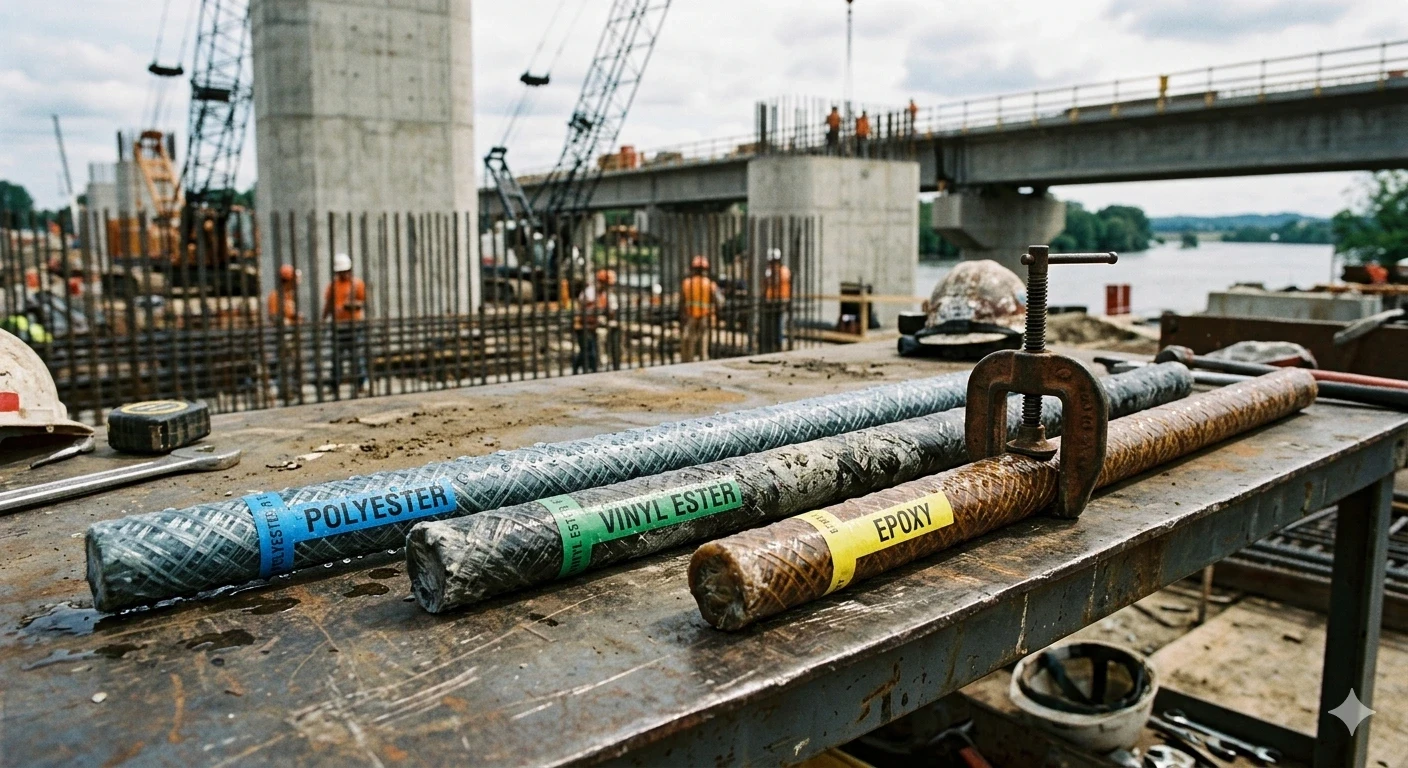
This article covers the three main types of resin used in FRP: polyester, vinyl ester, and epoxy along with where each works, and where it doesn’t. At the end, there's a straightforward application guide to help you specify the right one.
What Resin Actually Does in FRP
NFRP is a two-component material:
- Fiber provides tensile strength.
- Resin does everything else.
The Resin:
- Holds fibers in the correct orientation
- Transfers stress between individual fibers
- Protects fibers from moisture, chemicals, and UV exposure
- Determines bond performance with concrete or other materials
- Influences long-term behavior of product under sustained loads
This means resin selection is not just a material choice, it's a durability and performance decision.
A composite made with high-quality fibers but a poor resin system can degrade from the outside in, often without visible warning signs until performance is compromised.
Understanding the benefits and limitations of FRP as a material helps put this in context. Resin quality is one of the factors that determines whether FRP lives up to its advantages in the field. One more important point: resin type is often not clearly disclosed in product brochures by suppliers. Unless you ask, you may not know what you’re getting.
Types of Resins Used in FRP: A Quick Comparison
Before going into each FRP resin type in detail, here's how they stack up across the properties that matter most in construction:
Property | Polyester | Vinyl Ester | Epoxy |
| Cost | Lowest |
Medium |
Highest |
| Corrosion Resistance |
Low–Moderate |
High |
Very High |
| Mechanical Strength |
Moderate |
High |
Very High |
| Bond to Fiber |
Moderate |
Good |
Excellent |
| Shrinkage During Cure |
High |
Medium |
Low |
| Processing Ease |
Easy |
Moderate |
Difficult |
| Typical Use |
General, non-structural |
Structural, corrosive environments |
High-performance, specialist |
1. Polyester Resin
Polyester is the most widely used resin in FRP manufacturing globally, largely due to its low cost and ease of processing. It cures quickly, is compatible with most fiber types, and works well in high-volume production methods.
Properties of Polyester Resin
- Low cost
- Fast cure time
- Adequate mechanical strength for non-structural applications
- High shrinkage during curing
- Weaker chemical bond with fibers compared to other resins
Where Polyester Resin Works
Polyester is suitable where:
- Structural loads are low
- Environmental exposure is mild
- Cost is the primary constraint
Typical applications include:
- Roofing sheets
- Decorative panels
- Architectural cladding
- Low-pressure pipes
- General-purpose enclosures
Where Polyester Resin Doesn’t Work
- Polyester is not suitable for structural or long-life applications, especially in the presence of moisture or chemicals.
- The key issue is hydrolysis, a process where water gradually breaks down the bond between resin and fiber. Over time, this allows moisture to penetrate deeper into the composite, leading to loss of strength.
- In environments like coastal structures or buried reinforcement, degradation can begin early and accelerate with temperature and chemical exposure. Polyester may be acceptable for short-life or non-structural applications, but it is not appropriate for reinforced concrete, marine environments, or infrastructure with a long design life beyond 15–20 years in exposed conditions.
2. Vinyl Ester Resin
Vinyl ester was developed specifically to address the limitations of polyester, particularly in corrosion resistance and fiber bonding. It offers a balance between performance and processability by sharing some of polyester's processing ease while delivering corrosion resistance and mechanical performance significantly closer to epoxy.
Properties of Vinyl Ester Resin
High resistance to moisture and chemicalsStrong bond with glass fibersLower permeability compared to polyesterBetter elongation before failureModerate shrinkageHigher cost than polyester, though the gap has narrowed as demand has grown
Where Vinyl Ester Resin Works
Vinyl ester is the standard choice for structural FRP in civil applications, including:
- GFRP rebars in reinforced concrete
- Marine and coastal structures
- Water and sewage treatment facilities
- Bridge decks
- Chemical storage (moderate exposure)
The key advantage lies in its performance in alkaline environments. Concrete typically has a pH of 12–13, which can degrade glass fibers over time if not properly protected. Vinyl ester forms a tight, low-permeability barrier that significantly slows this process, helping maintain long-term structural integrity.
Where Vinyl Ester Resin Doesn't Work
- In environments with highly aggressive chemicals such as concentrated acids or strong oxidizing agents, vinyl ester may not provide sufficient resistance.
- These cases are less common in civil infrastructure but relevant in certain industrial applications.
Vinyl ester offers the best balance of durability, corrosion resistance, and cost for most structural FRP applications. When you see a quality GFRP rebar product, vinyl ester resin is almost always part of the specification.
3. Epoxy Resin
Epoxy is the highest-performing resin used in FRP systems. It delivers superior mechanical properties, exceptional bonding, and very low moisture absorption. These qualities have made it the resin of choice in aerospace, defence, and high-performance automotive composites.
Properties of Epoxy Resin
- Excellent tensile and compressive strength
- Very low shrinkage, important for dimensional accuracy and residual stress
- Outstanding adhesion to glass, carbon, and aramid fibers
- High resistance to moisture and chemicals
- Longer processing time
- Significantly higher cost
- Slower to cure, requires more controlled processing conditions
In FRP manufacturing, resin choice is closely tied to the production method. The pultrusion process, which is commonly used to manufacture FRP rebars and structural profiles, can work with all three resin types, but the resin selected directly affects the line speed, processing conditions, and ultimately the quality of the finished product.
Where Epoxy Resin Works
Epoxy is used where performance requirements are critical and cost is secondary:
- Carbon fiber composites (CFRP)
- Aerospace and defence applications
- Structural repair systems
- High-load tendons and cables
- Advanced infrastructure applications
Epoxy in FRP Rebars
While some manufacturers use epoxy in FRP rebars, it is less common due to:
- Higher cost
- More complex processing
In most cases, the performance advantage of epoxy does not justify these trade-offs for standard civil applications.
Epoxy is ideal for high-performance and specialized applications, but not typically necessary for standard reinforced concrete work.
For standard reinforced concrete work, water infrastructure, or coastal structures, vinyl ester gives you what you need at a more reasonable cost.
Choosing the Right Resin Type for the Application
Application | Recommended Resin | Reason |
| GFRP rebars in concrete | Vinyl Ester |
Alkaline resistance, fiber bonding, long-term durability |
| Coastal and marine structures |
Vinyl Ester |
Sustained saltwater and chloride exposure |
| Water and sewage treatment plants |
Vinyl Ester |
Chemical exposure, long service life |
| Bridge deck reinforcement |
Vinyl Ester |
Structural performance + corrosion resistance |
| FRP roofing and cladding panels |
Polyester |
Low structural demand, cost-sensitive |
| Decorative or architectural FRP |
Polyester |
Non-structural, aesthetic application |
| Chemical storage (aggressive media) |
Vinyl Ester / Epoxy |
Depends on specific chemical exposure level |
| CFRP structural composites |
Epoxy |
Maximum fiber bonding and mechanical performance |
| Aerospace or defence FRP |
Epoxy |
High performance requirement, cost not primary |
| Temporary or short-life FRP components |
Polyester |
Short design life, low cost priority |
Resin choice also interacts with how the FRP is designed into a structure. The design considerations for reinforced concrete structures using FRP cover how material properties including those influenced by resin type feed into structural calculations and detailing decisions.
When choosing between vinyl ester and epoxy, the decision usually comes down to exposure severity and budget. In most civil environments, vinyl ester provides sufficient performance at a more practical cost.
What to Ask Your FRP Supplier
Resin type is not always clearly specified. Some suppliers list fiber content and tensile strength but leave resin type vague. To avoid uncertainty, ask:
1. What resin system is used, and what grade?
Not all vinyl esters are the same. There are standard grades and higher-performance grades developed for specific chemical environments. Ask for the resin manufacturer and product name if possible.
2. Can you provide the resin datasheet?
A reputable supplier should be able to share the resin manufacturer's technical datasheet alongside their own product datasheet. If they can't, that's worth noting.
3. What is the chemical resistance rating of the resin in alkaline conditions?
This is particularly relevant for rebars. Alkaline resistance data is available from resin manufacturers and should be part of the product qualification.
4. Does the product comply with IS 17652 or ACI 440?
These standards specify minimum performance requirements for GFRP rebars, and products meeting them will typically use vinyl ester or better resin systems. Compliance is not a guarantee of resin quality on its own, but it's a useful filter.
5. Has the product been independently tested?
Third-party test reports from accredited laboratories carry more weight than internal test data. Ask whether durability testing, particularly alkaline conditioning tests has been conducted.
The Right Resin Type Choice Defines FRP Durability
If you're specifying GFRP rebars, structural FRP profiles, or any FRP product going into a corrosive or demanding environment, vinyl ester is the resin to ask for and to verify before purchasing.
In FRP design, resin selection is not a secondary detail, it is central to long-term performance.
The practical breakdown is straightforward:
- Polyester: suitable for low-cost, non-structural applications
- Vinyl ester: the default choice for structural and infrastructure use for corrosion resistance and long-term performance
- Epoxy: reserved for high-performance, specialized applications
In many cases, failure due to resin choice is gradual and not immediately visible. That makes it even more important to specify the right system upfront.
For most civil engineering applications, particularly GFRP rebars, vinyl ester provides the durability, chemical resistance, and reliability needed for long design lives. High-quality GFRP rebars in the market typically use vinyl ester resin for this reason.
Tapashri Engineering follows this approach in GFRP rebars, using vinyl ester systems selected for alkaline resistance and long-term performance in reinforced concrete. If you're specifying FRP for a project, it’s worth confirming the resin system, not just assuming it.
Frequently Asked Questions (FAQs)
Find clear answers to the most common queries.
-
Which resin is best for GFRP rebars?
-
Why is polyester resin not suitable for structural applications?
Polyester has weaker bonding with fibers and lower resistance to moisture and chemicals, which can lead to gradual degradation in structural environments.
-
Is epoxy better than vinyl ester for FRP?
Epoxy offers higher strength and better bonding, but in most civil applications, vinyl ester provides sufficient performance at a more practical cost.
-
How does resin affect the lifespan of FRP?
Resin controls moisture resistance, chemical durability, and fiber protection, all of which directly impact how long the FRP performs in service.
-
Can FRP fail due to the wrong resin choice?
Yes. Using an unsuitable resin can lead to internal degradation, loss of strength, and reduced service life, often without visible early signs.
-
How can I verify the resin used in an FRP product?
Ask the supplier for the resin type, manufacturer datasheet, and test reports, especially for chemical and alkaline resistance.
Subscribe to Our Newsletter
Get updates on products, research collaborations, and new developments in FRP technology.

Subscribe to Our Newsletter
Subscribe our newsletter and get notifications to stay update