
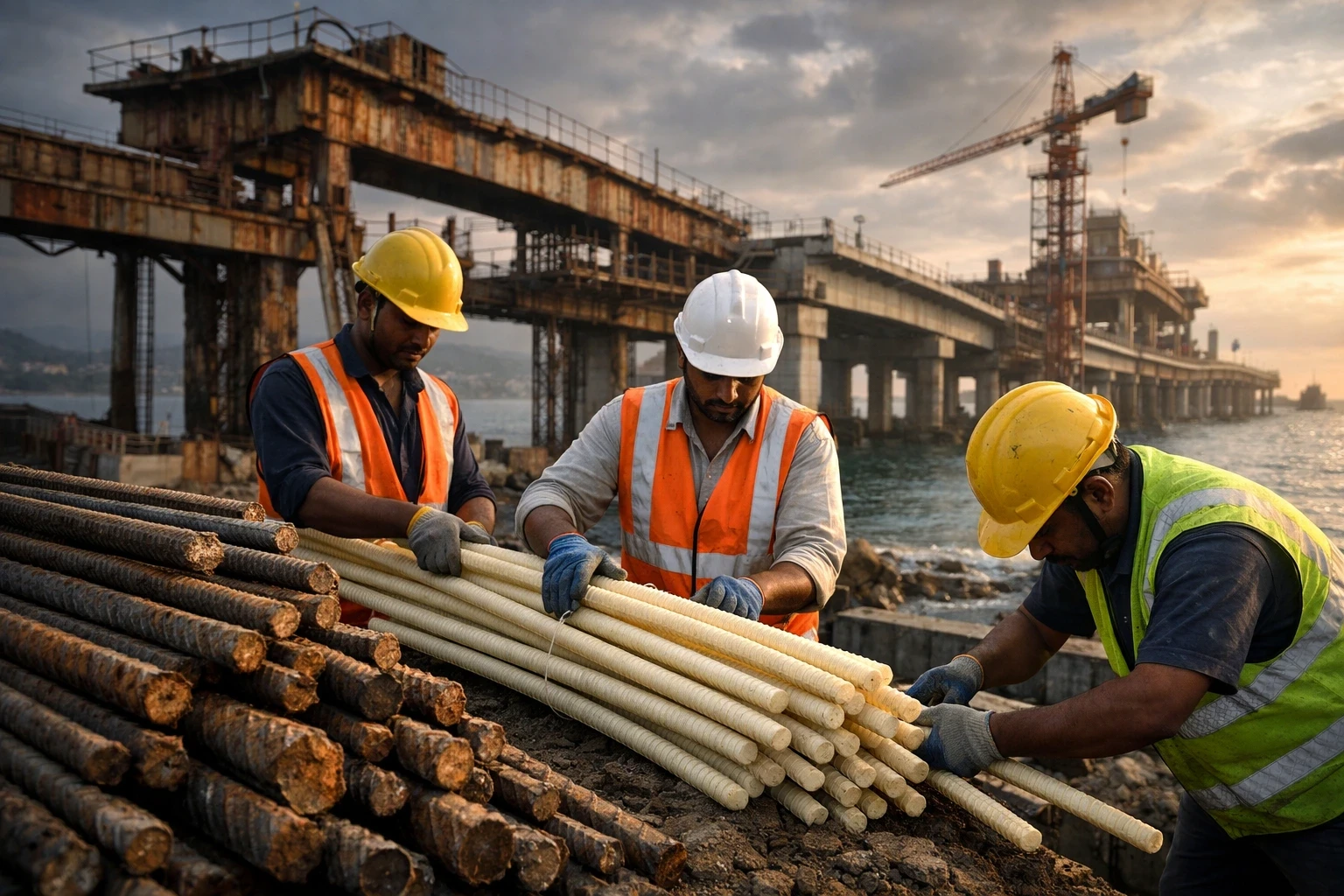
FRP (Fiber Reinforced Polymer) is a corrosion-resistant alternative to steel, used as GFRP rebars in Indian infrastructure like bridges, coastal structures, and water projects.

Resources
13
Apr'26Why FRP Adoption is Slow in India and What's Changing
India is building at scale: roads, bridges, metros, coastal highways, irrigation systems. Infrastructure investment over the past decade has been massive.
And yet, a material that has been used globally for over 30 years: Fiber-Reinforced Polymer (FRP), particularly GFRP rebars, remains largely unfamiliar on Indian construction sites.
This is not because the material lacks relevance. In fact, it fits Indian conditions extremely well.
The real issue? Adoption has been constrained not by performance but by the ecosystem around it.
The Case for FRP in India Is Already Strong
The core properties and advantages of FRP reinforcement are well established:
- Corrosion resistance (critical in coastal and humid environments)
- Lightweight and easy handling
- Non-magnetic and non-conductive
- Long service life with minimal maintenance
In India, where:
- Coastal infrastructure faces constant chloride exposure
- Aging urban structures show widespread corrosion damage
- Maintenance budgets are stretched
…FRPadvantages are directly relevant.
So the question isn’t why FRP works. It’s why adoption hasn’t kept pace.
Top Reasons that Has Slowed FRP Adoption in India
Here’s why the adoption of FRP hasn’t paced up in India.
1. Upfront Cost Dominates Decision-Making
FRP rebars are more expensive than steel on a per-kg basis.
That’s usually where comparisons stop.
What often gets ignored:
- Reduced maintenance costs
- Elimination of corrosion repairs
- Longer service life
Over a 50-year lifecycle, FRP can be more economical, especially where steel fails within 15–20 years due to corrosion. The economics of FRP vs steel look very different over a long span.
But procurement in India is still largely driven by lowest upfront cost, not lifecycle value.
2. Deep-Rooted Reliance on Steel
Steel has been the default for multiple generations of Indian structural engineers.
- Design practices are built around it
- Contractors know how to handle it
- Site processes are optimized for it
Switching to FRP requires:
- New design approaches
- Different detailing practices
- Changes in site handling
- Site-level training for handling and FRP installation
Design considerations for FRP differ from steel in several important ways.
For most stakeholders, sticking with steel feels safer and carries no professional risk.
3. India Had No Formal Standard for a Long Time
For years, India lacked a national standard for FRP reinforcement. Without a code to reference, structural consultants had no formal basis to specify FRP and most weren't going to take that step without one.
That changed with IS 17652 (2021), which established minimum performance requirements for GFRP rebars and understanding FRP specifications is becoming increasingly relevant as more engineers begin working with it
However:
- Awareness remains limited
- Many engineers are still unfamiliar with its application
A standard only helps if it’s widely understood and used.
4. Supply Chain Limitations
Historically, FRP availability in India was inconsistent:
- Heavy reliance on imports
- Limited domestic manufacturers
- Long lead times
- Minimal technical support
- Higher prices
Contractors who tried FRP on one project and faced supply issues were unlikely to specify it again. Reliability matters as much as performance when material decisions are made under project timelines.
5. Lack of Local Case Studies
Indian engineers want local proof.
Global examples from North America or the Middle East don’t fully address:
- Indian climate conditions
- Construction practices
- Load environments
The absence of well-documented Indian projects has made it harder to build confidence among specifiers who were otherwise open to the material.
6. No Institutional Push
In many countries, FRP adoption was accelerated by:
- Government mandates
- Standardization by large consultancies
In India, this kind of institutional push has been largely absent. Adoption has depended on individual engineers or firms taking the initiative, which produces isolated projects rather than sustained market growth.
What’s Changing in FRP and Why It Matters
Now While the barriers haven’t disappeared, they are weakening.
IS 17652 is Gaining Ground
Engineers now have a national standard to reference. As awareness grows, specifying FRP becomes easier and more defensible.
Domestic Manufacturing is Expanding
More Indian manufacturers mean:
- Better availability
- Shorter lead times
- More competitive pricing
- Improved technical support
As more manufacturers adopt established production methods like pultrusion, consistency and quality across domestic supply is also improving.
The Cost of Corrosion is Becoming Visible
Repair and rehabilitation costs are rising.
Agencies managing aging infrastructure are increasingly open to solutions that eliminate corrosion, rather than manage it.
Infrastructure Pipeline Fits FRP Use Cases
Current projects (coastal highways, metros, ports, water systems) are ideal for FRP.
More consultants are being asked to evaluate it seriously, often for the first time.
A New Generation of Engineers
Younger engineers are:
- More exposed to global practices
- Less tied to traditional materials
- More open to performance-driven decisions
International Collaboration
Joint ventures with global firms are:
- Bringing FRP experience into Indian projects
- Creating early local references
- Gradually building confidence
What Needs to Happen Next for FRP
To accelerate adoption, a few gaps need to close:
- Wider awareness of IS 17652 across practicing engineers
- Published Indian case studies with real performance data
- Pilot mandates in corrosion-prone infrastructure
- Practical design guidance tailored to Indian conditions
- Site-level training for handling and installation
FRP: From Alternative Material to Mainstream Consideration
FRP’s slow adoption in India has never been about whether the material works, it clearly does. The challenge has been aligning cost frameworks, standards, supply chains, and on-ground familiarity to support its use at scale.
That alignment is now beginning to take shape.
As awareness of IS 17652 grows, domestic manufacturing strengthens, and more projects begin to demonstrate real-world performance, the case for FRP is becoming harder to ignore, especially for GFRP rebars in corrosion-prone and long-life infrastructure.
The shift may not be immediate, but it is underway. And as the industry gradually moves from upfront cost thinking to lifecycle performance, FRP is likely to move from an alternative option to a standard consideration in Indian infrastructure design.
Companies like Tapashri are working to bridge critical gaps by improving access to GFRP rebars, supporting engineers with specification guidance, and contributing to the broader adoption of FRP in Indian infrastructure.
Frequently Asked Questions (FAQs)
Find clear answers to the most common queries.
-
How is FRP used in India?
-
Why is FRP adoption slow in India?
FRP adoption in India is slow due to higher upfront cost, low awareness of IS 17652, limited case studies, and strong reliance on traditional steel reinforcement.
-
Is GFRP rebar better than steel in Indian conditions?
GFRP rebars perform better than steel in corrosion-prone environments like coastal and humid regions, offering longer service life and lower maintenance.
-
What are the benefits of FRP in construction?
FRP offers corrosion resistance, lightweight handling, durability, non-conductivity, and reduced lifecycle costs in infrastructure projects.
-
Where can FRP rebars be used in India?
FRP rebars are ideal for coastal highways, bridges, metros, marine structures, water treatment plants, and corrosion-prone infrastructure in India.
Subscribe to Our Newsletter
Get updates on products, research collaborations, and new developments in FRP technology.

Subscribe to Our Newsletter
Subscribe our newsletter and get notifications to stay update