
Yes, with scope. GFRP is not recommended as primary reinforcement in a structure's ductile, lateral-force-resisting frame in high seismic zones, but it performs well in foundations, non-lateral elements, and secondary structural members even in Zone IV and V locations.

Resources
12
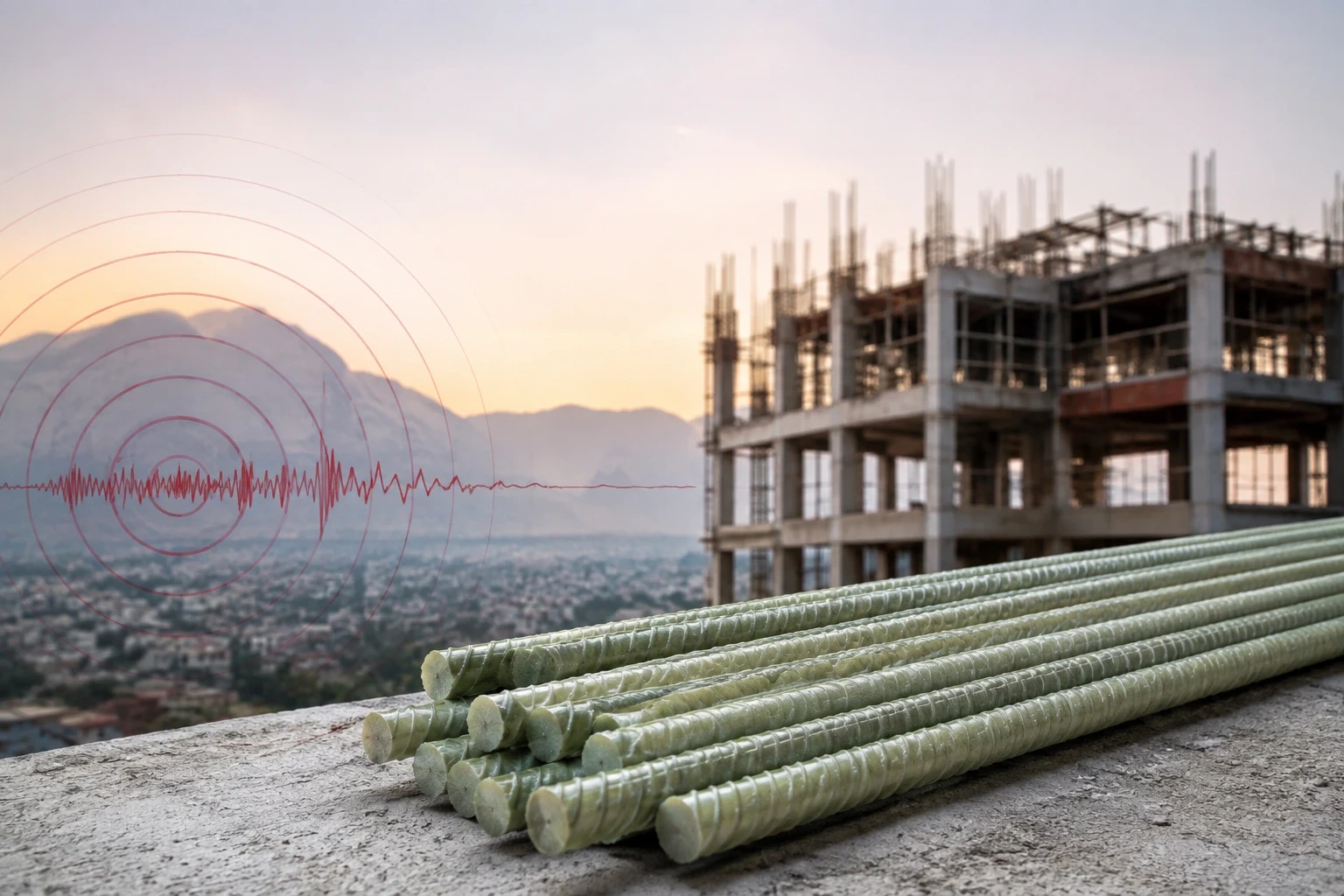
Aug'26GFRP Rebar in Seismic Zones: What Engineers Need to Know
A structural consultant we’ve worked with put it simply during a project review:
// “I like everything about GFRP rebar until someone says the word ductility.”
It’s a fair concern, and usually the first objection that comes up when GFRP is considered for projects in Gujarat’s Kutch region, the Himalayan belt, or the North-East: India's highest-risk seismic zones.
So let’s address it directly, the way we would in a design meeting:
Can GFRP rebar be used in earthquake-prone regions of India?
The honest answer is: yes, but not everywhere and not as a direct replacement for steel in every structural application.
The suitability of GFRP depends on where it is used within the structure, how the element participates in the seismic-force-resisting system, and what the governing design provisions permit.
This guide explains what the ductility concern actually means, how international codes approach GFRP in seismic applications, and where GFRP can be a practical and defensible choice, even on projects located in India's higher seismic zones.
India's Seismic Zones
India's seismic zoning framework classifies the country into four zones based on the expected level of seismic hazard.
Zone |
Risk Level |
Zone Factor (Z) |
Example Regions |
|---|---|---|---|
| Zone II | Low | 0.10 | Parts of peninsular India |
| Zone III | Moderate | 0.16 | Parts of Gujarat, Maharashtra, West Bengal and other regions |
| Zone IV | High | 0.24 | Delhi-NCR and parts of Bihar, Uttarakhand, Jammu & Kashmir |
| Zone V | Very High | 0.36 | Kutch, parts of the Himalayas, North-East India, Andaman & Nicobar Islands |
Note: Seismic-zone classification and the applicable design provisions should always be verified against the latest applicable revision of the relevant Indian Standards and the specific project location.
Why does this matter when selecting reinforcement? As seismic demand increases, the ductility and energy-dissipation capacity of the structural system become increasingly important.
The Core Issue: Why Ductility is Important in Seismic Design
The concern around GFRP in seismic applications starts with one fundamental difference between GFRP and conventional reinforcing steel: how the material behaves as it approaches failure.
Steel reinforcement can yield under extreme loading. It can bend and undergo significant plastic deformation before reaching failure. In a properly designed seismic structure, this behavior can be deliberately used to dissipate earthquake energy through controlled inelastic deformation at designated locations, such as plastic hinges.
That deformation provides the structure with a degree of ductility and energy dissipation.
GFRP behaves differently. It is generally linear-elastic until failure. It does not exhibit the same yielding plateau as steel. Once its ultimate tensile capacity is reached, failure can occur without the substantial plastic deformation associated with yielding steel.
This is an inherent material characteristic, not a durability problem or a manufacturing shortcoming. And it is precisely why GFRP cannot simply be treated as a one-for-one substitute for steel in highly ductile seismic-force-resisting systems.
What International Codes Say About GFRP in Seismic Applications
India has established specifications for GFRP reinforcement, but a dedicated Indian seismic design framework for GFRP-reinforced concrete is still developing.
As a result, international guidance, particularly the ACI and CSA frameworks, is useful for understanding how GFRP is treated in seismic design.
ACI 440.11-22
The ACI 440.11-22 building code provides design provisions for GFRP-reinforced concrete and differentiates its application based on Seismic Design Category (SDC).
Broadly, it permits GFRP in lower seismic categories while placing restrictions on its use in elements that form part of the seismic lateral-force-resisting system as seismic demands increase.
For the highest seismic design categories, GFRP is not treated as a direct substitute for conventional ductile reinforcement in primary seismic structural members.
The important point is that the restrictions are application-specific.
They do not mean that GFRP reinforcement cannot be used anywhere on a building simply because the building is located in a seismic zone.
ACI 440.1R
- ACI 440.1R provides guidance for the design and construction of concrete reinforced with FRP bars.
- It recognizes applications where GFRP can be advantageous while highlighting the limitations associated with its lack of yielding and lower modulus of elasticity compared with steel.
- This distinction becomes particularly important when considering elements that are part of a ductile moment-resisting system.
CSA S806 and CSA S807
Canadian standards and guidance also recognize FRP reinforcement and provide a framework for its use in concrete structures.
Research and design approaches have explored hybrid reinforcement systems, where GFRP is combined with steel or other reinforcement materials to take advantage of corrosion resistance while retaining the ductility associated with steel.
The broader pattern is consistent:
- The primary concern is GFRP as the sole reinforcement in highly ductile, seismic-force-resisting members, not the use of GFRP throughout an entire seismic-zone project.
Where Does This Leave Indian Design Practice?
India now has IS 18256:2023, which establishes requirements for GFRP reinforcement, including material properties, testing and quality requirements.
However, material specification and structural design methodology are two different things.
The existence of a standard for GFRP reinforcement does not automatically mean that GFRP can be substituted for steel in every structural application.
For seismic projects, the structural engineer must consider:
- The seismic demand on the structure
- Whether the element forms part of the seismic-force-resisting system
- The required ductility and energy-dissipation mechanism
- GFRP's tensile and bond characteristics
- Development and anchorage requirements
- Serviceability and deflection
- Appropriate detailing provisions
- The applicable Indian and international design guidance
In practice, engineers evaluating GFRP may therefore reference IS 1893, IS 18256, and applicable FRP design guidance such as ACI 440 provisions, depending on the project and engineering approach.
GFRP is Not a 1:1 Steel Replacement
This is perhaps the most important practical point.
Specifying GFRP does not mean taking the existing steel reinforcement schedule and replacing every steel bar with a GFRP bar of the same diameter.
GFRP has different:
- Tensile behavior
- Elastic modulus
- Bond characteristics
- Anchorage requirements
- Shear-related considerations
- Deflection behavior
- Durability characteristics
The reinforcement therefore needs to be designed for the specific application, rather than substituted on a diameter-for-diameter basis.
For seismic-zone projects, that makes early coordination between the structural designer, contractor and GFRP supplier particularly important.
Where GFRP Can Perform Well in Seismic Zones
The ductility limitation becomes much less restrictive when GFRP is used in elements that do not rely on yielding reinforcement to dissipate earthquake energy. This opens up several practical applications.
1. Foundations and Compression-Controlled Elements
Certain foundation applications can be suitable for GFRP, particularly where the reinforcement is not being relied upon as the primary source of ductility in a seismic-force-resisting system.
GFRP's resistance to corrosion can also provide a significant durability advantage where foundations are exposed to aggressive soil or groundwater conditions.
The specific element still needs to be checked by the structural engineer against the applicable design requirements.
2. Secondary Structural Elements
GFRP can be considered for secondary structural components that are not part of the building's primary lateral-force-resisting system.
Examples include:
- Slabs
- Secondary beams
- Certain precast elements
- Non-primary structural components
Being located inside a Zone IV or Zone V building does not automatically make every individual structural element part of the seismic-force-resisting system. That distinction is critical.
3. Non-Structural Applications
GFRP can also be used in applications where seismic ductility is not the governing design requirement.
Examples include:
- Walkways
- Cable trays
- Ladders
- Cladding supports
- Certain boundary-wall applications
- Utility and infrastructure components
These applications can benefit from GFRP's corrosion resistance without introducing it into the primary ductile frame.
4. Coastal and Seismic Regions
This is particularly interesting for regions such as Kutch and coastal Gujarat, where two design challenges can overlap:
Seismic demand + aggressive environmental exposure.
Steel reinforcement can be vulnerable to corrosion when concrete structures are exposed to chlorides, saline environments or other aggressive conditions.
GFRP does not corrode in the same way as conventional steel reinforcement.
This can make GFRP particularly attractive for suitable non-lateral structural and infrastructure applications in coastal seismic regions, provided its use is compatible with the structural design.
5. Hybrid GFRP + Steel Systems
Hybrid reinforcement is another area receiving attention.
The basic concept is straightforward:
Use GFRP where corrosion resistance provides the greatest benefit, while retaining steel where ductility and energy dissipation are essential.
For example, a structural system could potentially use conventional reinforcement in critical seismic-force-resisting members while using GFRP in suitable secondary or durability-critical components.
Hybrid systems are an evolving area of research and engineering practice, however, so they should be designed and detailed specifically for the project rather than treated as an established universal solution.
Key Design Considerations for GFRP Near Seismic Elements
When GFRP is selected for a seismic-zone project, the reinforcement schedule and detailing should account for its different mechanical behavior.
- Larger cross-sections or closer bar spacing, to compensate for the absence of yielding
- Extended development and lap splice lengths, generally 2 to 3 times the steel equivalent
- Deflection control governing the design more than strength, since GFRP's modulus of elasticity is roughly a quarter that of steel
- Sand-coated or helically wrapped bar surfaces, to ensure adequate bond strength with concrete
- Factory-formed bends only. GFRP bar bends are not made on site the way steel is field-bent, and minimum bend radius is typically around 10 times the bar diameter
Quick Decision Framework
The following provides a high-level starting point, not a substitute for project-specific structural design.
Application |
Is GFRP a Potential Fit? |
|---|---|
| Primary ductile moment-resisting frame in high seismic demand | Generally not suitable as a direct steel replacement |
| Primary seismic-force-resisting system | Requires careful code-based evaluation |
| Foundations and suitable compression-controlled elements | Potentially yes, with proper design |
| Secondary beams and slabs outside the lateral system | Potentially yes |
| Coastal infrastructure exposed to corrosion | Often a strong candidate |
| Culverts and suitable infrastructure elements | Potentially yes |
| Walkways, ladders and cable trays | Generally suitable where structurally appropriate |
| Boundary walls and other non-lateral elements | Potentially suitable |
| Hybrid GFRP + steel systems | Promising, but requires project-specific engineering |
The key question shouldn't simply be: “Is the project in a seismic zone?”
Instead, ask:
“Is this particular element part of the system that needs ductility and controlled energy dissipation during an earthquake?”
That question leads to a much more useful engineering decision.
GFRP in Seismic Zones
GFRP's lack of yielding is a genuine limitation and it shouldn't be ignored or marketed away.
But that limitation also shouldn't lead to the opposite conclusion that GFRP cannot be used anywhere in seismic regions.
The more accurate approach is to separate the structure into its different functional components.
- For primary ductile seismic-force-resisting frames, conventional steel or an appropriately engineered alternative may remain the preferred solution.
- For foundations, secondary structural elements, non-lateral components and corrosion-critical infrastructure, however, GFRP can offer substantial durability advantages without being asked to perform a function for which its material behavior is poorly suited.
In other words: Seismic zone does not automatically rule out GFRP. The structural role of the reinforcement determines whether GFRP makes sense.
Tapashri Engineering works with structural teams to identify where GFRP rebar is technically appropriate in seismic-zone projects and supplies IS 18256-compliant GFRP reinforcement for durability-critical applications.
Frequently Asked Questions (FAQs)
Find clear answers to the most common queries.
-
Can GFRP rebar be used in earthquake-prone areas of India?
-
Why is GFRP not recommended for ductile moment frames?
Because GFRP is linear-elastic to failure and doesn't yield the way steel does. Ductile moment frames rely on yielding to absorb and dissipate earthquake energy, which GFRP's material behavior doesn't provide.
-
Is GFRP rebar allowed in Zone V regions like Kutch?
It can be used for foundations, non-lateral elements, and applications like culverts, boundary walls, and coastal infrastructure, but not as primary reinforcement in the seismic-force-resisting system, consistent with ACI 440.1R/440.11 guidance.
-
What is hybrid GFRP-steel reinforcement, and does it solve the ductility issue?
It's an approach that combines GFRP with steel or stainless steel in the same member, aiming to pair GFRP's corrosion resistance with steel's ductility. It's an active area of research and not yet standard Indian practice, but it's a promising direction for future seismic-zone applications.
-
Does IS 18256:2023 cover seismic design provisions?
No. IS 18256:2023 covers GFRP rebar material specification and quality requirements. India does not yet have a dedicated seismic design code for GFRP-reinforced concrete, so current practice references ACI 440.1R and ACI 440.11 alongside IS 1893's seismic zone provisions.
Subscribe to Our Newsletter
Get updates on products, research collaborations, and new developments in FRP technology.

Subscribe to Our Newsletter
Subscribe our newsletter and get notifications to stay update