
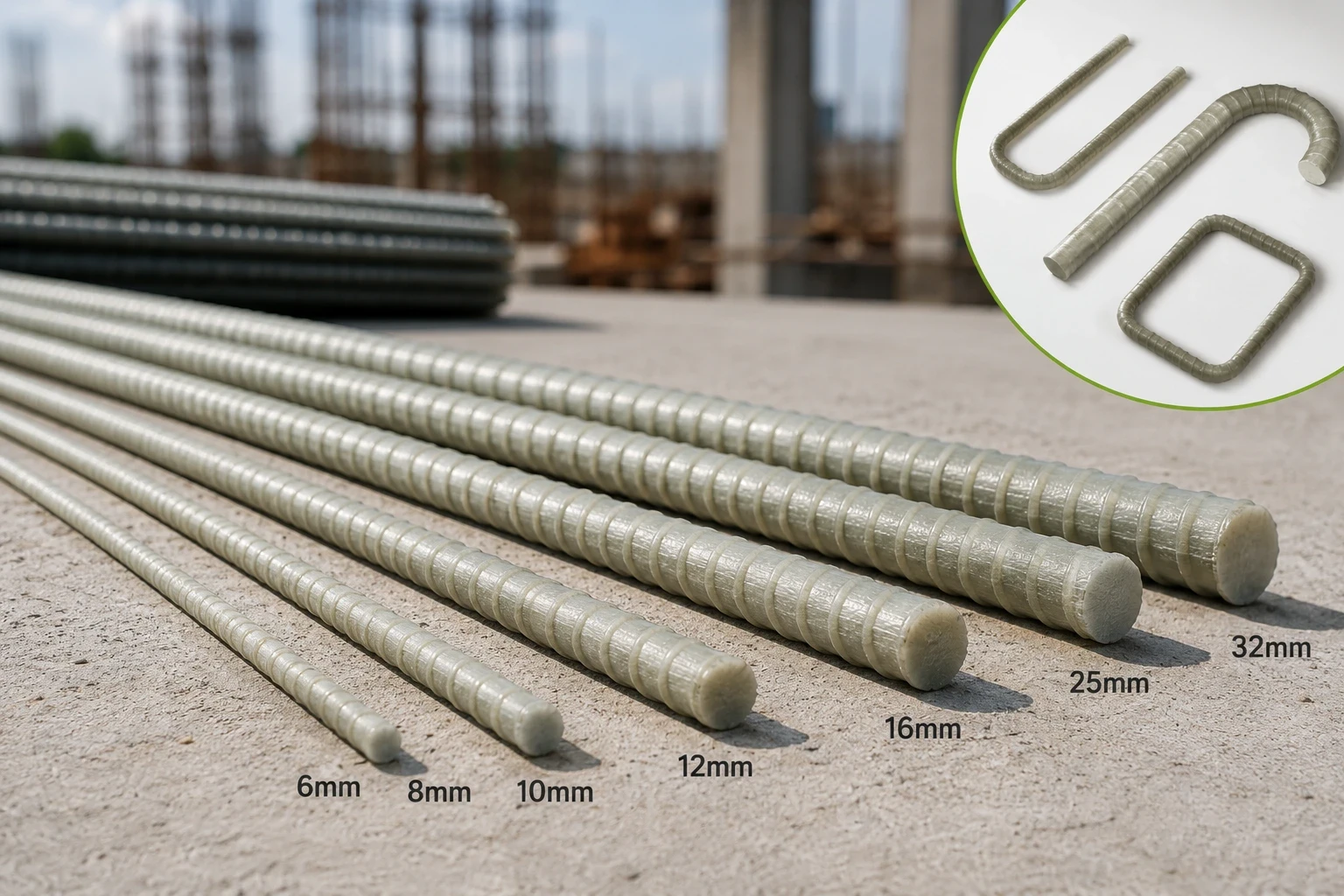
Standard GFRP rebar sizes typically range from 6 mm to 32 mm as specified in IS 18256:2023. Some manufacturers also offer smaller diameters (4 mm) for lightweight applications and larger diameters up to 40–50 mm for heavy infrastructure projects. The appropriate size depends on structural loads, span length, and serviceability requirements.

Resources
8
Jul'26GFRP Rebar Sizes and Diameter Selection Guide
Choosing the right rebar diameter is one of the most important decisions in reinforced concrete design. While engineers have decades of experience selecting steel rebar sizes, Glass Fiber Reinforced Polymer (GFRP) rebar follows different design principles than FRP materials are broadly known for. Simply replacing steel with the same GFRP diameter can lead to excessive deflection, wider cracks, and inefficient designs.
Unlike steel, GFRP has a lower elastic modulus, higher tensile strength, and linear-elastic behavior, meaning serviceability often governs design rather than ultimate strength.
This guide explains the standard GFRP rebar sizes, how diameter selection differs from steel, and the key factors engineers should consider when choosing the right bar for their project.
Standard GFRP Rebar Diameter Range
According to IS 18256:2023, the Bureau of Indian Standards specification for solid round GFRP bars, GFRP rebars are commonly manufactured in diameters ranging from 6mm to 32mm, covering most residential, commercial, and infrastructure applications. These sizes and tolerances are part of the broader FRP specifications engineers should reference during design.
Some manufacturers also offer:
- 4mm bars for lightweight or specialized applications
- 40–50mm bars for heavy infrastructure projects
- Custom diameters for project-specific requirements
Bent products such as stirrups, hooks, L-bars, and U-bars are generally available in a narrower range (typically 6mm to 25mm) due to manufacturing limitations associated with bending.
Diameter |
Typical Application |
|---|---|
| 6–10mm | Slabs, pavements, boundary walls, stirrups |
| 12–16mm | Beams, columns, residential and commercial structures |
| 16–25mm | Bridges, retaining walls, heavier industrial structural elements |
| 25–32mm | Heavy infrastructure, marine works, high-load applications |
Why You Can't Simply Replace Steel Sizes for GFRP
One of the most common mistakes in GFRP design is assuming that a steel bar can simply be replaced with a GFRP bar of the same diameter.
Although GFRP typically offers 2 to 2.6 times the tensile strength of conventional steel, its elastic modulus is only around 40–60 GPa, compared to approximately 200 GPa for steel.
This means that under the same loading:
- GFRP bars stretch more than steel.
- Structural members experience greater deflection.
- Crack-width control becomes more critical.
The bar remains elastic until failure, it does not yield like steel.
As a result, strength is rarely the governing design criterion for GFRP reinforcement.
Instead, engineers often design for:
- Deflection limits
- Crack-width control
- Serviceability requirements
This is why GFRP designs frequently use slightly larger diameters or closer bar spacing, even when a smaller bar would satisfy ultimate strength requirements.
Key Factors That Influence GFRP Rebar Diameter Selection
Selecting the appropriate GFRP diameter requires balancing multiple FRP design considerations rather than relying on strength calculations alone.
1. Structural Element
Different structural members have different governing criteria.
For example:
- Slabs are usually controlled by deflection.
- Beams require both flexural strength and serviceability checks.
- Columns demand adequate confinement and load capacity.
- Pavements focus on crack control and durability.
2. Load and Span
As spans increase, member stiffness becomes increasingly important.
Longer spans often require larger bar diameters, reduced spacing, additional reinforcement to satisfy serviceability requirements.
3. Deflection and Crack Width
Because GFRP has a lower modulus of elasticity than steel, deflection and crack width are often the governing design checks.
These serviceability limits frequently determine the final bar diameter, even when strength calculations indicate a smaller bar would be sufficient.
4. Concrete Cover and Reinforcement Spacing
Larger diameter bars require greater concrete cover, adequate spacing, and proper bond development.
Maintaining these detailing requirements ensures effective load transfer and long-term durability.
5. Environmental Exposure
One of GFRP's biggest advantages is its corrosion resistance.
For structures exposed to marine environments, coastal regions, chemical plants, wastewater facilities, de-icing salts, engineers may optimize bar diameter and spacing to maximize durability while minimizing maintenance.
6. Development Length
This is another important difference between steel and GFRP.
Because GFRP behaves differently in bond, it generally requires 30–60% longer development lengths than steel bars of the same diameter, as outlined in ACI 440.1R-15.
Larger diameters therefore require proportionally longer anchorage lengths, which can influence member detailing, lap splice lengths, material quantities, and overall project cost.
// Also, Explore GFRP Rebar Price Per Kg
Recommended Diameter by Application
Although every project requires structural design calculations, the following ranges are commonly used.
Application |
Typical Diameter |
|---|---|
| Slabs and pavements | 8–12 mm |
| Residential beams | 12–16 mm |
| Commercial beams | 16–20 mm |
| Columns | 12–20 mm |
| Bridges and retaining walls | 16–32 mm |
| Heavy infrastructure | 25–32 mm |
| Dowel bars | As specified by IRC 137:2022 |
Straight Bars vs. Bent Bars
Not all GFRP reinforcement products are manufactured in the same way.
Straight Bars
Straight bars are produced through a continuous pultrusion process and are available across the complete standard diameter range.
Bent Bars
Bent bars including stirrups, hooks, L-bars, U-bars are manufactured differently.
The bar is partially cured, bent to the required shape, and then fully cured under controlled heat.
This leads to one critical rule:
- GFRP bars cannot be bent on-site.
Attempting to bend a fully cured GFRP bar using conventional steel rebar bending equipment will permanently damage or fracture the reinforcement.
Projects requiring bent reinforcement should provide a complete Bar Bending Schedule (BBS) before manufacturing begins, including bend angles, bend radii, leg lengths, hook details, and quantities. Proper planning (covered in more detail in our FRP installation guidelines) avoids production delays and ensures accurate fabrication.
Relevant Standards for Diameter and Design
IS 18256:2023
The Indian Standard covering:
- Standard GFRP bar diameters
- Manufacturing tolerances
- Mechanical properties
- Material requirements
It establishes product specifications but does not provide complete structural design procedures.
IRC 137:2022
India's design guideline for GFRP reinforcement used in road-sector infrastructure (roads, bridges, culverts, retaining walls). It adapts international design principles to Indian loading conditions and safety factors.
ACI 440.1R-15
The internationally recognized reference for structural design using FRP reinforcement.
It includes equations for:
- Flexure
- Shear
- Deflection
- Crack-width control
- Development length
- Serviceability
Many engineers in India use ACI 440 alongside IS 18256 for structural design.
Common Mistakes to Avoid
Avoid these frequent design and procurement errors:
- Replacing steel with the same GFRP diameter without recalculating serviceability.
- Designing only for strength while ignoring deflection and crack-width limits.
- Underestimating the longer development length required for GFRP.
- Ordering bent reinforcement without a finalized Bar Bending Schedule.
- Comparing only the cost per bar instead of evaluating the total installed cost, where larger diameters may reduce reinforcement quantity and labour.
A Simple Diameter Selection Framework
When selecting GFRP reinforcement, follow this sequence:
- Identify the structural element (slab, beam, column, pavement, bridge, dowel, etc.).
- Determine design loads and span lengths.
- Perform strength calculations.
- Check deflection and crack-width requirements.
- Verify concrete cover and reinforcement spacing.
- Confirm development length and detailing.
- Validate the design against IS 18256:2023, IRC 137:2022 (where applicable), and ACI 440.1R-15.
Choose the Right GFRP Rebar Diameter for Long-Term Performance
Selecting the correct GFRP rebar diameter involves much more than matching the size of an equivalent steel bar. While GFRP provides significantly higher tensile strength and outstanding corrosion resistance, its lower stiffness and linear-elastic behavior shift the design focus toward deflection, crack-width control, and serviceability.
By considering structural application, span, loading, development length, and applicable design standards, engineers can select the most efficient diameter for long-term structural performance, part of the broader momentum behind GFRP adoption in India.
Whether you're designing a residential building, bridge, industrial structure, or marine project, selecting the right GFRP rebar size at the design stage helps avoid costly revisions and ensures the full benefits of composite reinforcement are realized.
If you need assistance selecting the right GFRP rebar diameter, bent shapes, or reinforcement schedule for your project, our team at Tapashri Engineering can help you identify the optimal specification and prepare a project-specific bar schedule tailored to your structural requirements.
Frequently Asked Questions (FAQs)
Find clear answers to the most common queries.
-
What are the standard GFRP rebar sizes?
-
Can GFRP rebar replace steel rebar of the same diameter?
No. GFRP rebar should not be substituted for steel on a one-to-one diameter basis. Although GFRP has much higher tensile strength, it has a lower modulus of elasticity, resulting in greater deflection under load. Engineers should recalculate the design for deflection, crack width, and development length before selecting an equivalent GFRP rebar size.
-
How do I choose the right GFRP rebar diameter?
Selecting the correct GFRP rebar diameter involves evaluating several factors, including the structural element, design loads, span length, deflection limits, crack-width requirements, concrete cover, reinforcement spacing, and development length. Engineers should design according to applicable standards such as IS 18256:2023, IRC 137:2022, and ACI 440.1R-15.
-
Can GFRP rebar be bent on-site?
No. Unlike steel reinforcement, GFRP rebar cannot be bent after manufacturing. Bent shapes such as stirrups, hooks, L-bars, and U-bars must be fabricated during production using controlled manufacturing processes. Any required bent bars should be specified in the project's Bar Bending Schedule (BBS) before ordering.
-
Where is GFRP rebar commonly used?
GFRP rebar is widely used in structures where corrosion resistance and long service life are critical. Common applications include bridges, marine structures, retaining walls, industrial facilities, wastewater treatment plants, parking structures, pavements, and coastal construction. It is also increasingly used in residential and commercial reinforced concrete projects to reduce maintenance and improve durability.
Subscribe to Our Newsletter
Get updates on products, research collaborations, and new developments in FRP technology.

Subscribe to Our Newsletter
Subscribe our newsletter and get notifications to stay update