
GFRP is used in coastal infrastructure in India because it does not corrode in chloride-rich environments, making it ideal for marine structures, bridges, and seawalls exposed to saltwater and humidity.

Resources
30
Apr'26The Role of GFRP in Coastal & Marine Infrastructure in India
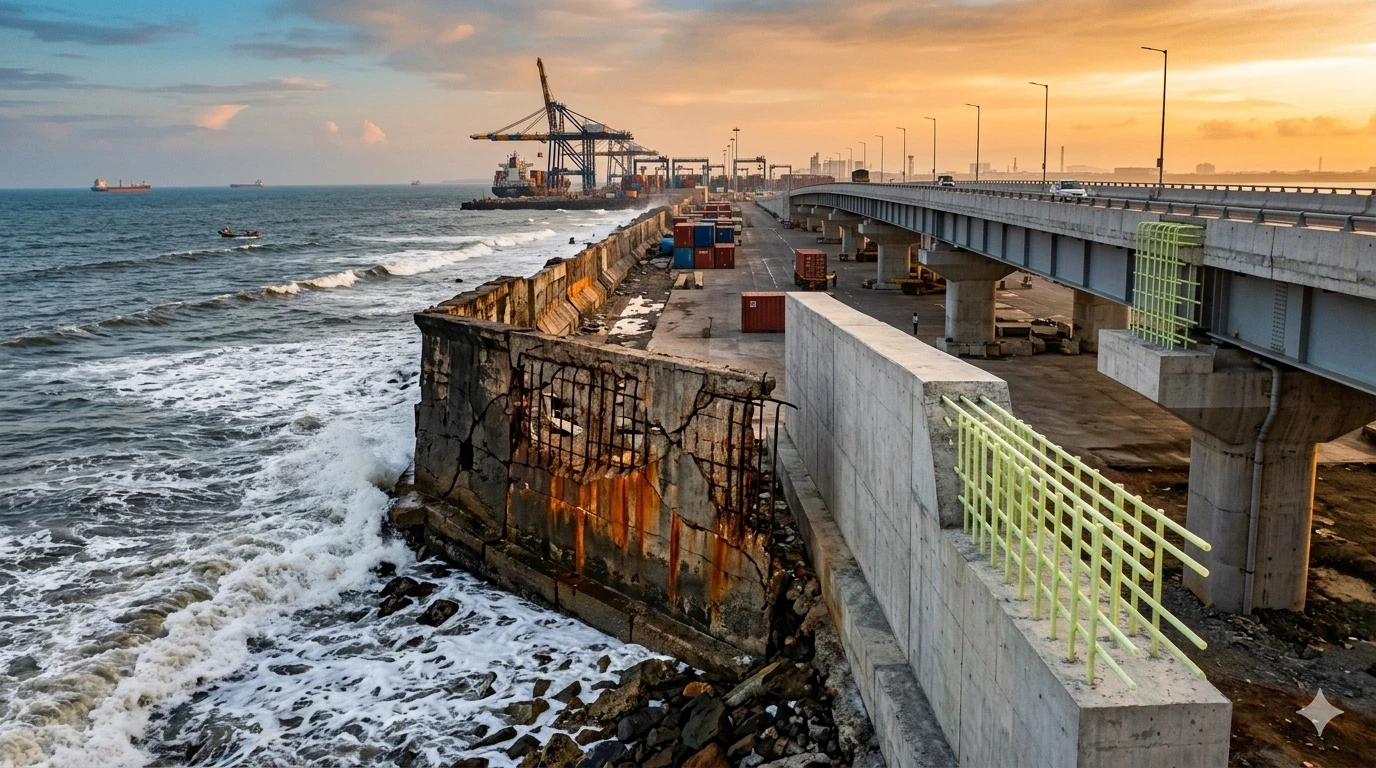
India’s 7,517 km coastline is no longer a passive geographic feature, it is an active construction zone.
- Ports are expanding.
- Coastal highways are being built.
- Bridges, culverts, seawalls, and water infrastructure are rising across Gujarat, Maharashtra, Tamil Nadu, Kerala, Andhra Pradesh, and Odisha.
Large-scale programs like Sagarmala and Bharatmala are driving hundreds of projects in salt-laden, high-humidity environments. And most of them are still being reinforced with steel.
That is the core problem. Steel performs adequately in controlled, inland environments. But in coastal conditions where chloride-rich air, constant moisture, and monsoon cycles dominate, its performance deteriorates far earlier than design assumptions predict.
GFRP rebar does not corrode. That is not a marketing claim. It is a material property.
This blog explains why coastal and marine infrastructure in India is exactly the application GFRP was built for and what engineers and project teams should know before specifying.
Why Coastal Environments in India Cause Early Failure of Steel-Reinforced Concrete
Concrete is not waterproof. Over time, chloride ions from seawater and salt-laden air penetrate through it and reach the embedded reinforcement.
Once chlorides reach steel:
- The protective oxide layer breaks down
- Corrosion begins
- Steel expands (up to 6× its original volume)
- Internal pressure cracks the concrete
- Spalling and structural damage follow
The critical issue is timing.
Visible damage (cracks, rust stains, concrete spalling) appears years after corrosion has already progressed internally.
Coastal vs Inland Reality
- Inland structures: 30–40 years before critical deterioration
- Coastal India: 12–20 years in aggressive exposure
This is a well-documented failure pattern across coastal infrastructure globally.
Steel-reinforced structures built today along India’s coastline are highly likely to require major rehabilitation well before their intended service life.
Why GFRP Outperforms Steel in Marine & Coastal Conditions
GFRP (Glass Fibre Reinforced Polymer) is not a coated or treated steel. It is a composite material made of glass fibres embedded in a polymer resin matrix.
That distinction changes everything.
- No iron
- No electrochemical reaction
- No corrosion mechanism
Chlorides may still penetrate concrete but they have no effect on GFRP.
In a coastal environment, this changes everything about long-term structural behaviour.
Key Advantages of GFRP for Coastal & Marine Construction Projects
Beyond corrosion resistance, GFRP offers practical advantages for coastal construction specifically:
1. Corrosion Immunity
The primary failure mode of steel simply does not exist.
2. Lightweight (≈75% lighter than steel)
- Easier transportation to remote coastal sites
- Reduced crane and handling requirements
- Lower logistical costs (especially for marine/offshore work)
3. Reduced Concrete Cover
- Steel: 50–75 mm concrete cover required to delay chloride ingress
- GFRP: 20–25 mm sufficient
This leads to:
- Less concrete usage
- Reduced structural weight
- Potential foundation cost savings
4. Non-Magnetic & Non-Conductive
Important for:
- Port infrastructure
- Electrified environments
- Sensitive instrumentation zones
A full breakdown of how these properties compare with steel is covered in our analysis of FRP vs steel reinforcement.
Applications of GFRP in India’s Coastal Infrastructure Projects
1. Coastal Bridges & Culverts (Bharatmala)
Bharatmala Pariyojana includes thousands of kilometres of coastal road corridors. Constant exposure to salt spray and humidity makes these structures highly vulnerable.
Best applications:
- Bridge decks
- Parapets
- Approach slabs
- Culvert walls
2. Ports, Jetties & Marine Structures (Sagarmala)
Piles, beams, and deck slabs in port infrastructure are in direct or near-direct contact with seawater. The Sagarmala Programme includes expansion of major ports and development of new ones along India's entire coastline.
These structures face the most aggressive conditions like tidal cycles, continuous wetting and drying, and high chloride concentration.
Steel in this environment requires:
- Epoxy coatings
- Cathodic protection
- Frequent maintenance
GFRP eliminates these requirements entirely.
3. Seawalls & Coastal Retaining Structures
Used to protect roads, ports, and coastal settlements.
GFRP ensures:
- Longer service life
- Minimal maintenance
- No corrosion-driven deterioration
4. Coastal Water Supply & Drainage Infrastructure
Jal Jeevan Mission and AMRUT are funding water infrastructure in hundreds of coastal towns. Pump houses, overhead tanks, distribution pipework supports, and drainage structures in these locations sit in the same corrosive environment as roads and bridges.
GFRP is well-suited for these secondary structural elements where maintenance access is limited and long service life is essential.
5. Desalination Plants
Desalination is growing in water-stressed coastal states including Gujarat, Tamil Nadu, and Andhra Pradesh.
Among the most aggressive environments:
- High salinity
- Chemical exposure
- Continuous moisture
GFRP remains chemically inert, unlike steel.
Design Considerations for GFRP Rebar
GFRP must be designed for, not substituted casually.
Relevant Indian Standards:
- IS 17652:2021 → Indian standard for GFRP bars, covering mechanical and durability requirements
- IRC 137:2022 → Governs use of FRP bars in Indian road infrastructure projects
These standards provide a formal framework for specifying Detailed Project Reports (DPRs) and government tenders.
Engineers no longer need to rely solely on international codes.
Key Design Differences Between GFRP & Steel
- GFRP has higher tensile strength but lower elastic modulus. Deflection and crack width typically govern design, not strength.
- It cannot be bent on-site; bars must be pre-fabricated in the correct geometry.
- Lap splice lengths are longer than steel equivalents.
- No yielding behaviour. Connections and terminations require specific detailing.
Engineers specifying GFRP for the first time will find it useful to go through how FRP is designed for structural applications and the key mechanical and durability specifications of FRP.
Lifecycle Cost of GFRP vs Steel in Coastal Infrastructure
Comparing GFRP and steel on per kg cost is misleading. The correct approach is comparing the lifecycle cost between Steel and GFRP over 30–50 years.
Steel in Coastal Conditions
- Maintenance begins: 15–20 years
- Activities: crack repairs, patching, structural rehabilitation
- Major repairs can cost 30–50% of original construction
GFRP Performance
- No corrosion-driven maintenance
- Minimal intervention required
The lifecycle savings particularly in coastal India offsets the higher upfront material cost.
Break-Even Analysis
- Break-even: 5–8 years
- Beyond that: GFRP is the cheaper option
Practical Limitations of GFRP Rebar in Construction Projects
A realistic assessment includes the constraints.
1. No Field Bending
GFRP cannot be field-bent. Design must be finalised before fabrication. This requires earlier coordination between structural consultants and the material supplier than steel typically demands.
2. Higher Initial Cost
The higher upfront cost remains a barrier in price-driven tendering. Projects evaluated purely on capital cost will default to steel. This is where engineers and consultants play a critical role by ensuring lifecycle cost arguments are included in DPRs and evaluation frameworks, particularly for government clients.
3. Site Handling Differences
Teams need basic orientation on cutting, placement, and storage. These are not barriers but they do require planning. The practical requirements for handling and installing FRP on site are worth reviewing before mobilisation.
Why Engineers Should Specify GFRP Early in Coastal Infrastructure Design
India’s coastal infrastructure push is happening today.
Projects under:
- Sagarmala
- Bharatmala
- Jal Jeevan Mission
- Smart Cities
…are being designed and executed right now.
The reinforcement choices made at this stage will determine whether structures last:
- 20 years (steel in coastal exposure) or
- 50–60 years (with GFRP)
Once built, the only options are:
- Maintenance
- Rehabilitation
- Replacement
All of which are significantly more expensive than getting it right at the start.
GFRP: The Right Choice for Long-Life Coastal Infrastructure in India
GFRP is not experimental. It is not untested. It is not unavailable.
It is:
- Standardised in India
- Proven globally
- Specifically suited for coastal environments
The question is whether it is being considered at the right stage during specification.
At Tapashri Engineering, we manufacture GFRP rebars in Surat and work closely with structural engineers, consultants, and project teams across India.
If you are working on a coastal or marine infrastructure project and want to evaluate whether GFRP is suitable for your application, reach out to our team for technical guidance.
Frequently Asked Questions (FAQs)
Find clear answers to the most common queries.
-
Why is GFRP used in coastal infrastructure in India?
-
Why does steel fail in coastal and marine environments?
Steel fails in coastal environments due to chloride-induced corrosion. Saltwater and humid air allow chlorides to penetrate concrete, breaking down the protective layer on steel, leading to rust, expansion, cracking, and eventual structural damage.
-
How is GFRP rebar better than steel for marine construction projects?
GFRP rebar outperforms steel in marine construction because it is corrosion-free, lightweight, and requires less concrete cover. It reduces maintenance costs, improves durability, and extends the service life of coastal infrastructure compared to traditional steel reinforcement.
-
What is the lifecycle cost difference between GFRP and steel in coastal infrastructure?
While GFRP rebar has a higher upfront cost, it offers lower lifecycle costs than steel in coastal infrastructure. Steel structures often require repairs within 15–20 years, whereas GFRP eliminates corrosion-related maintenance, typically achieving cost break-even within 5–8 years.
-
Is GFRP rebar approved for use in India’s infrastructure projects?
Yes, GFRP rebar is approved and standardised in India. It is governed by IS 17652:2021 for material specifications and IRC 137:2022 for road infrastructure applications, allowing engineers to confidently use it in government and private projects.
Subscribe to Our Newsletter
Get updates on products, research collaborations, and new developments in FRP technology.

Subscribe to Our Newsletter
Subscribe our newsletter and get notifications to stay update