
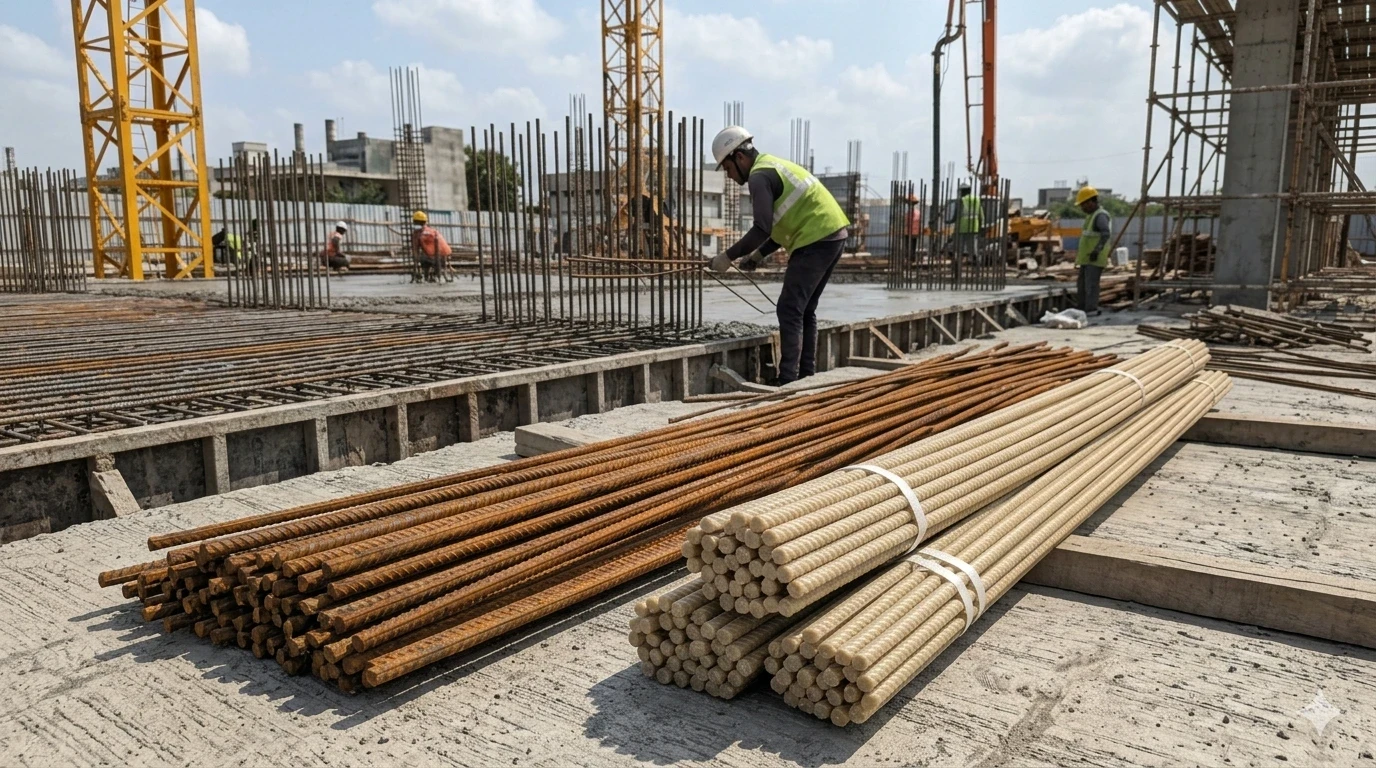
While the upfront price per KG of GFRP rebar (₹160 to ₹260/kg) is higher than conventional Fe550D TMT steel, GFRP is roughly one-fourth the weight of steel. This means one kilogram of GFRP yields four times more linear material. When your structural estimation transitions from weight to total linear meters required, the actual material cost differences largely equalize.

Resources
26
Jun'26GFRP Rebar Price per KG in India: Complete Cost & Estimation Guide
When engineering and procurement teams evaluate Glass Fiber Reinforced Polymer (GFRP) rebars for concrete structures, their primary question relates directly to material procurement costs: "What is the GFRP rebar price per KG in India?"
Evaluating composite reinforcing materials using standard steel procurement metrics leads to fundamental errors in structural cost estimations. Traditional reinforcement steel (such as Fe550D TMT) is priced and supplied based on absolute weight. Conversely, GFRP is a lightweight composite. Assessing it purely on weight distorts financial projections. This guide establishes structural benchmarks for GFRP pricing in India, outlines weight-to-length conversions, and defines accurate project estimation parameters.
Current GFRP Rebar Price per KG in India
In the Indian construction market, standard commercial-grade structural GFRP rebars range between ₹160 and ₹260 per KG (excluding statutory GST, which is applied at 18%). This rate indicates the basic ex-factory baseline. The variance within this cost bracket depends directly on specific raw material criteria:
- Resin Matrix Chemistry: Rebars manufactured with high-grade Vinyl Ester resin offer superior resistance against concrete's alkaline environment, commanding a premium over standard Polyester options. Understanding the types of resin in FRP production is critical for determining chemical compatibility and cost variations.
- Rebar Cross-Sectional Diameter: Thinner diameter bars (6mm to 10mm) incur higher production runtimes per metric ton during the pultrusion process. This results in higher per-kilogram rate than thicker configurations (16mm to 32mm).
- Fiber Volume Fraction: Structural applications conforming to standard India GFRP rebar standards like IS 18256 and IRC 137 require a strict minimum glass fiber content, directly influencing material weight and final pricing.
Material Yield: Converting Weight to Linear Length
GFRP has a structural density of approximately ρ=2.0×10³ kg/m³, whereas steel exhibits a density of ρ=7.85×10³ kg/m³. This means GFRP provides roughly one-fourth the weight of structural steel for an identical physical volume.
Purchasing one kilogram of GFRP delivers approximately four times the linear length of structural reinforcement obtained from an equivalent weight of steel. Financial and inventory accounting must shift from metric tons to linear meters.
Structural Weight Comparison Table
| Nominal Bar Size (mm) | Steel Weight (kg/m) | GFRP Weight (kg/m) | Linear Output per KG (Steel) | Linear Output per KG (GFRP) |
|---|---|---|---|---|
| 8 mm | 0.395 kg | 0.100 kg | 2.53 meters | 10.00 meters |
| 10 mm | 0.617 kg | 0.160 kg | 1.62 meters | 6.25 meters |
| 12 mm | 0.888 kg | 0.230 kg | 1.12 meters | 4.34 meters |
| 16 mm | 1.580 kg | 0.400 kg | 0.63 meters | 2.50 meters |
| 20 mm | 2.470 kg | 0.625 kg | 0.40 meters | 1.60 meters |
Critical Estimation Note: Comparing 1,000 KG of steel versus 1,000 KG of GFRP is structurally invalid. To reinforce the exact same concrete element length, a project requires only 250 KG of GFRP compared to 1,000 KG of steel.
Quantitative Project-Level Cost Analysis
To accurately balance project budgets, estimating engineers must measure structural equivalence and secondary design optimizations rather than basic raw material rates.
Tensile Properties and Cross-Section Optimization
GFRP rebar tensile strength (exceeding 600 to 1000 MPa depending on diameter) surpasses standard Fe550D TMT steel. In structural applications governed strictly by ultimate limit state design conditions, engineering formulas allow substituting smaller diameter composite bars for larger steel alternatives. For instance, replacing 12mm steel elements with 10mm GFRP segments reduces the physical volume of raw material required. Familiarity with standard FRP design considerations helps ensure code-compliant cross-section reductions.
Logistics, Handling, and Site Mobilization
The reduced weight of composite materials fundamentally decreases logistical and installation costs:
- Freight: Single flatbed trucks can transport four times the equivalent structural linear capacity of GFRP rebars relative to traditional steel load limits.
- On-Site Labor: Labor units can easily lift and position reinforcement cages, removing the need for heavy cranes, specialized lifting gear, or mechanical staging.
Reduced Concrete Cover Requirements
Traditional steel-reinforced concrete requires thick clear cover (often 50mm to 75mm in foundations or marine environments) to prevent structural failures caused by corrosion in RCC structures. Because GFRP materials are electrochemically inert, they do not rust. Concrete cover requirements can safely decrease to 30mm or structural code limits, yielding direct cost savings in overall concrete volumes across the project.
Capital Outlay vs. Life-Cycle Value Calculations
The financial justification for adopting GFRP rebars increases when projects evaluate Life-Cycle Costing (LCC) instead of short-term capital expenditures (CAPEX) alone. A rigorous GFRP vs steel lifecycle cost comparison in India demonstrates that traditional RCC elements in high-salinity zones, water infrastructure, or chemical plants demand active structural repair and electrochemical mitigation within 12 to 15 years.
GFRP composites eliminate corrosion fatigue entirely, delivering a service lifespan exceeding 75 years without structural maintenance or corrosion-related downtime. This longevity makes it highly effective for GFRP applications in coastal and marine infrastructure in India, allowing infrastructure asset managers to lower long-term operational expenditures (OPEX).
Recommended Procurement Framework
To secure accurate commercial proposals from specialized Indian GFRP manufacturers like Tapashri, commercial procurement teams must structure their Bills of Quantities (BOQ) around clear parameters:
- Specify Linear Meters: Standardize material requests based on required linear meters per bar size rather than metric tons.
- Define Environmental Exposure: Document whether the reinforcement is for standard foundation slabs, retaining walls, marine systems, or high-chemical zones. This ensures correct resin matrix selection based on FRP specifications thoroughly.
- Coordinate Pre-Fabricated Shapes: Thermoset GFRP composites cannot be adjusted on-site. All bent configurations, continuous stirrups, and structural links must be pre-fabricated under controlled factory conditions. Reviewing formal FRP installation guidelines before shipping ensures your Bar Bending Schedule (BBS) aligns with site capabilities.
Moving from Steel Price per KG to GFRP Cost per Meter
While the baseline price per KG of GFRP rebar appears higher than raw structural steel on standard ledger lines, its lower density gives it a volumetric advantage. Evaluating a direct comparison of FRP vs steel reveals that this material yield shift, along with lower transport costs and reduced concrete requirements, makes GFRP highly competitive for Indian infrastructure projects.
Procurement workflows must evaluate total linear costs to accurately realize these systemic savings. By shifting from weight-based to length-based estimation, project teams gain clarity on the true value proposition of composite reinforcement.
Frequently Asked Questions (FAQs)
Find clear answers to the most common queries.
-
Why is GFRP rebar priced higher per KG than TMT steel in India?
-
Can we cut and bend GFRP rebars on an Indian construction site?
No, GFRP rebars cannot be bent or hot-worked on-site like traditional steel because they are made of thermoset polymer resins. All structural bends, stirrups, and links must be pre-fabricated under controlled factory conditions by the manufacturer according to your Bar Bending Schedule (BBS). However, straight lengths can easily be cut on-site using a standard diamond-blade angle grinder or band saw.
-
How do you calculate the weight-to-length conversion for GFRP rebars?
Because GFRP has a low structural density ($\sim2.0 \times 10^3 \text{ kg/m}^3$), you calculate its weight by multiplying its cross-sectional area by its density. For quick reference, a standard 10mm GFRP rebar weighs approximately 0.160 kg/m (giving you 6.25 meters per kg), compared to a 10mm steel bar which weighs 0.617 kg/m (giving you only 1.62 meters per kg).
-
Does IS 18256 permit the reduction of concrete cover when using GFRP?
Yes. Traditional concrete designs require a thick clear cover (50mm–75mm) solely to protect internal steel from environmental moisture and subsequent corrosion. Because GFRP is electrochemically inert and completely rust-proof, Indian standards like IS 18256 and IRC 137 allow structural engineers to safely reduce the clear concrete cover to 30mm or code minimums, directly saving overall concrete material costs.
-
Which resin matrix provides the best cost-to-performance ratio for Indian infrastructure?
For structural concrete applications in India, Vinyl Ester resin provides the best long-term cost-to-performance ratio. While cheaper Polyester resins exist, they break down faster when exposed to the highly alkaline environment of curing concrete. Vinyl Ester matrices ensure the rebar maintains its high tensile strength and structural integrity over a 75+ year lifecycle.
-
Is GST applicable on GFRP rebars in India?
Yes, under current Indian tax guidelines, Glass Fiber Reinforced Polymer (GFRP) rebars attract a standard statutory GST of 18%. Commercial quotes provided by domestic manufacturers are typically issued on an ex-factory basis, with GST and regional freight logistics calculated separately based on the project's delivery location.
Subscribe to Our Newsletter
Get updates on products, research collaborations, and new developments in FRP technology.

Subscribe to Our Newsletter
Subscribe our newsletter and get notifications to stay update