
The main causes of corrosion in RCC structures are carbonation, chloride attack, poor concrete quality, inadequate concrete cover, and cracks that allow moisture and oxygen to reach the steel reinforcement.

Resources
9
Jun'26Corrosion in RCC Structures: Causes, Warning Signs and Prevention Strategies
Reinforced Cement Concrete (RCC) is the backbone of modern infrastructure in India. From residential buildings and bridges to water tanks, flyovers, ports, and industrial facilities, RCC is the most widely used construction material.
Despite its durability, many RCC structures begin to deteriorate far earlier than their intended service life. Cracks develop, rust stains appear on surfaces, concrete starts to break away, and costly repairs become unavoidable.
In many cases, structures designed to last 50 years or more start showing visible signs of distress within just 15–20 years.
The primary cause behind this premature deterioration is corrosion of the embedded steel reinforcement.
Understanding why corrosion occurs, how to identify it early, and what can be done to prevent it is essential for engineers, contractors, consultants, and infrastructure owners alike.
How Corrosion Begins Inside RCC
Steel naturally corrodes when exposed to moisture and oxygen. Fortunately, steel embedded within concrete is normally protected.
Fresh concrete is highly alkaline, creating a protective layer around the reinforcement known as the passive film. This microscopic layer prevents the steel from reacting with its environment and keeps corrosion at bay.
However, this protection is not permanent.
Over time, environmental factors penetrate the concrete and gradually destroy the alkaline conditions that maintain the passive film. Once the protective layer breaks down, moisture and oxygen reach the steel reinforcement, initiating corrosion.
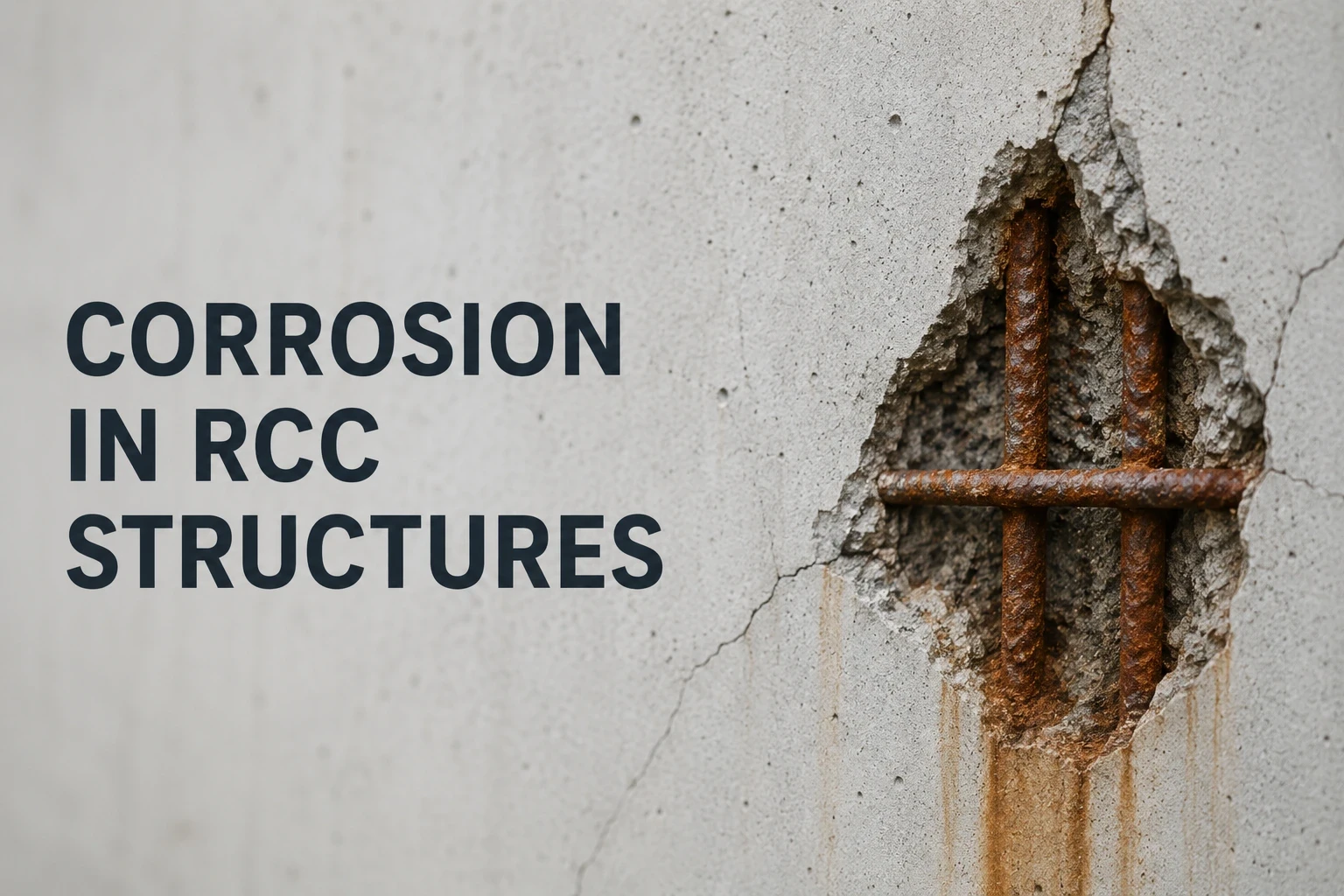
Unlike many forms of structural damage, corrosion tends to accelerate once it begins. Rust occupies a larger volume than the original steel, creating internal pressure that cracks and eventually breaks the surrounding concrete.
What Causes Corrosion in RCC Structures
1. Carbonation
Carbonation is one of the most common causes of reinforcement corrosion.
Atmospheric carbon dioxide (CO₂) slowly penetrates the concrete surface and reacts with alkaline compounds within the concrete matrix. This chemical reaction gradually reduces the concrete's alkalinity.
As the carbonation front moves deeper into the concrete and reaches the reinforcement, the passive film protecting the steel is destroyed.
Once this happens, corrosion can begin.
Factors That Accelerate Carbonation:
- High concrete permeability
- Low cement content
- Poor curing practices
- Thin concrete cover
- Exposure to dry urban environments
Carbonation is a natural process that affects almost all RCC structures over time, though the rate varies significantly depending on construction quality and environmental conditions.
2. Chloride Attack
While carbonation is common, chloride-induced corrosion is often far more aggressive. Chlorides penetrate concrete and directly attack the protective passive film around the steel, even when the concrete remains alkaline.
Common sources of chlorides include:
- Seawater
- Coastal air
- Marine environments
- Contaminated construction materials
- Industrial exposure
- De-icing salts in colder regions
Once chlorides reach the reinforcement, localized corrosion can start rapidly and spread unnoticed.
Why It is Important in India
India's extensive coastline makes chloride attack a major durability concern. Structures located near coastal regions are constantly exposed to salt-laden air, which can penetrate concrete over time, even without visible cracks.
As a result, coastal buildings, bridges, ports, and marine infrastructure often experience corrosion much earlier than similar structures located inland.
3. Poor Concrete Quality
Concrete quality plays a decisive role in determining how quickly corrosive agents reach the reinforcement.
Poor-quality concrete typically contains more interconnected pores and voids, making it easier for moisture, carbon dioxide, and chlorides to penetrate.
Common construction-related causes include:
- Excessive water-cement ratio
- Inadequate compaction
- Poor mix design
- Honeycombing
- Segregation
- Improper curing
These defects may not be obvious immediately after construction, but they significantly reduce the structure's long-term durability.
4. Inadequate Concrete Cover
Concrete cover is the thickness of concrete between the external surface and the embedded reinforcement.
The cover acts as the first line of defense against environmental exposure.
When cover is insufficient:
- Harmful substances reach the steel sooner
- Carbonation progresses faster
- Chloride penetration occurs more rapidly
- Corrosion initiates earlier
Common causes of inadequate cover include:
- Improper bar placement
- Missing cover blocks
- Displacement during concreting
- Construction errors
Even a small reduction in cover can significantly shorten a structure's service life.
5. Cracking in Concrete
Cracks provide a direct pathway for water, oxygen, and chlorides to reach the reinforcement.
Even fine cracks that appear harmless can become entry points for aggressive substances.
Common Sources of Cracking:
- Plastic shrinkage
- Drying shrinkage
- Thermal stresses
- Settlement
- Structural overloading
- Poor curing
- Foundation movement
In coastal and humid environments, cracks can dramatically accelerate corrosion activity.
Signs That Corrosion Has Already Started
One of the biggest challenges with corrosion is that visible symptoms often appear only after significant internal damage has already occurred. Regular inspections should focus on identifying early warning signs.
- Rust Stains: Brown or reddish stains appearing on concrete surfaces often indicate active corrosion beneath the surface.
- Longitudinal Cracks: Cracks running parallel to reinforcement bars are a strong indicator that corrosion products are expanding inside the concrete.
- Concrete Spalling: As rust expands, internal pressure builds until pieces of concrete break away. This process, known as spalling, often exposes corroded reinforcement.
- Delamination: Delaminated concrete separates into layers and frequently sounds hollow when tapped. This is often a precursor to spalling.
- Exposed Reinforcement: Visible steel reinforcement is a serious sign of advanced deterioration and requires immediate assessment.
If any of these are present, the structure needs professional assessment. The internal damage is almost always worse than what is visible.
Structures Most Vulnerable to Corrosion in India
Some environments accelerate corrosion significantly:
Coastal Structures
Buildings, bridges, jetties, ports, and marine facilities located near the sea face continuous chloride exposure.
Salt-laden air can significantly reduce the service life of conventional steel-reinforced concrete.
Water Retaining Structures
Examples include:
- Overhead water tanks
- Reservoirs
- Sewage treatment plants
- Wastewater infrastructure
Continuous exposure to moisture and chemicals creates ideal conditions for corrosion.
Bridges and Flyovers
These structures face multiple durability challenges:
- Rainwater exposure
- Vehicle emissions
- Chloride contamination in coastal regions
- Leakage through expansion joints
Bridge decks and undersides are particularly susceptible.
Basements and Underground Structures
Groundwater containing chlorides, sulphates, or other aggressive chemicals can accelerate reinforcement deterioration over time.
How to Prevent Corrosion? Effective Strategies
Preventing corrosion is significantly more economical than repairing damaged structures later.
1. Use High-Quality Concrete
Durable concrete should be:
- Dense and well-compacted
- Properly cured
- Designed with a low water-cement ratio
- Produced using quality-controlled materials
Reduced permeability slows the ingress of harmful substances.
2. Provide Adequate Concrete Cover
Concrete cover should comply with the exposure requirements specified in relevant design standards such as IS 456.
Proper cover blocks and spacers should always be used during construction.
3. Apply Protective Coatings to Reinforcement
Protective reinforcement options include:
- Epoxy-coated rebars
- Galvanized rebars
- Fusion-bonded coatings
These systems provide an additional barrier against corrosive agents.
However, coating damage during transportation, handling, or installation can reduce effectiveness.
4. Cathodic Protection Systems
For critical infrastructure and severely exposed structures, cathodic protection offers an effective corrosion-control solution.
These systems actively prevent corrosion by altering the electrochemical behavior of the reinforcement.
While highly effective, they require:
- Specialist design
- Installation expertise
- Ongoing monitoring and maintenance
5. Consider Non-Corrosive Reinforcement
One of the most effective long-term solutions is eliminating steel corrosion altogether.
GFRP Rebars
Glass Fibre Reinforced Polymer (GFRP) rebars do not contain steel and therefore cannot rust.
Key advantages include:
- Complete corrosion resistance
- High durability in chloride environments
- Reduced maintenance requirements
- Extended service life
- Lightweight handling
When comparing long-term economics, the lifecycle cost of GFRP versus conventional steel often favors FRP reinforcement, particularly for structures in aggressive environments. Engineers evaluating this transition will also find it useful to understand FRP design considerations and the benefits and limitations of FRP before specifying it for a project.
For coastal infrastructure, marine projects, water-retaining structures, and long-life assets, GFRP reinforcement is increasingly being evaluated as a practical alternative to conventional steel, a shift that reflects broader FRP adoption trends across India.
The True Cost of Corrosion
Corrosion affects more than structural performance, it has major financial consequences.
Repairing corroded RCC structures often requires:
- Removal of damaged concrete
- Cleaning or replacement of reinforcement
- Structural strengthening
- Recasting of affected sections
- Protective treatment applications
For large infrastructure projects, rehabilitation costs can reach 30–50% of the original construction cost.
Even after repair, restoring the structure to its original condition is rarely possible.
The most cost-effective strategy is preventing corrosion from occurring in the first place through better design, material selection, and construction practices.
Building RCC Structures That Last
Corrosion is one of the biggest threats to the durability of RCC structures, particularly in coastal, water-retaining, and high-moisture environments. While factors like carbonation, chloride attack, poor concrete quality, and inadequate cover can accelerate deterioration, most corrosion-related damage can be prevented through proper design, construction practices, and material selection.
Understanding what FRP material is and how it is produced, including how the pultrusion process works and the role of different resin types helps engineers and specifiers make more informed decisions. Tapashri Engineering is helping address these challenges with FRP reinforcement solutions designed for durability and low maintenance.
Ultimately, investing in corrosion prevention at the design stage is far more cost-effective than repairing damaged structures later.
Frequently Asked Questions (FAQs)
Find clear answers to the most common queries.
-
What causes corrosion in RCC structures?
-
What are the early signs of corrosion in reinforced concrete?
Common signs include rust stains, longitudinal cracks along rebars, concrete spalling, delamination, and exposed reinforcement steel.
-
Why is corrosion more common in coastal RCC structures?
Coastal RCC structures are exposed to salt-laden air and chlorides, which penetrate concrete and accelerate reinforcement corrosion, reducing structural durability.
-
How can corrosion in RCC structures be prevented?
Corrosion can be prevented through high-quality concrete, adequate cover, proper curing, protective coatings, cathodic protection, and corrosion-resistant reinforcement materials.
-
Are GFRP rebars a good alternative to steel reinforcement?
Yes. GFRP rebars are non-corrosive, lightweight, and highly durable, making them an effective solution for coastal, marine, and water-retaining RCC structures.
Subscribe to Our Newsletter
Get updates on products, research collaborations, and new developments in FRP technology.

Subscribe to Our Newsletter
Subscribe our newsletter and get notifications to stay update