
No. Lap splice length is calculated based on bond and development length requirements, not convenience. Reducing it without the engineer's approval can leave the joint unable to transfer the required load.

Resources
11
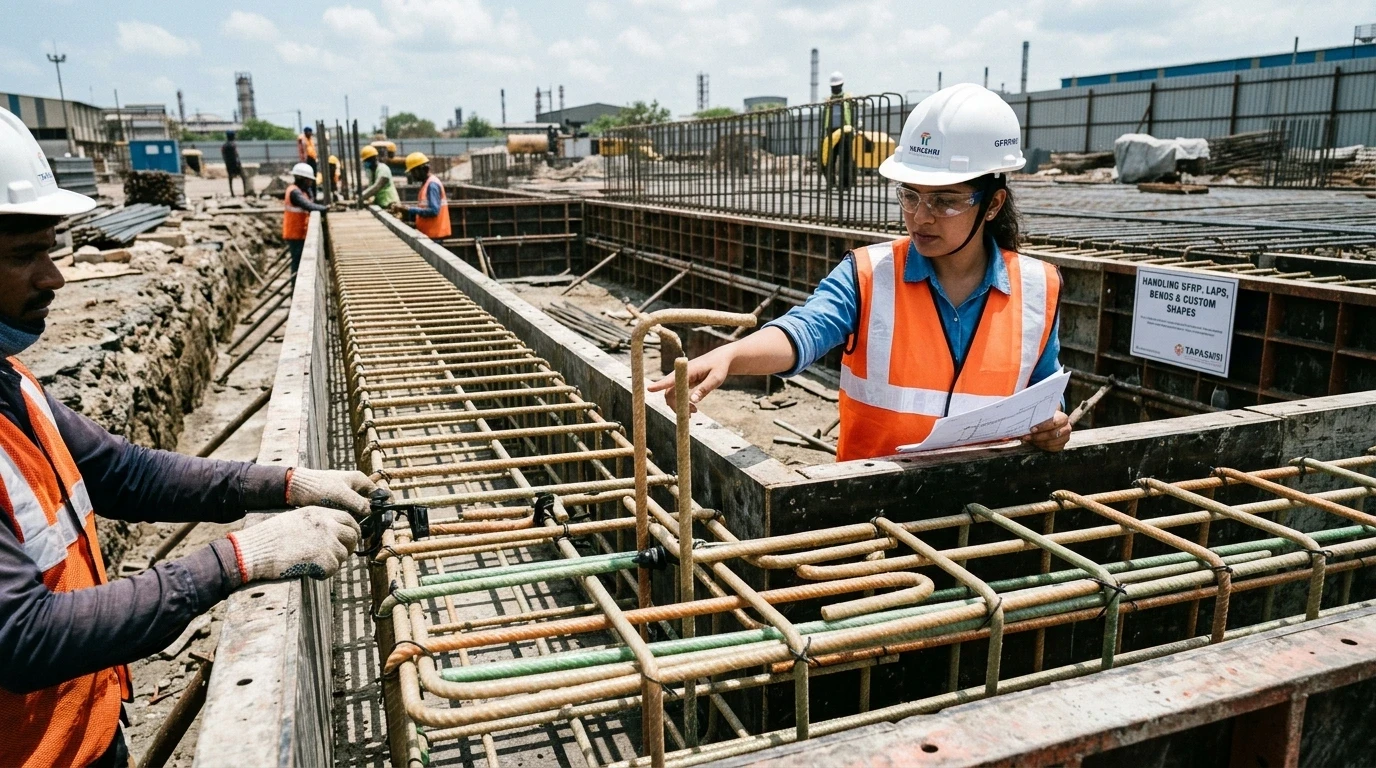
Sep'26How to Handle Laps, Bends, and Custom Shapes with GFRP Rebar
Every reinforced concrete project eventually runs into the same three execution questions on site:
- How do I join two rebar runs?
- How do I turn a corner or detail an anchorage hook?
- What do I do about odd-shaped structural elements in the drawings?
With steel rebar, the answers are almost always found directly on site. A bar bender, a gas torch, a welding rig, and an experienced fabricator can solve most unforeseen geometric problems as they arise.
With Glass Fiber Reinforced Polymer (GFRP) rebar, the answers look different. Because of the FRP material's unique physical properties, laps, bends, and custom shapes cannot be improvised on the fly. They must be planned earlier, detailed precisely, and manufactured to exact specifications before arriving at the job site.
This guide breaks down how to handle laps, factory bends, and custom geometries so structural detailers, contractors, and site engineers can execute projects seamlessly.
Why GFRP Requires a Different Construction Perspective
GFRP is a linear-elastic composite, not a ductile metal. It is manufactured by embedding high-strength continuous glass filaments into a thermoset resin matrix (typically vinyl ester or epoxy). Once that resin undergoes cross-linking during factory curing, its shape is permanently locked in place.
The GFRP Material Principle
- Zero site-bending: Bends must be formed at the factory prior to resin curing.
- Pure bond reliance: Without plastic deformation or field welding, lap splices transfer loads purely through surface bond and embedment length into the concrete.
- Manufactured geometry: Custom shapes must exist as factory-produced components rather than field modifications.
Understanding this upfront makes the rest of the planning process straightforward.
1. Handling Laps and Splices on Site
Why GFRP Bars Are Spliced Differently Than Steel
Steel splices rely heavily on the metal's ability to yield, redistribute stress, and deform plastically. GFRP has no yield plateau; it behaves linear-elastically until its ultimate tensile failure point. Therefore, a GFRP lap splice transfers stress purely through the shear bond developed between the rebar's outer surface (sand-coated, ribbed, or helically wrapped) and the surrounding concrete matrix.
Because of this mechanism, GFRP lap splices are generally longer than equivalent steel splices for the same bar diameter and load requirement.
Key Factors Determining Lap Splice Length
Never guess lap lengths based on steel intuition. In accordance with standards such as IS 18256:2023, IRC 137:2022, and ACI 440.11, lap splice length is derived from the bar's basic development length multiplied by applicable splice class factors.
Development length depends directly on:
- Bar Diameter & Surface Finish: Sand-coated vs. ribbed vs. wrapped profiles yield different bond stress values.
- Concrete Compressive Strength: Higher strength concrete provides greater shear resistance along the bond surface.
- Concrete Cover & Spacing: Adequate cover prevents splitting failures along the lap line.
- Bar Location: Top-cast horizontal bars (with >300 mm of fresh concrete placed below them) require increased development length due to bleed water entrapment under the bar.
| Site Scenario | Recommended Execution Strategy |
|---|---|
| Joining straight bar runs in long slabs or walls | Use the exact lap splice length shown on the design drawings, never estimate from steel practice. |
| Splice falls in a high-stress / peak moment zone | Flag it immediately to the design engineer. Splices should ideally be staggered or shifted away from maximum flexural zones. |
| Rebar congestion at the lap zone | Consider staggering splices or consulting the designer on mechanical couplers where available, rather than reducing lap length. |
| Lap length appears significantly longer than steel | This is expected. GFRP bond behavior is different, and lap lengths are not directly comparable to steel. |
The most common site error isn't a calculation mistake. It's assuming steel intuition carries over. It doesn't. Always work from the project-specific bar bending schedule (BBS) and the engineer's detailing, and confirm actual splice lengths against the manufacturer's certified test data for that specific bar.
2. Factory Bends and Corner Detailing
We already know that GFRP rebar can't be bent on site, but the short version matters here too, because it directly affects how laps and custom shapes get planned.
Cured GFRP rebar can never be cold-bent, heated, or adjusted on site.
Attempting to bend cured GFRP destroys the internal resin matrix, snaps glass fiber bundles, and causes immediate or latent structural degradation, often without visible surface cracks.
All bends including stirrups, column ties, L-bars, U-bars, spirals, and 90°/135° hooks must be formed at the factory while the resin is uncured and fiber bundles remain flexible around shaping mandrels. Once cured, that geometry is locked in permanently.
Design and Procurement Rules for Bends
- Bend Strength Reduction: Due to localized stresses and fiber curvature at the bend corner, bent GFRP sections exhibit lower tensile strength than straight sections (typically 40%–50% reduction per ACI 440/IS 18256 guidelines). Structural designers account for this by adjusting stirrup spacing or bar diameters.
- Fixed Bend Radii: Factory bends adhere to strict minimum mandrel diameter ratios to prevent fiber over-stretching during production.
- Zero Field Buffers: You cannot bend "a few extra corner ties" if you run short on site. Every bent element must be counted, specified, and procured beforehand.
3. Custom Shapes and Complex Geometries
For specialized structural elements such as circular column stirrups, tapered cage configurations, cranked bars, or headed end anchorages, custom factory production is required.
Typical GFRP Custom Shapes:
- Stirrup/Tie
- Spiral/Hoop
- U-Bar
These are all fabricated at the factory before cure.
Procurement Workflow for Custom Geometries
Because GFRP geometry is fixed during the pultrusion and curing process, any shape outside the standard catalog has to be:
- Precise Detailing: Provide full 3D dimensions, internal leg lengths, bend angles, and required tolerances during the shop drawing phase.
- Manufacturer Capability Review: Verify that the supplier has the specific mandrels and molds required for non-standard radii or complex 3D shapes.
- Certified Quality Control: Ensure custom shapes are manufactured to IS 18256:2023 standards and supplied with factory lot test certificates confirming tensile and bend shear strength.
- Lead Time Planning: Custom tooling, batch setup, and heat-curing schedules take time. Build manufacturing lead times directly into your site procurement schedule.
Unacceptable Site Practices vs. Structural Field Solutions
Unacceptable Site Practice |
Approved Field Solution |
|---|---|
| Applying a blowtorch or heat gun to "soften" resin and force a bend on site. (Degrades the polymer resin matrix). | Splicing a straight GFRP bar to a factory-supplied L-bar or hook using the calculated lap length. |
| Forcing a straight bar into a curved formwork by mechanical jacks or extreme bending beyond flexible limits. | Ordering factory-curved hoops or using pre-formed mechanical couplers/headed anchors. |
| Notching or cutting into the bar profile to create a flex hinge. (Destroys fiber continuity). | Re-detailing the joint using a hybrid detail (e.g., stainless steel or epoxy-coated steel bent sections combined with straight GFRP runs, subject to designer sign-off). |
Pre-Execution Planning Checklist: Laps, Bends, and Custom Shapes
Before issuing your purchase order or taking delivery of GFRP rebar on site, run through this verification checklist:
- Lap Lengths Verified: All lap splice lengths are explicitly calculated based on IS 18256 / IRC 137 / ACI 440 for the exact concrete grade and bar diameter, not assumed from steel practice.
- BBS Finalized: The Bar Bending Schedule (BBS) accounts for every single hook, stirrup, L-bar, and custom shape before production starts.
- Manufacturer Verification: The supplier can produce required bend geometries within code-specified bend-radius-to-bar-diameter limits.
- Schedule Buffer: Factory production and curing lead times for pre-bent elements are factored into the site delivery schedule.
- Test Certificates Received: Factory test certificates (tensile strength, glass fiber mass fraction, bond strength) accompany the delivery batch.
- Site Team Briefing: Site engineers, foremen, and steel-fixers are instructed that no field heating, bending, or un-bending is permitted under any circumstances.
The Underlying Principle: Plan Early, Execute Smoothly
Laps, bends, and custom shapes all tie back to a single construction principle: GFRP rewards early planning and penalizes late improvisation.
- Steel allows contractors to react and modify rebar cages on site during steel-fixing.
- GFRP shifts that adaptability upstream into early detailing, accurate BBS generation, and close coordination with the manufacturer.
When projects embrace this shift, site execution becomes surprisingly efficient. Splices fit seamlessly because lap lengths are calculated correctly, pre-formed stirrups drop right into place, and every structural component arrives backed by certified factory test data.
Tapashri Engineering manufactures high-performance GFRP rebar and pre-formed factory components fully compliant with IS 18256:2023. From straight runs to custom stirrups and corner ties, our technical team provides full detailing support and certified test reports for your structural design.
Frequently Asked Questions (FAQs)
Find clear answers to the most common queries.
-
Can I shorten a GFRP lap splice if space is tight on site?
-
Are GFRP lap splices longer than steel lap splices?
Generally, yes, for a given bar size and stress level, because GFRP relies purely on bond rather than any yielding behavior. The exact length still depends on bar surface, concrete strength, and cover conditions.
-
Can a custom GFRP shape be made without ordering it in advance?
No. Since shaping only happens during manufacturing while the resin is uncured, any non-standard geometry needs to be specified and ordered ahead of time, with appropriate lead time for tooling and curing.
-
What should I do if a bend or shape wasn't ordered and is needed urgently on site?
Use an approved alternative such as splicing a straight bar to a pre-ordered factory-bent piece, or using a mechanical anchor rather than attempting to bend or reshape the GFRP bar on site.
-
Does bending reduce the strength of a GFRP bar?
Yes, even properly factory-formed bends have lower tensile capacity than straight sections, which is why design codes apply a bend strength reduction factor based on the bend-radius-to-bar-diameter ratio.
Subscribe to Our Newsletter
Get updates on products, research collaborations, and new developments in FRP technology.

Subscribe to Our Newsletter
Subscribe our newsletter and get notifications to stay update