
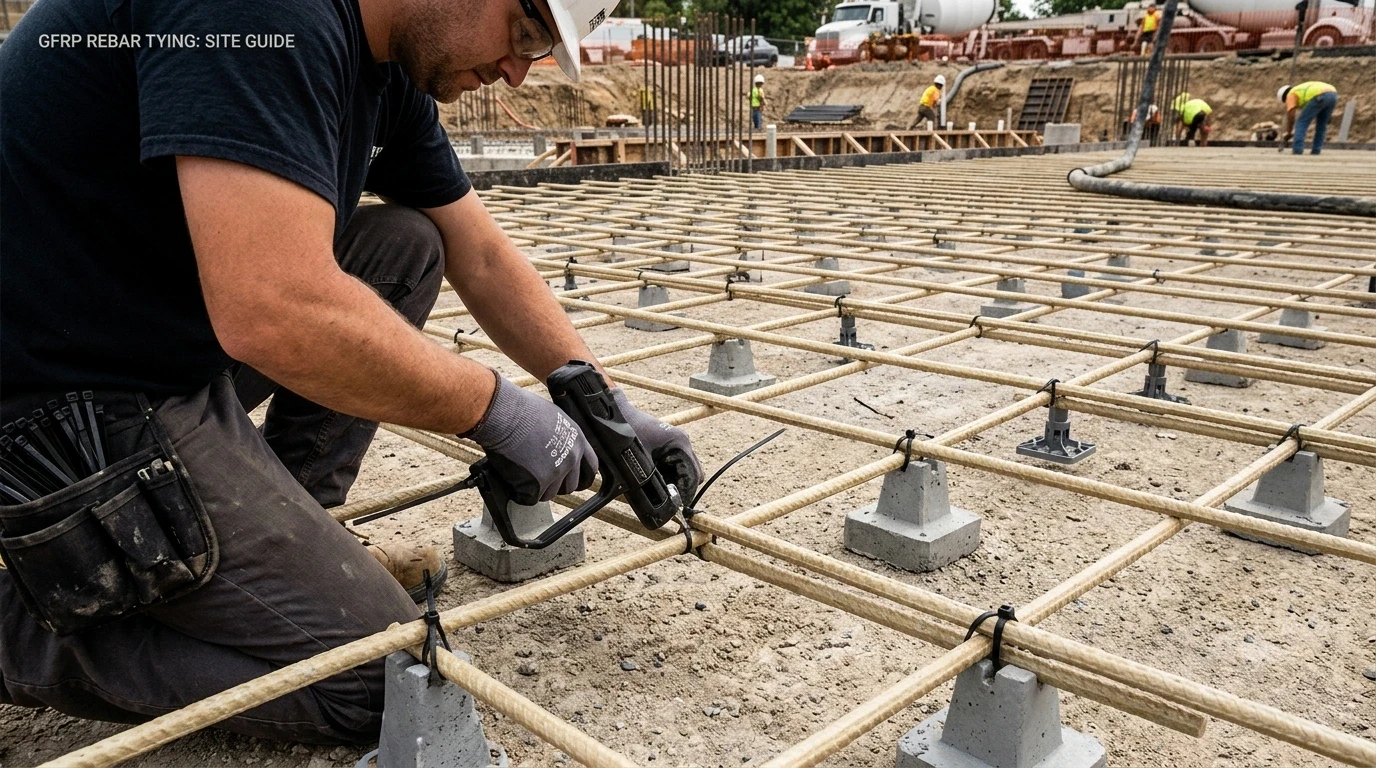
GFRP rebar is typically tied using suitable plastic ties or compatible non-metallic ties to hold the reinforcement securely in position. Ties should maintain the required spacing and alignment without damaging the bars. Always follow the project specifications and the manufacturer's installation guidelines.

Resources
13
Oct'26How to Tie GFRP Rebar on Site: Ties, Spacing and Anti-Float Checklist
GFRP (Glass Fibre Reinforced Polymer) rebar is tied much like steel, but its lower weight, different surface characteristics, and inability to be conventionally re-bent on site require extra care during installation.
If the reinforcement grid shifts, floats or loses its specified cover during concrete placement, the structure may not meet its design requirements. Correct tying, stable supports and careful concrete placement are therefore essential.
This guide explains how to select ties, secure intersections, maintain bar spacing and prevent GFRP reinforcement from moving during a concrete pour. It concludes with a practical pre-pour checklist for site teams.
For a more in-depth overview, read FRP Installation Guidelines.
What Do Ties Do?
Ties hold intersecting reinforcement bars in position during handling and concrete placement. They do not provide structural strength or replace the lap lengths, anchorage or reinforcement detailing specified by the structural designer.
Ties alone also cannot maintain concrete cover or reinforcement elevation. Chairs and spacers support the grid at the required height, while ties secure the intersections.
Remember: Ties hold the bars together; supports hold the reinforcement in position.
Which Ties Should You Use for GFRP Rebar?
Use the fastening method approved in the project specification and compatible with the reinforcement product. Non-metallic ties or purpose-made clips may be suitable where corrosion resistance, electrical insulation or non-magnetic performance is important.
Option |
Best for |
Watch out for |
Suits non-magnetic / non-conductive work |
|---|---|---|---|
| UV-stabilised nylon cable ties | General slabs, walls and foundations; grids left in the sun before the pour | Non-stabilised ties turn brittle in sunlight; untrimmed tails are sharp | Yes |
| Non-metallic rebar clips | Repetitive grids where speed matters | Must match bar diameter and crossing; undersized clips pop off | Yes |
| Automatic tying tools | Large grids | Many tools tie with steel wire, which brings the binding-wire problem; tool force can mark the bar surface; confirm compatibility with the bar supplier | Only if the tool ties with a non-metallic material |
| Steel binding wire | Only where the specification expressly permits it | Puts corrodible metal into a corrosion-proof grid; defeats non-magnetic and non-conductive use | No |
Select ties according to the bar size, grid configuration, handling conditions and manufacturer's recommendations. Do not assume one tie size or strength is suitable for every GFRP application.
Why Avoid Steel Binding Wire?
Steel binding wire is not automatically prohibited in every GFRP installation, but it may be unsuitable where the project requires a completely non-metallic reinforcement assembly.
Three considerations matter:
- Corrosion: Exposed or insufficiently protected wire may corrode and cause staining or local deterioration.
- Non-magnetic and non-conductive requirements: Metal ties may undermine the purpose of using GFRP in applications such as MRI facilities or certain electrical installations.
- Surface damage: Tightly twisted wire can scratch or locally damage the bar surface.
Where these properties are critical, specify approved non-metallic ties and accessories.
How Many Intersections Should You Tie?
The tying pattern depends on the reinforcement layout, bar size, grid stiffness, handling requirements and concrete placement method. There is no single tying pattern that is appropriate for every project.
Use the pattern specified by the structural designer or approved installation procedure. Pay particular attention to:
- Slab and mat edges: Secure the perimeter to prevent movement during handling and placement.
- Interior intersections: Follow the approved tying pattern and add restraint where necessary to maintain alignment.
- Laps and splices: Secure the bars at suitable points so the specified lap arrangement remains in position.
- Walls and reinforcement cages: Provide adequate restraint against movement during concrete placement and vibration.
- Stirrups and custom shapes: Secure intersections to maintain the approved cage geometry.
Do not alter bar spacing, lap lengths, anchorage or reinforcement positions to make tying easier. If a bar does not fit the approved detail, consult the design engineer.
How Tight Should GFRP Rebar Ties Be?
Tighten each tie until the intersection remains stable during normal handling, without crushing, cutting or visibly indenting the bar surface.
Over-tightening can damage the bar or its surface enhancement. This is particularly important when using tools that apply high tension.
After tying, check that:
- The tie holds the intersection securely.
- There are no visible cuts, deep scratches or crushing marks.
- Tie tails are trimmed flush and do not create sharp projections.
- The reinforcement remains aligned and at the specified spacing.
If a bar appears damaged, do not conceal the damage with another tie. Have it assessed in accordance with the manufacturer's guidance and project quality procedures before use.
How to Prevent GFRP Rebar from Floating During Concrete Placement
GFRP rebar is considerably lighter than steel. Depending on the bar and concrete placement conditions, inadequately restrained reinforcement may move upward or sideways during pouring and vibration.
Use these measures to keep the grid stable.
Before the Pour
- Install adequate supports. Position chairs and spacers at the spacing specified in the approved drawings or installation procedure.
- Secure both reinforcement layers. Where top and bottom mats are used, provide suitable connections and supports to maintain their relative positions.
- Use appropriate accessories. Select compatible chairs, spacers and hold-downs that maintain the required cover.
- Check the restraint system. Confirm that the reinforcement can withstand the anticipated handling and placement forces without shifting.
During the Pour
- Place concrete progressively and evenly, following the approved pouring sequence.
- Avoid concentrated discharge that could displace the grid.
- Keep pump hoses and heavy equipment supported independently rather than resting them on the reinforcement.
- Prevent workers from walking directly on unsupported bars; use suitable working platforms.
- Operate vibrators without striking or displacing the reinforcement.
- Assign a team member to monitor bar position, spacing and cover as concrete placement progresses.
Important: chair spacing and hold-down requirements must be determined for the specific project. Do not use a universal spacing recommendation in place of the approved installation details.
How to Check Bar Spacing and Concrete Cover
Correct spacing helps maintain the designed reinforcement layout, while concrete cover provides the specified distance between the reinforcement and the concrete surface.
Use a tape measure and suitable cover gauges rather than relying on visual estimation.
- Establish a reference line from the approved drawings.
- Mark the required bar spacing using a measuring tool or template.
- Position and tie the bars to the specified layout.
- Recheck spacing at regular intervals and at the edges of the grid.
- Verify cover at multiple locations using a suitable gauge.
- Inspect the grid again before pouring and monitor it during placement.
Bar diameter, spacing and cover must follow the approved design and project requirements.
Tying Notes by Application
The tying method stays the same; what changes is what the pour does to the grid.
Application |
What to watch |
|---|---|
| Slabs and industrial floors | Large flat mats float easily; use dense chair support and walking boards, and keep concrete trucks and pumps off the grid |
| Foundations and footings | Hold the cage position against the formwork and trench sides; check bottom cover before the pour |
| Walls | Tie both faces and keep them at the right distance from each other; vibration and pour height push on the grid |
| Roads and pavements | Support the mat ahead of the pour and keep construction traffic and paving equipment off it [VERIFY: match to the paving method] |
Common GFRP Tying Mistakes to Avoid
Mistake |
Why it matters |
Recommended action |
|---|---|---|
| Using steel wire without checking the specification | Adds corrosion points and defeats non-magnetic or non-conductive use | Use non-metallic ties unless the specification permits wire |
| Over-tightening ties | Damages the bar surface at every intersection | Tighten only enough to secure the intersection |
| Relying on ties for cover and elevation | The grid sags and shifts during the pour | Add chairs and spacers at the specified spacing |
| Inadequate restraint during pouring | Light bars may float up in fluid concrete | Use adequate chairs and supports; tie the top mat to the bottom mat where specified |
| Walking on the unsupported mat | Moves bars and reduces concrete cover | Lay walking boards on suitable supports |
| Striking bars with vibrators | Displaces bars and can mark their surfaces | Follow the approved concrete vibration procedure |
| Forcing a bend on site | Can crack or damage GFRP bars | Order factory-bent shapes in advance |
| Skipping final checks | Installation errors may remain undetected | Inspect the reinforcement before and during the pour |
GFRP Rebar Pre-Pour Checklist
Use this checklist before concrete placement begins.
- Bar diameter, spacing and layout match the approved drawings.
- Ties comply with the project specification.Intersections and laps are secured adequately.
- Ties are snug, without visible bar damage.
- Chairs and spacers are stable and correctly positioned.
- Required cover has been checked at multiple points.
- Top and bottom mats are adequately restrained, where applicable.
- Hold-downs are installed where required by the placement method.
- Pump hoses, equipment and walking platforms are independently supported.
- A team member is assigned to monitor reinforcement position during pouring.
Best Practices for Tying GFRP Rebar on Site
Properly tying GFRP rebar involves more than securing intersections. Site teams must maintain the approved reinforcement layout, protect the bars from damage, provide stable supports and prevent movement during concrete placement.
The key practices are simple: use compatible ties, follow the approved tying pattern, avoid excessive tension, maintain cover with suitable supports and inspect the grid throughout the pour.
Tapashri provides GFRP rebar solutions for modern construction and infrastructure projects, with a focus on durability, corrosion resistance and long-term performance. Understanding the right installation practices helps ensure these benefits are carried through from material selection to on-site application.
Frequently Asked Questions (FAQs)
Find clear answers to the most common queries.
-
How do you tie GFRP rebar on site?
-
What type of ties should be used for GFRP rebar?
Plastic ties or other manufacturer-approved, non-metallic tying materials are commonly used for GFRP rebar. The selected ties should provide sufficient holding strength during concrete placement and be compatible with the reinforcement system.
-
How do you prevent GFRP rebar from floating during concrete pouring?
To prevent GFRP rebar from floating or shifting, secure the reinforcement grid at appropriate intervals, use suitable supports and spacers, and check the assembly before pouring. Concrete should be placed carefully to minimize displacement and maintain the specified reinforcement position and cover.
-
Can GFRP rebar be tied and installed like steel rebar?
GFRP rebar can be assembled using similar reinforcement-grid principles, but its handling and installation require specific precautions. Unlike steel, GFRP rebar should not be bent, cut, or handled in ways that damage its fibers or resin matrix. Follow the manufacturer's instructions and approved project details for tying, spacing, supports, and concrete cover.
-
Can I use binding wire on GFRP rebar?
Only where the project specification expressly permits it. Wire adds corrodible metal to a corrosion-resistant grid and rules out non-magnetic or non-conductive use. Nylon ties or non-metallic clips are the usual choice.
-
How tight should GFRP rebar ties be?
Snug enough that the intersection does not slide under hand pressure, and no tighter. The tie should hold position, not clamp the bar.
-
Why does GFRP rebar float during pouring?
GFRP is lighter than fresh concrete, so a lightly restrained mat can be pushed up as concrete flows around it. Closer chair spacing, tying the top mat down, and controlled pouring prevent it.
-
Do I need chairs for GFRP rebar?
Yes. Ties hold intersections together but do not hold cover or elevation. Use non-metallic chairs or spacers at the specified spacing.
Subscribe to Our Newsletter
Get updates on products, research collaborations, and new developments in FRP technology.

Subscribe to Our Newsletter
Subscribe our newsletter and get notifications to stay update