
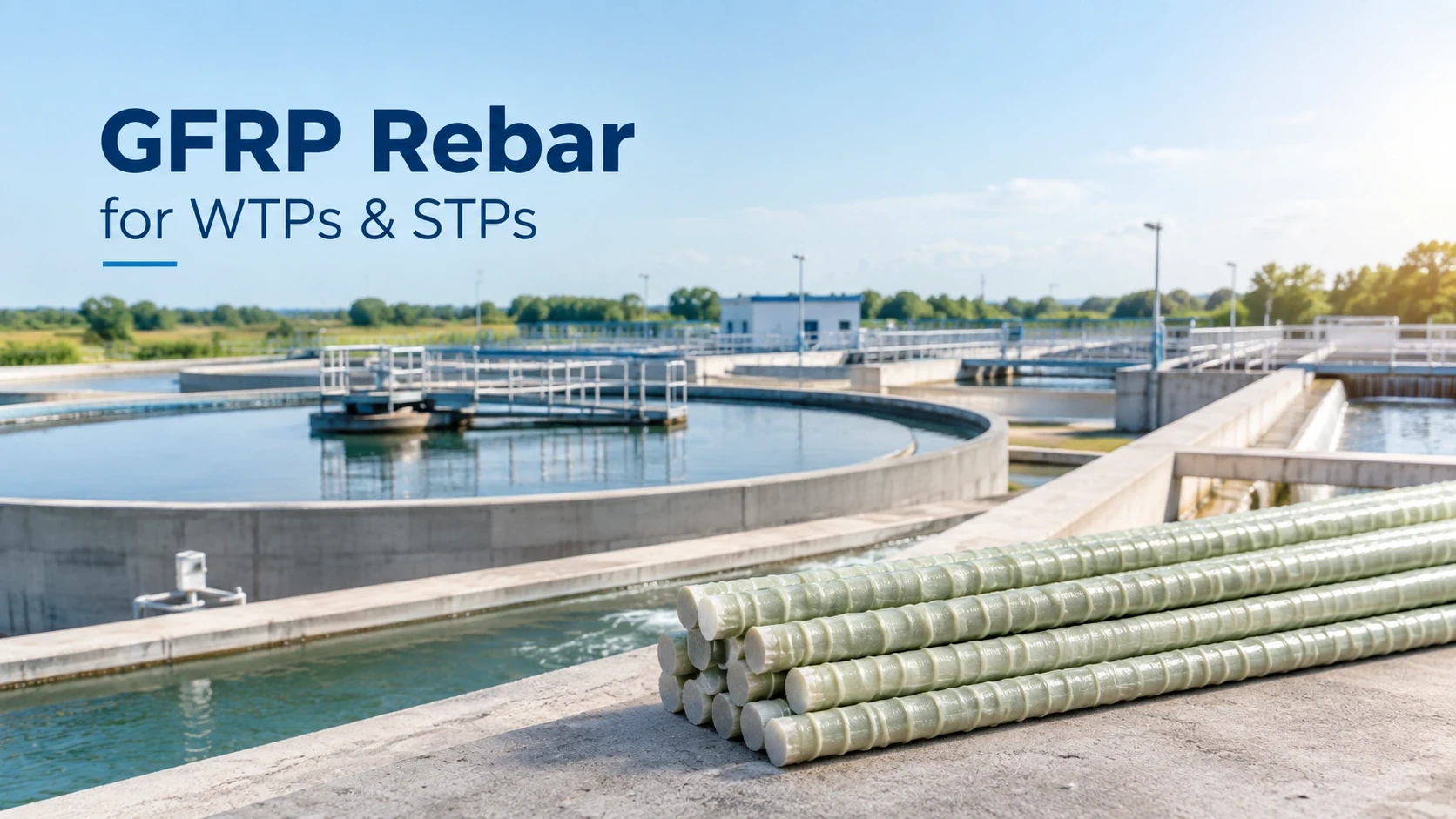
GFRP rebar is used in water and sewage treatment plants because it is resistant to corrosion from moisture, chlorides, and many aggressive chemical environments. Unlike steel, GFRP does not rust, helping reduce corrosion-related cracking, spalling, and long-term maintenance.

Resources
22
Sep'26GFRP in Water Treatment Plants (WTPs) & Sewage Treatment Plants (STPs)
Water Treatment Plants (WTPs) and Sewage Treatment Plants (STPs) expose reinforced concrete structures to some of the most aggressive service conditions in civil infrastructure. Continuous moisture, chlorides, chemical dosing, hydrogen sulfide, fluctuating pH, and wet-dry cycles can accelerate the deterioration of conventional steel reinforcement.
When corrosion begins inside concrete, rust formation creates expansive pressure around the reinforcement. Over time, this can lead to cracking, delamination, spalling, leakage, and costly rehabilitation.
This is where GFRP (Glass Fiber Reinforced Polymer) offers a corrosion-resistant alternative. Unlike steel, GFRP does not rust, making it particularly suitable for tanks, clarifiers, digesters, channels, reservoirs, and other water- and wastewater-related structures.
Why Steel Reinforcement is Vulnerable in WTPs & STPs
Two major deterioration mechanisms are particularly important in wastewater and water-treatment environments.
1. Microbiologically Induced Corrosion (MIC)
In wastewater systems, anaerobic bacteria can generate hydrogen sulfide (H₂S). Under suitable conditions, H₂S can be converted by microorganisms into sulfuric acid (H₂SO₄). This acidic environment can attack concrete surfaces and reduce the protection normally provided by the alkaline concrete cover.
As deterioration progresses and reinforcement becomes exposed, steel can corrode rapidly. The resulting expansion of corrosion products can cause cracking and spalling around the bars.
2. Chloride and Chemical Exposure
WTPs use chemicals such as chlorine compounds, alum, ferric salts, and other treatment chemicals. Chlorides and other aggressive agents can migrate through concrete over time.
When sufficient chloride reaches conventional steel reinforcement, it can disrupt the steel's passive protective layer and initiate corrosion. In structures that remain wet or experience repeated wet-dry cycles, this can become a significant long-term durability concern.
Key Advantages of GFRP for WTPs & STPs
GFRP rebar consists of continuous glass fibers embedded in a polymer resin matrix. Its corrosion-resistant properties make it fundamentally different from conventional steel reinforcement.
1. Corrosion Resistance
Made from high-purity glass fibers encapsulated in a vinyl ester or epoxy resin matrix, GFRP does not rust or degrade the way steel does. It is completely resistant to hydrogen sulfide, sulfuric acid, chlorides, and water-treatment chemicals.
This lowers maintenance expenses and increases the service life of the infrastructure it reinforces.
In an STP clarifier or a WTP filtration tank, that means no expansion cracking, no spalling cover concrete, and no progressive structural weakening over decades of wet service.
2. Reduced Concrete Cover Requirements
Steel reinforcement in aggressive exposure zones requires 50 mm to 75 mm of sacrificial concrete cover purely to delay chloride ingress. Because GFRP does not corrode, engineers can optimize concrete cover (often down to 25–30 mm), reducing element thickness, total concrete volume, and structural dead load.
3. High Tensile Strength
GFRP bars can provide tensile strengths above 1,000 MPa, depending on the product and manufacturing specification.
This high tensile capacity makes GFRP suitable for applications where reinforcement must resist tensile stresses generated by hydrostatic pressure, temperature changes, shrinkage, and structural loading. It is important to note that GFRP has a different stress-strain behavior from steel.
It is linear elastic until failure and does not yield like steel. Consequently, structural design must account for its specific material properties.
4. Suitable for Water-Contact Structures
Unlike steel, which can leak rust staining and heavy metal oxidation into treated water, GFRP remains chemically stable, safeguarding potable water purity in WTP clear water reservoirs.
5. Lightweight and Easier to Handle
GFRP has a density of approximately 2.0–2.1 g/cm³, compared with about 7.85 g/cm³ for steel.
This makes GFRP reinforcement substantially lighter than steel. The lower weight can simplify transportation, handling, cutting, placement, and installation, particularly in large tanks, confined spaces, and elevated or difficult-to-access areas.
6. Non-Conductive and Non-Magnetic
GFRP is electrically non-conductive and non-magnetic. This can be advantageous around sensitive electrical, instrumentation, and monitoring systems commonly found in modern treatment facilities.
It can also be considered where electromagnetic transparency is required for specific applications.
Critical Application of GFRP in WTPs and STPs
Facility Section |
Components |
Main Exposure |
GFRP Solution |
|---|---|---|---|
| STP Inlet Works | Screen chambers, grit channels, wet wells | High turbulence, H₂S gas, raw sewage | Total acid and bio-gas immunity |
| Primary & Secondary Basins | Aeration tanks, clarifiers, sludge digesters | Continuous immersion, wet-dry cycling, organic acids | Prevents micro-cracking and wall leaks under hydrostatic load |
| WTP Chemical Zones | Alum/chlorine mixing chambers, flash mixers | High concentration of corrosive chemicals | Resists chemical attack without epoxy coatings |
| Water-Retaining Structures | Reservoirs, filter tanks, clear-water tanks | Moisture and chloride exposure | Eliminates conventional steel corrosion |
| Conveyance & Covers | Effluent trenches, culverts, precast slab covers | Moisture ingress, heavy ground contact | Lightweight, high strength, easy maintenance removal |
Market analysts have taken note of this shift as well: the GFRP rebar market is projected to grow from USD 0.54 billion in 2025 to USD 0.95 billion by 2030, at a CAGR of 12.1%, and water treatment plant applications are expected to register the third-highest growth rate within that market, driven specifically by the need for corrosion-resistant materials in highly corrosive treatment environments.
GFRP vs. Steel: Looking Beyond Initial Cost
GFRP rebar can have a higher upfront material cost than conventional steel when compared purely on a per-kilogram basis. However, lifecycle cost provides a more meaningful basis for evaluating reinforcement in aggressive environments.
Lower Handling & Transportation Weight
GFRP rebar has a specific gravity of roughly 2.0 g/cm3, making it one-quarter the weight of steel (7.85 g/cm3). You require significantly fewer kilograms of GFRP to achieve equal or superior structural reinforcing performance.
Reduced Corrosion-Protection Requirements
Steel in aggressive environments may require additional durability measures, such as increased concrete cover, specialized concrete mixes, coatings, membranes, or other corrosion-protection systems.
GFRP can reduce dependence on reinforcement-specific corrosion protection because the bars themselves do not undergo conventional steel corrosion.
Long-Term Durability
The service life of any reinforced concrete structure depends on concrete quality, structural design, exposure conditions, workmanship, detailing, and maintenance, not reinforcement alone.
GFRP can nevertheless provide a major durability advantage where steel corrosion is one of the primary deterioration mechanisms. Properly designed GFRP-reinforced structures can therefore be considered for long-service-life infrastructure where minimizing corrosion-related rehabilitation is a priority.
Understand the difference: GFRP Vs Steel
GFRP Rebar Standards & Design Considerations in India
GFRP reinforcement should be designed and specified according to the applicable standards, project requirements, and manufacturer's verified material properties.
Relevant Indian standards and guidelines include:
- IS 18256:2023: The official Indian Standard governing specifications and testing methods for Glass Fiber Reinforced Polymer (GFRP) bars for concrete reinforcement.
- IRC 137: Standard guidelines covering design and construction parameters for polymer composite rebars.
- Crack-Width & Serviceability Control: GFRP's high tensile capacity, combined with proper distribution design, ensures that crack widths in water-retaining structures remain strictly within code-specified limits without risk of rust propagation.
Build More Durable WTP & STP Infrastructure with GFRP
For WTPs and STPs, corrosion resistance is not simply a material advantage, it can be a critical part of long-term structural durability.
GFRP rebar offers a lightweight, non-corrosive alternative to conventional steel reinforcement, making it suitable for treatment tanks, clarifiers, reservoirs, channels, chemical areas, and other moisture- and chemical-exposed concrete structures.
At Tapashri Engineering, our GFRP rebars are manufactured for durability-focused infrastructure applications. Our technical team can support project-specific requirements with tensile test reports, technical documentation, and customized factory-manufactured bent shapes.
Frequently Asked Questions (FAQs)
Find clear answers to the most common queries.
-
Why is GFRP rebar used in WTPs and STPs?
-
Is GFRP rebar better than steel for water treatment plants?
GFRP and steel have different material properties and design characteristics. GFRP offers a major advantage where corrosion resistance is a priority, while steel has a higher elastic modulus and yields before failure. The appropriate reinforcement should be selected based on structural design, exposure conditions, applicable standards, and lifecycle requirements.
-
Where can GFRP rebar be used in WTPs and STPs?
GFRP rebar can be used in clarifiers, aeration tanks, sludge tanks, reservoirs, filter tanks, wet wells, chemical mixing chambers, effluent channels, culverts, and other reinforced concrete structures exposed to moisture or aggressive environments.
-
Does GFRP rebar corrode in sewage and chemical treatment environments?
GFRP does not undergo conventional steel corrosion or rusting. Its resistance to moisture, chlorides, and many chemical environments makes it suitable for aggressive wastewater and water-treatment applications. The specific resin system and chemical exposure should be evaluated for each project.
-
Is GFRP rebar suitable for long-life WTP and STP infrastructure?
Yes. GFRP can be considered for long-life water and wastewater infrastructure where reinforcement corrosion is a key durability concern. However, overall service life depends on concrete quality, structural design, exposure conditions, detailing, installation, and maintenance, not the reinforcement material alone.
Subscribe to Our Newsletter
Get updates on products, research collaborations, and new developments in FRP technology.

Subscribe to Our Newsletter
Subscribe our newsletter and get notifications to stay update