
BFRP offers a modest improvement in tensile strength and stiffness over GFRP, but it costs more and has less established design and standards coverage in India. For most projects, GFRP remains the more practical and better-supported choice.

Resources
30
Jul'26GFRP vs Basalt FRP (BFRP) vs Carbon FRP (CFRP): Composite Rebar Comparison
Glass fiber isn't the only fiber used to reinforce concrete. As FRP adoption grows in India, engineers and procurement teams increasingly ask a follow-up question: how does GFRP compare with basalt FRP (BFRP) and carbon FRP (CFRP)?
Each material is manufactured through the same pultrusion process, but the fiber type changes strength, stiffness, cost, and the applications each is suited for.
This guide compares the three composite rebar types to help engineers, consultants, and procurement teams select the right material for their project.
Understanding the Difference Between Three FRP Fiber Types
All FRP rebars are:
- Corrosion-resistant
- Non-metallic
- Non-conductive
- Non-magnetic
- Lightweight
The core FRP benefits that make composites attractive over steel in the first place.
The key difference is the reinforcing fiber embedded within the resin matrix:
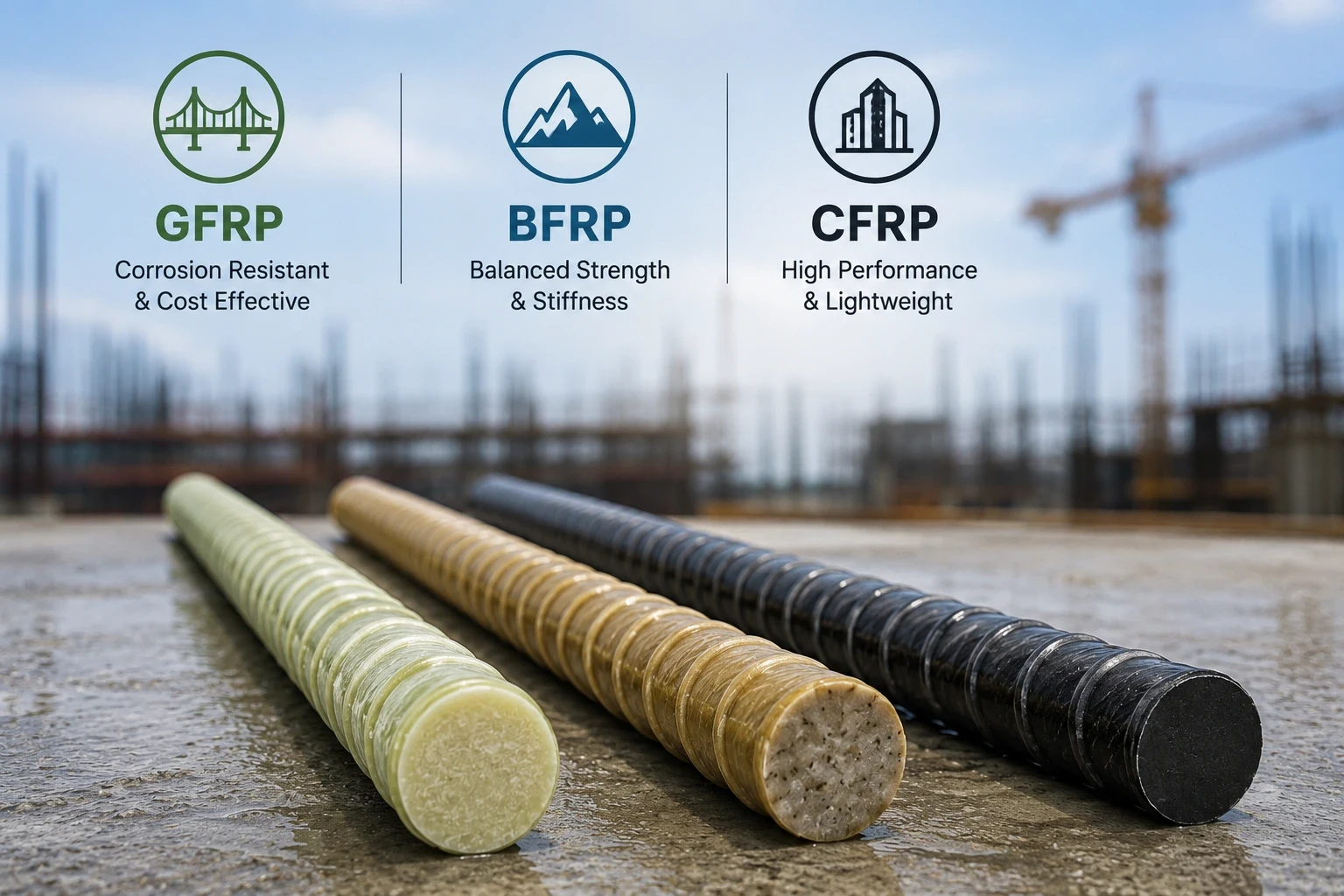
- GFRP (Glass Fiber Reinforced Polymer): Made using E-glass or E-CR glass fibers. It is the most established, widely available, and cost-effective FRP rebar.
- BFRP (Basalt Fiber Reinforced Polymer): Manufactured using fibers derived from melted basalt rock. It offers improved stiffness over GFRP but has more limited adoption.
- CFRP (Carbon Fiber Reinforced Polymer): Uses carbon fibers to deliver exceptional strength and stiffness, making it suitable for highly specialized structural applications.
GFRP vs BFRP vs CFRP Comparison
Property |
GFRP |
BFRP |
CFRP |
|---|---|---|---|
| Tensile Strength | ~600–1,200 MPa | ~1,000–1,500 MPa | ~1,400–2,400 MPa |
| Elastic Modulus | ~40–60 GPa | ~45–70 GPa | ~120–180 GPa |
| Density | ~1.9–2.1 g/cm³ | ~2.1–2.2 g/cm³ | ~1.5–1.6 g/cm³ |
| Relative Cost | Lowest (baseline) | Moderate (roughly 1.3–2× GFRP) | Highest (often 5–10× GFRP) |
| Chemical Resistance | Good | Very good | Excellent |
| UV Sensitivity | Requires cover/coating | Requires cover/coating | Requires cover/coating |
| India Standards | Covered under IS 18256:2023 and IRC 137:2022 | No dedicated standard | No dedicated standard |
| Availability in India | Well established, multiple manufacturers | Limited, mostly project-specific or imported | Limited, mostly strengthening/retrofit applications |
Note: Mechanical properties vary by manufacturer, fiber content, resin system, and bar diameter. Always verify performance using certified test reports instead of relying solely on published ranges.
Why Material Selection Isn't Just About Strength
It's easy to assume that higher strength automatically means a better material but that's rarely the case.
In FRP-reinforced concrete, serviceability, particularly deflection and crack control, often governs the design rather than ultimate strength.
GFRP
GFRP has a lower elastic modulus than steel, which means members may experience greater deflection under load. However, this behavior is well understood, supported by Indian standards, and routinely addressed during design. Combined with its affordability, GFRP remains the preferred choice for most reinforced concrete structures.
BFRP
BFRP provides moderately higher stiffness than GFRP, helping reduce deflection in certain applications. However, the improvement comes at a higher cost, and the absence of dedicated Indian design standards means its use is generally limited to project-specific engineering decisions.
CFRP
CFRP offers significantly higher stiffness, allowing reduced deflections and potentially smaller reinforcement requirements. However, its premium cost means it is rarely used as primary reinforcement. Instead, it is widely used for structural strengthening, retrofitting, and prestressing applications.
Typical Applications of Each Material
Applications of GFRP
GFRP is the practical choice for most reinforced concrete construction, including:
- Coastal and marine structures
- Bridges and flyovers
- Water treatment plants
- Retaining walls
- Pavements
- Residential and commercial buildings
- Industrial RCC structures exposed to corrosive environments
Explore the full range of GFRP applications across Tapashri's infrastructure projects.
Applications of BFRP
BFRP may be considered for:
- Longer-span structural members requiring improved stiffness
- Projects involving elevated operating temperatures
- Specialized applications where moderate performance improvements justify the additional cost
Its adoption in India remains relatively limited.
Applications of CFRP
CFRP is best suited for:
- Structural strengthening and retrofitting
- Seismic rehabilitation
- Prestressing tendons
- MRI facilities and electromagnetically sensitive environments
- Weight-critical structures where premium performance outweighs cost considerations
Cost is Usually the Deciding Factor
For most infrastructure and building projects, GFRP already delivers a strong lifecycle cost advantage over conventional steel by eliminating corrosion-related maintenance.
Moving from GFRP to BFRP or CFRP increases material costs considerably. Unless a project has specific requirements for higher stiffness, elevated temperature performance, or structural rehabilitation, the additional investment is often difficult to justify.
When comparing reinforcement options, evaluate the total installed cost including reinforcement quantity, labour, maintenance, and expected service life instead of comparing material prices per kilogram alone.
Which FRP Rebar Should You Choose?
The right choice depends on your project's structural requirements, budget, and design constraints.
- Choose GFRP for most reinforced concrete applications. It offers the best balance of performance, availability, cost, and Indian standards compliance (IS 18256:2023 and IRC 137:2022).
- Consider BFRP when improved stiffness or higher operating temperature is a documented project requirement, and reliable manufacturer test data is available.
- Use CFRP for strengthening, retrofit, prestressing, or specialized structures where its exceptional stiffness and lightweight properties provide measurable engineering benefits.
For the vast majority of new construction projects in India, GFRP remains the most practical and economical composite reinforcement solution.
Choosing Between GFRP, Basalt FRP and Carbon FRP
While GFRP, BFRP, and CFRP all offer the core benefits of FRP reinforcement, they serve different engineering needs. GFRP has become the industry standard for new reinforced concrete construction because it combines corrosion resistance, proven performance, code support, and cost efficiency. BFRP fills a niche where moderate performance gains are required, while CFRP is reserved for high-performance retrofit and specialized structural applications.
If you're evaluating composite reinforcement for an upcoming project, Tapashri Engineering can help you determine whether GFRP is the right solution or whether your application would benefit from an alternative FRP system.
Frequently Asked Questions (FAQs)
Find clear answers to the most common queries.
-
Is BFRP better than GFRP?
-
Can CFRP rebar replace GFRP rebar in a normal building?
Technically yes, but it's rarely economical. CFRP's cost premium is only justified when its high stiffness or low weight solves a specific engineering problem, such as retrofit strengthening or long, slender members with strict deflection limits.
-
Does India have a standard for BFRP or CFRP rebar like it does for GFRP?
Not yet. IS 18256:2023 and IRC 137:2022 currently cover GFRP specifically. BFRP and CFRP projects in India typically rely on manufacturer test data and international references such as ACI 440 until dedicated Indian standards are developed.
-
Which composite rebar is most corrosion resistant?
All three resist electrochemical corrosion far better than steel. CFRP and BFRP have somewhat better chemical resistance than standard E-glass GFRP, but for typical exposure conditions including marine and coastal environments, GFRP's corrosion performance is already sufficient, which is why it remains the standard choice.
Subscribe to Our Newsletter
Get updates on products, research collaborations, and new developments in FRP technology.

Subscribe to Our Newsletter
Subscribe our newsletter and get notifications to stay update