
Yes. GFRP can be cut by TBM cutters, which is why it is used in soft-eye zones at launch and retrieval shafts.

Resources
30
Sep'26GFRP Rebar in Metro and Tunnel Projects: Applications, Benefits & Design
Metro and tunnel structures are some of the hardest places to keep steel reinforcement healthy. Groundwater, chlorides, limited access, and stray currents from DC traction systems can all drive corrosion in nearby steel. Once these structures are in service, repairs are expensive and disruptive.
Glass Fibre Reinforced Polymer (GFRP) rebar is an alternative where corrosion resistance, electrical insulation or lightweight reinforcement are primary design drivers. It is non-corrosive, non-conductive, non-magnetic and can be cut by tunnel boring machines (TBMs), making it particularly useful in TBM soft-eye zones.
This guide explains where GFRP rebar is used in metro and tunnel projects, its key benefits and limitations, and the design and installation factors engineers should consider.
Why Are Metro and Tunnel Structures Challenging for Steel Reinforcement?
Underground structures can combine several conditions that accelerate reinforcement corrosion and make repairs difficult.
Groundwater and Chlorides
Tunnel walls, station boxes, and retaining structures can remain exposed to groundwater for decades. In coastal or chloride-rich environments, chlorides can penetrate concrete and eventually cause corrosion of steel reinforcement. Corrosion can lead to cracking, delamination, and spalling, creating maintenance problems in locations where access is difficult.
Stray Current
DC-powered metro systems use rails as part of the electrical return system. Stray currents can enter surrounding structures and, where steel reinforcement provides a conductive path, contribute to corrosion.
GFRP is electrically non-conductive, so it does not provide the same conductive path as steel. However, GFRP alone does not replace a complete stray-current control strategy. Stray-current control typically includes insulated joints, drainage, and monitoring systems; GFRP complements these measures by removing a conductive path through the reinforcement.
Long Service Life
Metro and tunnel infrastructure is generally designed for long service periods. Preventing corrosion at the reinforcement level can therefore be an important part of the overall durability strategy.
Difficult Repairs
Repairing underground structures can require excavation, traffic or service restrictions, specialist equipment and significant labour. Selecting reinforcement with appropriate durability characteristics during construction can help reduce future maintenance requirements.
Key Properties of GFRP Rebar for Underground Construction
GFRP rebar consists of glass fibres embedded in a polymer resin, commonly manufactured using the pultrusion process. Four properties are particularly relevant to metro and tunnel applications.
1. Corrosion Resistance
GFRP does not rust like conventional steel. This makes it suitable for concrete structures exposed to moisture, groundwater, and chloride-containing environments. GFRP is not immune to all degradation. Alkaline attack from concrete pore water, moisture absorption over decades, and creep rupture under sustained load are considerations, but it avoids the electrochemical corrosion that affects steel.
2. Non-Conductive and Non-Magnetic Behaviour
GFRP does not conduct electricity and is non-magnetic. This is useful around traction, signalling and other systems where electrical or magnetic interference needs to be controlled.
3. TBM Cuttability
Unlike steel, GFRP can be cut by TBM cutters, which is particularly valuable in soft-eye sections of diaphragm and retaining walls. Instead of stopping the TBM to remove steel, the machine can pass through a section reinforced with GFRP. 4. High Strength and Low Weight GFRP has high tensile strength while weighing significantly less than steel. Its modulus of elasticity is lower which affects deflection and crack width calculations. Its low weight can simplify transportation, cage assembly, and manual handling in confined shafts and underground construction areas.
| Property | Steel Rebar | GFRP Rebar |
|---|---|---|
| Corrosion resistance | Can corrode | Does not corrode electrochemically |
| Electrical behaviour | Conductive | Non-conductive |
| Magnetic behaviour | Magnetic | Non-magnetic |
| TBM cuttability | Requires special treatment/removal | Can be cut by TBM |
| Weight | Higher | Approximately one-quarter of steel* |
| Load behaviour | Ductile, yields | Linear-elastic, no yielding |
| Tensile strength | ~500 MPa | ~600–1,200 MPa |
| Modulus of elasticity | ~200 GPa | ~40–60 GPa |
*Actual weight depends on bar diameter and product specification.
Major Applications of GFRP Rebar in Metro and Tunnel Projects
1. TBM Soft-Eye Zones
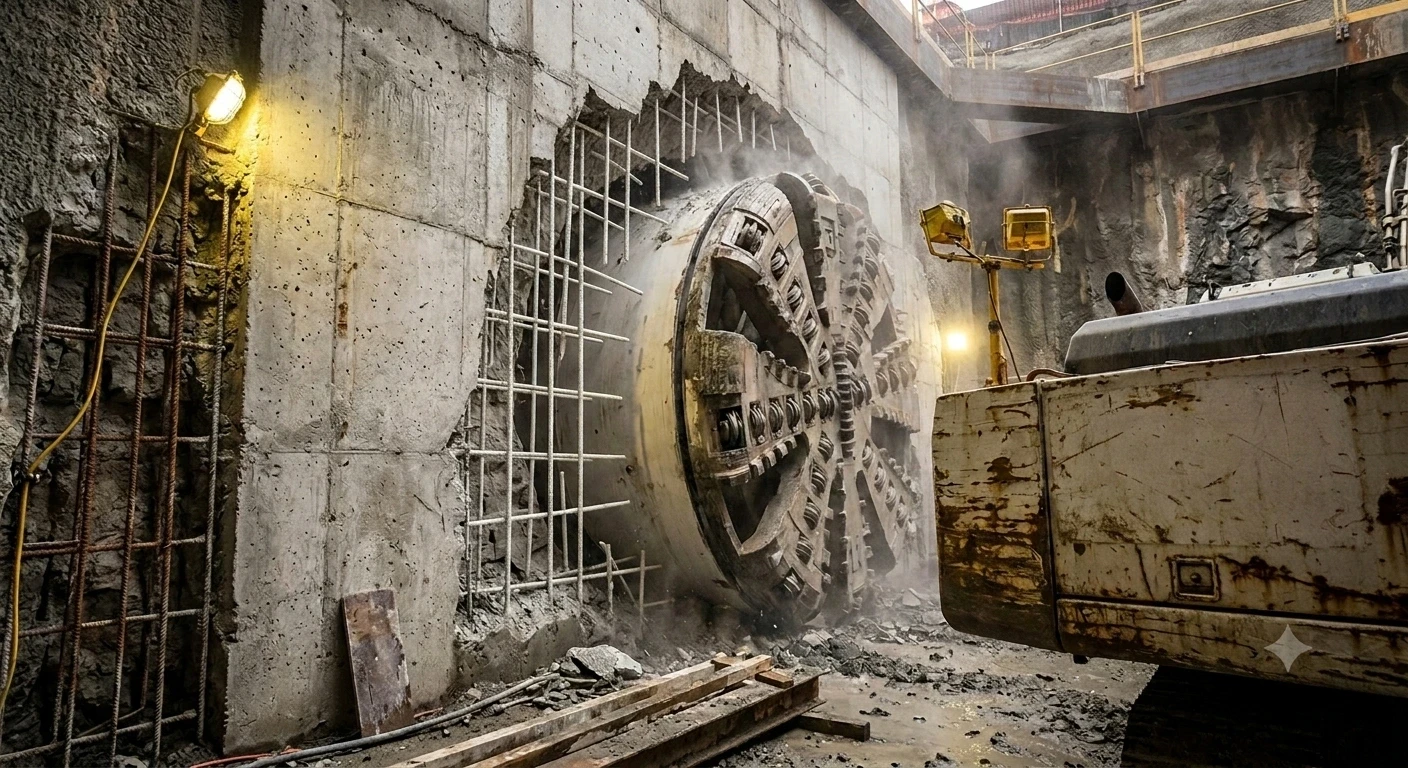
A soft eye is the section of a diaphragm wall or retaining structure through which a TBM enters or exits a station box or shaft. With conventional steel reinforcement, crews may need to break out concrete and cut or remove reinforcement before TBM breakthrough. This adds labour, time and safety considerations.
Using GFRP in the soft-eye area allows the TBM to cut through the concrete and reinforcement together. This can help:
- Reduce manual concrete breakout
- Reduce steel cutting and removal
- Shorten TBM launch and retrieval operations
- Reduce work in confined excavation areas
- Simplify the interface between the retaining wall and TBM
GFRP can be used only in the soft-eye zone while steel reinforcement remains elsewhere in the wall, making selective reinforcement a practical option where the main objective is TBM cuttability.
2. Diaphragm Walls and Secant Piles
Diaphragm walls and secant pile walls are widely used for station boxes, shafts and other underground excavations. GFRP can be specified in selected panels or sections where corrosion resistance or TBM cuttability is important. This allows engineers to target GFRP where its properties provide the greatest project benefit rather than necessarily replacing all steel reinforcement.
3. Tunnel Linings and Precast Segments
Tunnel segments are exposed to groundwater and other underground environmental conditions. GFRP reinforcement can be considered for precast tunnel segments where corrosion resistance and durability are priorities. However, segment design requires project-specific structural, fire and durability assessments, so GFRP should not be treated as a direct steel replacement.
4. Track Slabs and Areas Near Electrical Systems
The non-conductive and non-magnetic properties of GFRP can make it suitable for selected track slabs and structures located near traction and signalling systems.
However, reinforcement selection should be part of the overall electrical and stray-current design rather than considered in isolation.
5. Cross Passages, Shafts and Station Structures
Cross passages and shafts often involve difficult access and challenging environmental conditions. The low weight of GFRP can make reinforcement cages easier to transport and install, while its corrosion resistance can be valuable in moisture-prone underground environments.
GFRP Rebar in TBM Soft-Eye Zones: How It Works
The difference between conventional and GFRP reinforcement is particularly clear during TBM breakthrough.
Conventional Steel Reinforcement
- Construct the retaining wall with steel reinforcement.
- Prepare the soft-eye area before TBM breakthrough.
- Break out concrete.
- Cut and remove steel reinforcement.
- Prepare and support the opening.
- Launch or receive the TBM.
GFRP Reinforcement
- Construct the soft-eye section using GFRP reinforcement.
- Use steel reinforcement in other areas where required.
- Complete ground treatment and waterproofing measures.
- Allow the TBM to cut through the concrete and GFRP section.
The exact reinforcement arrangement, bar diameter, spacing and cage configuration should be determined by the project structural design and TBM requirements.
Design Considerations for GFRP Rebar
GFRP should not be treated as a one-to-one replacement for steel. Its mechanical behaviour is different and requires dedicated design. Commonly referenced standards include IS 18256, ACI 440.1R, ISO 10406-1 and CSA S807, depending on the project location and governing specification.
Key design differences:
- Lower modulus of elasticity: GFRP has a lower stiffness than steel, so deflection and crack width can become important design considerations.
- No yielding: GFRP behaves approximately linearly until failure rather than developing a steel-like yield plateau. In well-designed sections, concrete crushing often governs, but the design must account for the absence of ductility.
- Different development lengths: Anchorage and development requirements must be calculated according to the applicable GFRP design standard.
- Factory-made bends: GFRP bars cannot normally be bent on site after curing. Bends, stirrups and custom shapes must be manufactured in advance.
What Should Engineers Specify?
For a GFRP soft-eye application, the project team should establish:
- Bar diameter and spacing
- Cage and stirrup configuration
- Factory-made bends and shapes
- Connection between GFRP and adjacent steel reinforcement
- Tolerances and soft-eye boundaries
- TBM cutter compatibility
- Concrete cover and development requirements
| Design aspect | Steel | GFRP |
|---|---|---|
| Governing criterion | Strength and serviceability | Often serviceability |
| Failure behaviour | Ductile yielding | Linear-elastic, no yielding |
| Modulus of elasticity | Higher | Lower |
| Bends and hooks | Can be bent on site | Factory-made only |
Installation Guidelines for Underground Projects
Proper handling and installation are essential for maintaining the designed performance of GFRP reinforcement.
- Storage: Keep bars supported, protected from damage and away from prolonged exposure to sunlight where required by the manufacturer's instructions.
- Cutting: Use suitable cutting tools and appropriate personal protective equipment to manage fibre dust.
- Cage assembly: Follow the manufacturer's recommendations for ties and supports.
- Concreting: GFRP cages are lightweight and may move or float during concrete placement, so adequate supports are important.
- Inspection: Check bar diameter, shape, condition and concrete cover before pouring.
Limitations Engineers Should Consider
GFRP offers important advantages, but it also has limitations.
Fire Performance
The polymer resin in GFRP softens near its glass transition temperature, typically 60–120°C depending on resin type, which can reduce bond and tensile performance. Strength and bond behaviour can be affected as temperatures approach this range. Underground structures with fire-rating requirements therefore need specific fire and cover calculations. In tunnel applications, where fire ratings are stringent, GFRP may require sacrificial cover, fire-resistant coatings, or hybrid reinforcement strategies.
Brittle Failure
GFRP does not yield like steel. The design must account for its linear-elastic behaviour and aim for an appropriate concrete-controlled failure mode where required by the governing design standard.
Factory Fabrication
Bends, stirrups and custom shapes must generally be manufactured before delivery. Bar schedules should therefore be finalized early.
Project Approvals
Before specifying GFRP, confirm acceptance with the structural consultant, client and relevant metro or infrastructure authority.
GFRP vs Steel: Looking Beyond Initial Cost
GFRP can have a higher initial material cost than conventional steel. However, the economic comparison should also consider installation, maintenance, corrosion-related repairs and service-life requirements.
Selective GFRP use can be particularly practical in TBM soft-eye zones, where avoiding steel removal can reduce construction work. Broader use may be considered in areas where corrosion resistance is a major design requirement.
Conclusion
GFRP rebar offers metro and tunnel projects three main advantages: freedom from corrosion in wet, chloride-rich ground, non-conductive and non-magnetic behaviour near sensitive systems, and direct cuttability by TBMs at soft-eye zones. It needs a dedicated design that respects its lower modulus, its brittle failure mode and its fire behaviour, but used in the right places it can reduce risk, save time and extend service life.
However, GFRP is not a direct bar-for-bar substitute for steel. Engineers need to account for its lower stiffness, non-yielding behaviour, fire performance, development requirements and factory-made bends during design.
For a metro or tunnel project, the right reinforcement strategy depends on the structure, environment, TBM method, applicable standards and project requirements.
Key Takeaways
- Use GFRP in soft-eye zones to allow direct TBM breakthrough.
- Consider GFRP in diaphragm walls, slabs, and linings where durability and non-conductivity matter.
- Design with serviceability in mind, and order factory-made bends early.
- Account for fire performance, brittle failure, and alkaline/moisture degradation in durability assessments.
- GFRP complements, rather than replaces, a complete stray-current control strategy.
Further Resources to Explore
Frequently Asked Questions (FAQs)
Find clear answers to the most common queries.
-
Can a TBM cut through GFRP rebar?
-
What is a soft eye in tunnelling?
A soft eye is the section of a shaft or station wall that a TBM passes through when launching or arriving. It is built from material the TBM can cut, so no manual breakout is needed.
-
Is GFRP rebar suitable for metro track slabs?
It can be, particularly near signalling and traction equipment where non-conductive and non-magnetic reinforcement is useful. The design must follow the applicable standards and be approved by the project consultant.
-
Does GFRP rebar prevent stray current corrosion?
GFRP does not conduct current and does not corrode, so it removes the reinforcement as a path for stray current in the zones where it is used. It does not stop stray current in the wider system, so stray current control measures are still needed.
-
Is GFRP rebar approved for use in Indian metro projects?
Approval depends on the project and the client. IS 18256 provides a national specification for GFRP bars, and acceptance is decided by the metro authority and its consultants.
-
What diameters are used in diaphragm walls?
Diameter depends on wall thickness, loads and design. Bars are supplied across a wide range of sizes, and selection follows structural design. See our guide to GFRP rebar sizes and diameter selection.
Subscribe to Our Newsletter
Get updates on products, research collaborations, and new developments in FRP technology.

Subscribe to Our Newsletter
Subscribe our newsletter and get notifications to stay update