
GFRP rebar is covered under IS 18256:2023 and IRC 137:2022, which give highway engineers and authorities a recognized basis for specifying it on road and bridge structures. Approval requirements can vary by project and authority, so it's worth confirming acceptance criteria for your specific contract.

Resources
21
Aug'26GFRP Rebar in Highway & Road Construction in India
India's roads and highways face a constant combination of moisture, traffic loads, chemicals, and temperature changes. During the monsoon, water can penetrate pavement joints, bridge decks, culverts, and drainage structures. In coastal areas, salt-laden air adds another corrosion risk, while industrial and urban environments can expose concrete structures to additional chemicals and pollutants.
When conventional steel reinforcement corrodes, the resulting rust expands inside the concrete. This creates internal pressure that can lead to cracking, spalling, joint deterioration, and costly repairs.
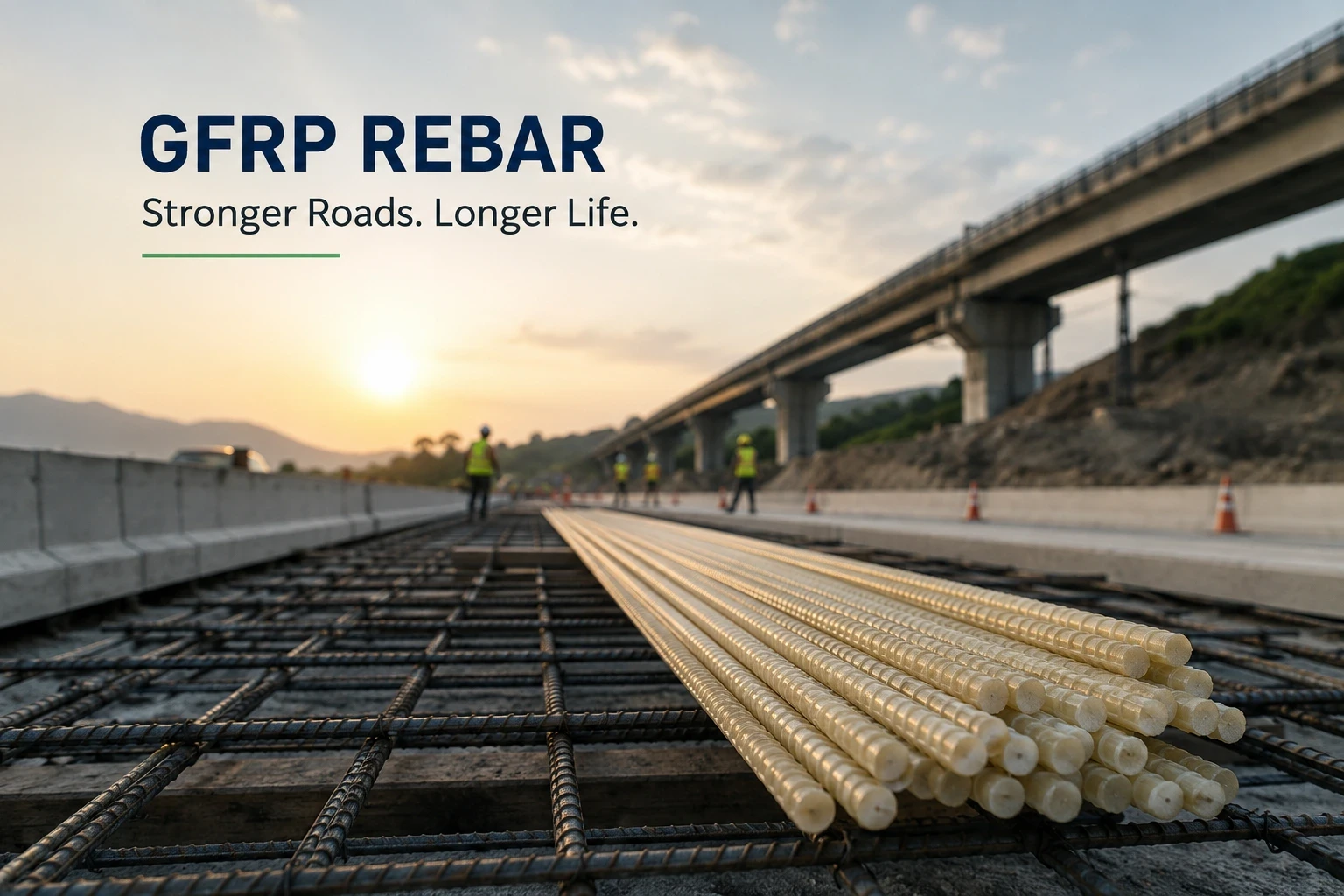
Glass Fiber Reinforced Polymer (GFRP) rebar offers an alternative for applications where corrosion resistance and long-term durability are priorities. Unlike steel, GFRP does not rust or corrode, making it particularly relevant for highway structures exposed to moisture, salts, and other aggressive environments.
At Tapashri Engineering, we work with infrastructure contractors and project teams evaluating GFRP reinforcement for road, highway, pavement, and bridge applications.
This guide explains where GFRP rebar can be used in highway construction, the relevant Indian standards, and the factors engineers should consider when evaluating it.
Why Highways Are a Strong Use Case for GFRP Rebar
Highway infrastructure is exposed to environmental conditions that can accelerate steel corrosion, particularly where reinforcement is close to the concrete surface.
1. Continuous Moisture Exposure
Pavement joints, bridge decks, drainage structures, and culverts are regularly exposed to rainwater and runoff. If water reaches steel reinforcement, corrosion can eventually begin.
2. Salt and Chemical Exposure
Coastal highways are exposed to chloride-rich environments, while roads in colder regions may encounter de-icing salts. Industrial areas can also expose concrete structures to aggressive pollutants and chemicals.
3. Long Service-Life Requirements
Major highway and bridge infrastructure is designed for long service lives. Corrosion-related deterioration of steel can create significant maintenance requirements during that period.
4. Disruption During Repairs
Repairing a highway or bridge isn't simply a material expense. Lane closures, traffic diversions, labour, equipment, and repeated rehabilitation can significantly increase the overall lifecycle cost.
Because GFRP reinforcement is non-corrosive, it can eliminate corrosion as a potential deterioration mechanism in appropriately designed applications.
Where is GFRP Rebar Used in Road & Highway Construction?
GFRP rebar can be considered for several highway and transportation infrastructure applications where corrosion resistance is important.
Concrete Pavements
GFRP reinforcement can be used in concrete pavement applications where reinforcement is exposed to moisture and chloride penetration. Its corrosion resistance can help address deterioration associated with conventional steel reinforcement.
Dowel and Tie Bars
Dowel bars transfer loads between adjacent pavement slabs, while tie bars help maintain alignment between concrete sections. Because pavement joints are particularly vulnerable to water penetration, corrosion-resistant GFRP can be an attractive option for these applications.
Bridge Decks and Approach Slabs
Bridge decks experience repeated exposure to water, chlorides, temperature variations, and traffic loading. GFRP reinforcement can be used where reducing corrosion-related deterioration is a design priority.
Parapets and Barriers
Road barriers and parapets are continuously exposed to weather. GFRP can provide corrosion-resistant reinforcement for these elements, particularly in coastal or chemically aggressive environments.
Culverts, Retaining Walls & Drainage Structures
Structures exposed to soil moisture, groundwater, and road runoff can benefit from corrosion-resistant reinforcement. GFRP can therefore be considered for selected culverts, retaining walls, drainage channels, and related structures.
GFRP Dowel Bars: An Important Highway Application
Dowel bars deserve particular attention because they operate directly at pavement joints, locations where water infiltration can accelerate corrosion.
A conventional steel dowel can corrode when moisture and chlorides reach the reinforcement. As corrosion progresses, rust occupies more volume than the original steel. This can generate pressure within the surrounding concrete, contributing to cracking and joint deterioration.
Corrosion can also affect the dowel's ability to provide smooth load transfer between adjacent slabs.
GFRP dowel bars eliminate the corrosion mechanism itself. Since GFRP does not rust and expand like steel, it can help maintain the intended performance of pavement joints over a longer service period when properly designed and installed.
For pavement engineers, this makes GFRP particularly relevant in applications where joint durability is a major concern.
GFRP Rebar Standards in India
Successful adoption of any reinforcement material on infrastructure projects depends on appropriate design standards, material specifications, testing, and project approval.
Two important Indian references for GFRP reinforcement are:
IS 18256:2023
IS 18256:2023 is the Bureau of Indian Standards specification covering GFRP reinforcement. It establishes requirements relating to material properties, testing, and quality.
This provides an important reference for manufacturers, consultants, contractors, and project authorities evaluating GFRP reinforcement.
IRC 137:2022
IRC 137:2022 provides guidance for the use of GFRP reinforcement in road and bridge structures. It is particularly relevant to highway engineers evaluating GFRP for transportation infrastructure.
The applicable requirements and approval procedures can vary depending on the project, authority, design, and contract specifications. Project teams should therefore verify the latest applicable requirements before specifying GFRP.
For more information, see our guide to India's GFRP rebar standards: IS 18256 and IRC 137.
GFRP and India's Growing Infrastructure Network
The push toward corrosion-resistant reinforcement isn't happening in isolation, it lines up directly with where India's largest road-building programs are headed.
Bharatmala Pariyojana
Covers tens of thousands of kilometres of highways, including economic corridors and coastal stretches where humidity and salt exposure are constant design considerations.
Sagarmala
Sagarmala is driving port-linked road connectivity through some of the most corrosion-prone environments in the country, coastal roads built to serve port and logistics infrastructure.
Smart Cities Mission
It is upgrading urban road networks and flyovers across 100 cities, many of which face the combined pressures of traffic load, pollution, and ageing infrastructure.
Together, these programs represent a large and growing pool of projects where corrosion resistance isn't a nice-to-have. It's a design requirement, and one that steel alone struggles to meet cost-effectively over a multi-decade service life.
GFRP vs Steel Rebar for Highway Applications
Consideration |
Steel Rebar |
GFRP Rebar |
|---|---|---|
| Corrosion resistance | Vulnerable to corrosion in aggressive environments | Inherently corrosion-free |
| Weight | Heavy | ~1/4 the weight of steel |
| Handling | Requires more labour and equipment | Easier to transport and handle |
| Initial material cost | Generally lower | Generally higher |
| Maintenance | Recurring inspection, coating, repair cycles | Minimal; no corrosion-driven rehabilitation |
| Electrical properties | Electrically conductive | Non-conductive |
| Lifecycle considerations | Potentially higher where corrosion drives repairs | Can reduce corrosion-related lifecycle costs |
GFRP typically has a higher initial material cost than conventional steel. However, evaluating only the purchase price can overlook potential costs associated with corrosion, rehabilitation, traffic disruption, and replacement.
For long-life highway assets, a lifecycle-cost approach can provide a more meaningful comparison.
There's also a practical construction-phase benefit: GFRP's lighter weight means faster handling and placement, which matters on live highway sites where lane closures and traffic diversions carry their own cost.
Key Considerations Before Specifying GFRP
Specifying GFRP on a highway project involves a few practical differences from a standard steel design:
Structural Design
GFRP has different mechanical properties from steel, including different stiffness and failure behaviour. Reinforcement design, spacing, development length, and detailing should therefore follow the applicable GFRP design guidance rather than simply copying a steel reinforcement schedule.
Bar Diameter and Application
The appropriate GFRP diameter and profile depend on the application, design loads, spacing, and construction requirements.
Quality Assurance
For government and infrastructure projects, documentation and material testing are critical. Contractors should ensure that the supplied GFRP reinforcement meets the applicable specifications and is accompanied by the required test certificates and quality documentation.
Why Consider GFRP for Highway Projects?
For highway authorities, consultants, and contractors, the strongest case for GFRP is not simply that it is lighter than steel. Its key advantage is corrosion resistance.
In pavement joints, bridge decks, coastal infrastructure, drainage structures, and other moisture-exposed applications, eliminating reinforcement corrosion can reduce one of the major deterioration mechanisms associated with conventional reinforced concrete.
The lower weight can also simplify transportation, handling, and installation at busy highway construction sites.
The right solution ultimately depends on the structural design, environmental conditions, applicable standards, and project economics.
GFRP Rebar for Road & Highway Infrastructure
GFRP rebar is becoming an important option for infrastructure projects where durability and corrosion resistance are major design considerations. From concrete pavements and dowel bars to bridge decks, barriers, culverts, and drainage structures, it can provide an alternative to conventional steel in suitable applications.
Tapashri supports contractors, consultants, and infrastructure teams with GFRP reinforcement for highway and structural applications, including customized bar sizes, profiles, and project documentation.
If you're evaluating GFRP reinforcement for a highway, bridge, pavement, or infrastructure project, contact Tapashri Engineering to discuss your project requirements.
Frequently Asked Questions (FAQs)
Find clear answers to the most common queries.
-
Is GFRP rebar approved for use in Indian highway projects?
-
What's the difference between GFRP dowel bars and steel dowel bars?
Steel dowel bars corrode at pavement joints where moisture concentrates, causing them to expand, lock against the concrete, and lose their load-transfer function, which leads to joint faulting. GFRP dowel bars don't corrode, so they continue transferring load smoothly for the design life of the pavement.
-
Does GFRP rebar cost more than steel for highway projects?
Yes, the upfront material cost is higher. However, when maintenance, lane-closure costs, and rehabilitation cycles are factored in over a structure's full service life, GFRP typically works out more cost-effective for long-design-life highway assets.
-
Can GFRP rebar be used in bridge decks?
Yes. Bridge decks are one of the most common applications for GFRP rebar, since the top-of-deck reinforcement faces the most direct exposure to water, de-icing salts, and traffic loading, exactly the conditions where steel corrodes fastest.
-
Which IRC/IS codes govern GFRP use in road construction?
IS 18256:2023 is the Bureau of Indian Standards specification for GFRP rebar material properties and testing. IRC 137:2022 is the Indian Roads Congress guideline specifically addressing GFRP rebar use in road and bridge structures.
Subscribe to Our Newsletter
Get updates on products, research collaborations, and new developments in FRP technology.

Subscribe to Our Newsletter
Subscribe our newsletter and get notifications to stay update