
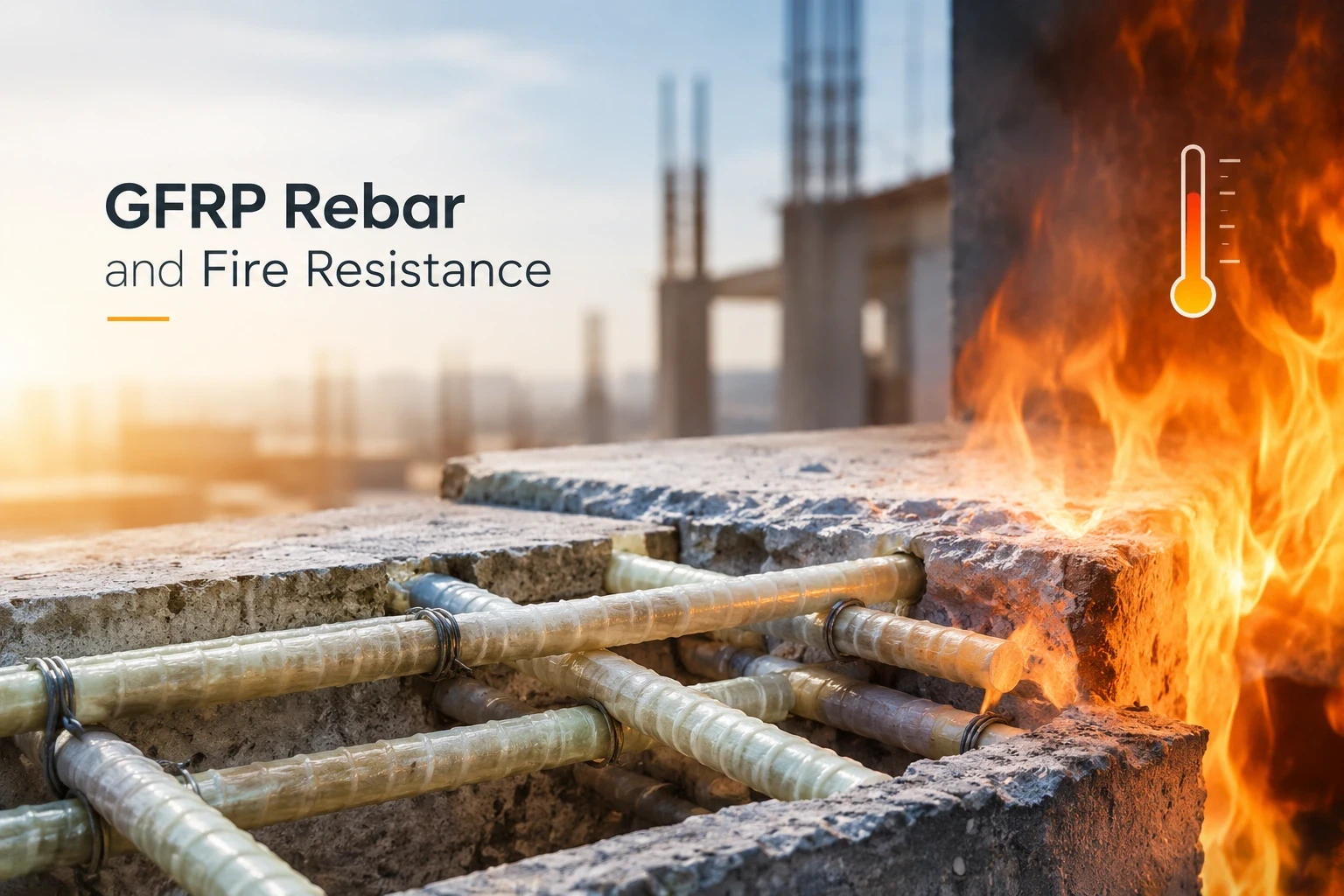
GFRP rebar is not inherently fireproof. Its glass fibers tolerate high temperatures, but the polymer resin matrix can soften and degrade as temperature increases. Fire performance depends on the GFRP system and the surrounding concrete.

Resources
7
Oct'26GFRP Rebar Fire Resistance: How It Performs at High Temperatures
GFRP rebar solves corrosion, adds electrical neutrality, and cuts weight. But when it is proposed for a building, tunnel, or industrial structure, one question comes up almost every time: what happens to GFRP rebar in a fire?
The short answer: GFRP rebar is not fireproof. Its glass fibers tolerate heat well, but the polymer resin that holds them together does not. Fire performance depends on the whole concrete section, not on the bar alone, and it can be managed through resin selection, concrete cover, and sound structural design.
Fire behavior is one of the key limitations of FRP reinforcement that engineers need to plan for. This guide explains what heat does to GFRP rebar, how it compares with steel, why concrete cover matters, where GFRP is suitable, and what to ask your supplier. It is written for structural designers, consultants, and contractors.
Is GFRP Rebar Fireproof?
No. GFRP is a composite of two components that react to heat very differently:
- Glass fibers: Inorganic and capable of carrying almost all of the tensile load. They retain their structural integrity at temperatures far above what any polymer matrix can survive (>600°C).
- Vinyl ester resin: Binds the fibers, transfers shear stress between them, and bonds the bar to concrete. This is the temperature-sensitive component.
Thermoset resins do not melt like thermoplastics. Instead, they soften as temperatures rise and chemically decompose at higher thresholds. Either change reduces how well the bar transfers load and bonds to concrete.
How Heat Affects GFRP Rebar
Glass Transition Temperature (Tg)
Tg is the temperature range in which the resin changes from a rigid, glassy state to a soft, rubbery state. Above Tg, the resin loses stiffness quickly and can no longer transfer stress between the glass fibers as effectively.
Two key principles are often misunderstood:
- Tg is not a failure temperature. The bar does not break the moment it reaches Tg. It marks the point where performance starts to decline noticeably.
- Tg is not a fire rating. A concrete member's fire rating depends on how long the concrete cover delays heat from reaching the reinforcement.
Tg depends on the resin system and on the cure achieved during manufacturing, including the pultrusion process. It is measured by Differential Scanning Calorimetry (DSC) or Dynamic Mechanical Analysis (DMA), so always ask for the test report rather than relying on a generic figure.
Temperature Zones and Material Behavior
Temperature Zone |
What Happens in the Bar |
|---|---|
| Normal Service Temperatures | Full structural properties retained as specified on technical datasheets. |
| Approaching Tg | Resin stiffness begins to decline. Bond with concrete begins to weaken. |
| Above Tg | Resin stiffness begins to decline. Bond with concrete begins to weaken. |
| Resin decomposition range (typically several hundred °C) | The resin chars and decomposes, and most of the composite action is lost. |
Bond Fails Before Tensile Strength
While glass fibers carry the tensile load, they can only do so if the bar remains anchored within the concrete matrix. Elevated-temperature research confirms that bond strength degrades significantly earlier and faster than fiber tensile strength.
This makes anchorage zones, lap splices, and member ends the critical structural locations during a fire event. Because these regions depend heavily on mechanical and chemical surface bonds, they require conservative detailing and adequate concrete cover protection.
GFRP vs. Steel Rebar in a Fire
Steel is not immune to fire. Conventional steel reinforcement loses roughly half of its yield strength at around 500-600°C. The difference is that fire design for steel is standardized and well documented, whereas GFRP needs section-specific thermal design.
Property |
GFRP Rebar |
Steel Rebar |
|---|---|---|
| Thermal Conductivity | Very low (approx. 0.35-0.5 W/m·K) | High (approx. 45-50 W/m·K) |
| Coefficient of Thermal Expansion (Longitudinal) | 5–10 × 10⁻⁶ /°C | ≈ 12 × 10⁻⁶ /°C |
| Temperature-Sensitive Component | Resin matrix | The steel itself |
| Elevated Temperature Behavior | Resin softening, bond degradation, resin charring | Gradual loss of yield strength and stiffness |
| Fire Design Standards | Project-specific thermal calculations, guided by ACI 440 | Well-established standard fire curves and codes |
GFRP's low thermal conductivity works in its favor. The bar does not act as a heat bridge that carries heat deep into the member.
Why Concrete Cover Matters
Concrete is a naturally effective insulator. During a fire, the internal temperature at the reinforcement depth lags significantly behind the external ambient fire curve.
- Greater concrete cover directly extends the time required for heat to penetrate to the rebar depth.
- Larger cross-sections provide greater thermal mass, slowing internal temperature rise.
- Fire-induced cover requirements often exceed the minimum cover dictated strictly by environmental durability.
Key rule: choosing a bar with a higher Tg does not replace adequate cover. Both work together to achieve the required fire rating, for example a 1-hour or 2-hour rating.
Which Structural Members Are Most Sensitive?
- Slabs and Beams: Tension reinforcement located near soffits (bottom surfaces) is exposed directly to rising heat. Soffit cover and member depth control the fire resistance duration.
- Columns: Compression members require extra care because the reinforcement carries load concurrently with concrete that is also experiencing thermal degradation.
- Anchorage, Laps, and Ends: Governed strictly by surface bond performance, requiring careful placement away from maximum temperature zones where possible.
- Thin Members & Precast Panels: Lower thermal mass means heat reaches the internal reinforcement substantially faster.
Suitability Matrix by Application
Fire Risk |
Typical Applications |
Approach |
|---|---|---|
| Low Fire Risk (no fire rating required) | Marine and coastal structures, jetties, water and sewage treatment plants, bridge decks, highway slabs and barriers, MRI rooms, substations. | Well suited. Corrosion resistance, non-conductivity, and durability govern the design. |
| Moderate / Specific Evaluation | Multi-story parking structures, industrial facilities with process heat, building elements with a fire rating. | Evaluate the fire exposure. Check cover, assess thermal lag, and consider protective coatings or hybrid detailing. |
| Strict Fire Requirements | Road and metro tunnels, enclosed underground structures, critical fire-rated structural frames. | Use GFRP selectively, for example in TBM soft-eye zones where cuttability is the goal, with steel or fire-protected sections elsewhere. |
Design Strategies to Improve Fire Performance
Fire performance is a design requirement, not just a material specification. The main strategies are:
- Increase concrete cover: Size the cover to the required fire resistance period using thermal penetration calculations.
- Specify a verified resin system: Choose vinyl ester GFRP with a documented Tg test report.
- Use hybrid reinforcement: Keep steel in fire-critical elements and use GFRP where corrosion or non-magnetic behavior is the main concern.
- Add passive protection: Fire-rated boards, cementitious sprays, or intumescent coatings on soffits where extra cover is impractical.
- Detail anchorage conservatively: Stagger lap splices and avoid placing critical anchorage in the hottest zones.
- Commission a project-specific fire analysis for any structure with a fire rating.
Relevant Codes and Standards
- IS 18256:2023: Specifies material requirements and quality testing for GFRP bars in India. It defines material performance parameters rather than structural member fire ratings.
- IRC:137-2022: Provides design guidelines for GFRP-reinforced concrete bridges, culverts, retaining walls, and highway pavements—applications naturally characterized by low fire risk.
- ACI 440.1R-15 / ACI 440.11-22: Widely referenced international guidelines for structural GFRP design, providing frameworks for calculating reduced material factors under elevated temperatures.
- National Building Code (NBC Part 4): Governs structural fire protection and life safety in India. Fire engineers should verify that GFRP cover depth aligns with NBC fire resistance ratings.
What to Ask Your GFRP Supplier
Before procuring GFRP rebar for projects with thermal or fire requirements, request the following:
- Resin Specification: The resin type and the resin manufacturer's datasheet.
- Tg Test Report: Measured glass transition temperature by DSC or DMA from an accredited laboratory.
- Elevated-Temperature Data: Any available data on tensile and bond strength retention at higher temperatures.
- Standards Compliance: Compliance with IS 18256:2023 and ASTM D7957, along with the technical specifications and batch test certificates.
GFRP Rebar Fire Resistance Myths vs. Facts
Myth: "GFRP melts in a fire."
- Fact: Thermoset vinyl ester resins do not melt. They soften past Tg and decompose at much higher temperatures.
Myth: "GFRP cannot be used in any building project."
- Fact: It depends on the element, the fire rating required, and the cover provided. Many foundation slabs, retaining walls, and similar elements have little or no fire exposure requirement.
Myth: "Steel rebar is completely safe in fires."
- Fact: Steel also loses a large share of its strength at high temperature. Its advantage is well-documented fire design, not immunity to heat.
Myth: "A high Tg makes the rebar fireproof."
- Fact: Tg is a material property. Fire resistance is a property of the whole member and is governed mainly by concrete cover and section geometry.
Designing for Fire Resistance with GFRP
GFRP rebar removes corrosion and the maintenance that comes with it, and it lowers lifecycle cost in aggressive environments. It must still be designed with a clear understanding of how it behaves at high temperature. By accounting for the resin system, providing adequate concrete cover, and detailing anchorage carefully, engineers can specify GFRP with confidence across a wide range of demanding projects.
Tapashri Engineering manufactures vinyl ester GFRP rebar as per IS 18256:2023, IRC:137-2022, and ASTM D7957. Contact our technical team to request datasheets, test reports, or design support for your next project.
Frequently Asked Questions (FAQs)
Find clear answers to the most common queries.
-
Is GFRP rebar fireproof?
-
What happens to GFRP rebar during a fire?
As temperature increases, the polymer matrix can lose stiffness and its ability to transfer loads between the glass fibers can decrease. The extent of performance loss depends on temperature, exposure duration, resin properties, concrete cover, and structural loading.
-
What is the maximum temperature GFRP rebar can withstand?
There is no single figure. It depends on the resin system, how long the bar is exposed and how it is loaded. The glass transition temperature is the key indicator, and it should be taken from the manufacturer's test report.
-
What is the glass transition temperature of GFRP rebar?
The glass transition temperature (Tg) is the temperature range where the polymer resin transitions from a relatively rigid state to a softer rubbery state. The exact Tg varies by resin system and should be obtained from the manufacturer's technical documentation.
-
Does GFRP rebar melt in a fire?
GFRP is a composite rather than a material that behaves like a simple thermoplastic. Its polymer matrix can soften and eventually thermally degrade at elevated temperatures, while the glass fibers have much greater thermal stability.
-
Is GFRP better than steel rebar during a fire?
Neither material is universally better for every fire scenario. Steel has well-established fire-design methods, while GFRP's thermal performance is strongly influenced by its polymer matrix and requires specific consideration in fire-rated applications.
-
How does concrete cover affect GFRP rebar in a fire?
Concrete cover acts as thermal protection and delays the increase in temperature at the reinforcement. Adequate cover can therefore be an important part of the fire-resistance strategy for GFRP-reinforced concrete.
Subscribe to Our Newsletter
Get updates on products, research collaborations, and new developments in FRP technology.

Subscribe to Our Newsletter
Subscribe our newsletter and get notifications to stay update